


Gouramis come in an impressive variety of shapes, sizes and temperaments, but not every species thrives in the same setup. We take a closer look at eight popular choices, along with two that require considerably more commitment.
When choosing a centrepiece fish for a community aquarium, the shortlist often comes down to cichlids and gouramis. The right choice depends on the size of your tank, the temperament of your existing fish and the sort of aquarium you want to create.
Gouramis come in a remarkable range of sizes, colours and temperaments. Some make excellent additions to peaceful community tanks, while others are territorial, grow surprisingly large or need specialist care.
Here, we're looking at eight gouramis worth considering for your aquarium, along with two species that are best approached with caution.
Related article: New ways to mix your community fish.
What is a gourami?
Gouramis are anabantids, they have a specialised labyrinth organ that enables them to breathe air, just like Bettas and paradise fish. This special adaptation allows them to thrive in water that is low in dissolved oxygen, while other fishes might perish. Particularly useful in habitats that go through seasonal droughts with dropping water levels and stagnant water. In captivity we need to ensure they have access to the warm humid air above their tanks to allow them to exhibit their air gulping behaviour.
However, that's not an excuse to provide them with poor quality water. They still need a clean environment to thrive, so a mature, appropriately sized filter is still required along with the usual frequent water changes. It does give us some indication of the sort of aquarium that would suit them. A briskly flowing river style aquarium is not the right home for a gourami, but a well planted, gently flowing tank with a tight fitting lid is a great starting point for many of the species we will cover today. As always, each species has their own unique requirements.
There are some gouramis that are more specialist in their requirements, for example liquorice gouramis (Parosphromenus spp.) and chocolate gouramis (Sphaerichthys spp.). These are not well suited for the standard community aquarium and instead require tanks built around their needs.
The popular community gouramis
There are a few species that appear frequently in fish shops up and down the country, and probably worldwide (I just haven't visited them to know for sure). I've picked out eight of them to highlight as possible options, plus two more that you should think twice about.
Below you'll find a brief overview of each species along with a fact file outlining the key information for each!
Three-spot gourami
This is a species that goes by many names. We are talking about Trichopodus trichopterus. The gold gourami, blue gourami, opaline gourami and white gourami are all tank bred colour variants of this species and all have the same care requirements.
It's one of the larger species and certainly can develop an aggressive side as it matures. In large, more boisterous communities it can be an attractive option, but it must not be kept alongside small, shy or easily intimidated fish.

Photo by Shutterstock
Three-spot gourami fact file
Scientific name: Trichopodus trichopterus
Size: Up to 15 cm (6 in).
Origin: Southeast Asia in the Mekong basin and in northern parts of Indonesia.
Habitat: Usually found in areas with plenty of aquatic plants and slow flowing water.
Tank size: 120 x 45 x 45 cm (48 x 18 x 18 in).
Water requirements: Hardy and adaptable to a range of water conditions, a pH 5.5 and 8 works well with a hardness of up to 25°dH.
Temperature: 23-30°C (73-86°F).
Temperament: Males are territorial, turning very aggressive when breeding. Outnumbering males with females to spread their attention can help but other factors are also at play. Can be kept with larger, more robust shoaling fish in a well thought out community tank.
Feeding: Unfussy omnivores accepting most common aquarium foods. Offer a varied diet of quality prepared foods supplemented with live or frozen fare.
Availability & cost: Common and available in a variety of tank bred strains. Prices often around £5 per fish.
Dwarf gourami
Perhaps the most instantly recognisable species is the dwarf gourami (Trichogaster fasciata). It was long known as Trichogaster lalius, a name still widely used in aquarium literature, but a taxonomic revision published in 2022 reinstated T. fasciata as the correct name.

Photo by Alex Bell
It adorns many a beginner fishkeeping guide, and I even remember one delightful specimen being proudly shown on the box of my first ever aquarium.
The males are the attractive ones, sporting vertical stripes of red and iridescent blue, although other tank bred colour variants are commonly available including fish with predominantly red or blue flanks. Females are rather drab in comparison, sporting a greenish-silver all over.
Sourcing quality dwarf gouramis has become a challenge, as they have been suffering with a virus (dwarf gourami iridovirus) for many years. The disease is fatal and there isn't a known cure. Fish can already be infected, but not yet show symptoms so it can be a bit of a mine field trying to source healthy fish.
Pay close attention to any fish prior to buying them, as you always should with any fish, and if anything looks remotely concerning, walk away and keep looking.

Photo by Alex Bell
Dwarf gourami fact file
Scientific name: Trichogaster fasciata (formerly Trichogaster lalius).
Size: Males up to 9 cm (3.5 in) females stay smaller.
Origin: Southern Asia, across Northern India, Bangladesh and Pakistan.
Habitat: Usually found in areas with plenty of aquatic plants in ponds, swamps, ditches and slow flowing streams.
Tank size: 60 x 30 x 36 cm (24 x 12 x 14 in).
Water requirements: Somewhat adaptable, but wild fish are usually found in soft, acidic water. A pH of 6 to 7.5 will work with a hardness up to 18°dH.
Temperature: 22-27°C (72-81°F).
Temperament: They can be a little shy, but also territorial. Similar fish may be chased away while larger, boisterous fish will quickly outcompete the gouramis. Housing alongside shoals of peaceful rasboras such as those from the genus Trigonostigma often works well.
Feeding: Unfussy omnivores accepting most common aquarium foods. Offer a varied diet to see them at their best.
Availability & cost: Common and available in a variety of tank bred strains. Prices often around £5 per fish.
Honey gourami
A fish that is fast becoming one of my favourites. This is an excellent alternative to the dwarf gourami if you are struggling to source healthy stock. Honey gourami (Trichogaster chuna) are commonly available in their gold tank bred variant, however with some searching you can find the wild coloured fish, and they're worth it when you see them in breeding condition.

Photo by Alex Bell
What's more, they're naturally tolerant of cooler water than many gouramis, thriving in temperatures down to 18°C (64°F). This means that an unheated, temperate aquarium is potentially suitable if it is placed in a well insulated UK home. It is always advisable to have a heater in the tank set to 18°C (64°F) just in case the temperature of the home suddenly drops.

Honey gourami fact file
Scientific name: Trichogaster chuna
Size: Up to 5.5 cm (2.2 in)
Origin: Northern India and Bangladesh across the Ganges and Brahmaputra river systems
Habitat: Lowland swamps, ponds and flooded fields with abundant vegetation. The conditions of the habitat can change throughout the year with the seasons.
Tank size: 60 x 30 x 30 cm (24 x 12 x 12 in).
Water requirements: Most individuals in the hobby are captive bred and will thrive in a pH of 6 to 7.5 and a hardness up to 20°dH.
Temperature: 18-28°C (64-83°F).
Temperament: Males can become a little overzealous when courting females, so it is a good idea to have at two females per male to spread out the males' attention. Outside of breeding they are peaceful community fish that do well alongside smaller, peaceful shoaling species and bottom dwellers.
Feeding: Unfussy, offer a varied diet including small live or frozen foods like Daphnia and Cyclops to help condition them.
Availability & cost: Fairly common, although wild coloured fish are harder to come by. Prices often around £5 per fish.
Sparkling gourami
Another one of my favourites, and a fish I have already covered for the website: Everything you need to know about the brilliantly bright sparkling gourami. This small fish packs a colourful punch with dark red fins with iridescent blue spots. The body is also decorated in iridescence, and during displays these fish really do light up.
They're tiny in size, reaching no more than 4 cm (1.5 in) and can be found in flooded fields and peat swamps making them well suited for a range of aquarium styles.
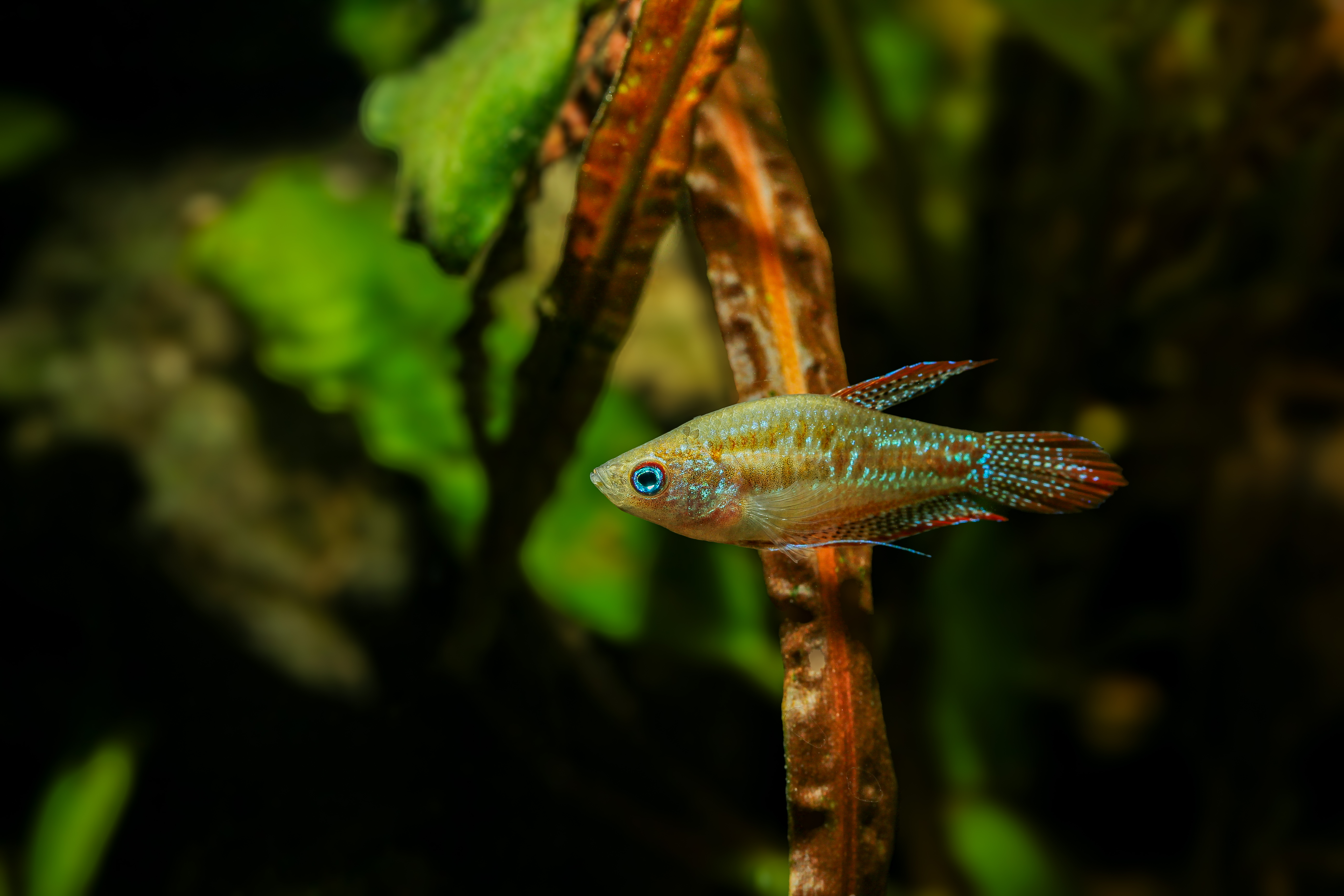
Photo by Alex Bell
Sparkling gourami fact file
Scientific name: Trichopsis pumila
Size: Up to 4 cm (1.5 in).
Origin: Found across Cambodia, Thailand, Vietnam and Laos within the lower Mekong River basin.
Habitat: Found in a range of habitats including but not limited to: floodplains, canals, small tributaries, roadside ditches and peat swamps. Shows a preference for areas with dense aquatic or marginal vegetation.
Tank size: 45 x 30 x 30 cm (18 x 12 x 12 in) for a group.
Water requirements: Soft and acidic is ideal, but they will tolerate slightly alkaline and moderately hard water. Aim for 6-7.5 pH with less than 15°dH.
Temperature: 22-28°C (71-82°F).
Temperament: A generally peaceful fish although males may squabble, suited to a community of small fishes. Easily outcompeted by larger boisterous fish so these should be avoided. Despite their small size they will eat small ornamental shrimp.
Feeding: In the wild likely to predominantly consume invertebrates. In home aquariums they will readily eat prepared foods like flakes and pellets but offerings of frozen or live food should be included to well-condition the fish.
Availability & cost: Regularly available although the quality can vary so it is worth shopping around. Expect to pay around £4 a fish.
Croaking gourami
A larger relative of the sparkling gourami, croaking gouramis (Trichopsis vittata) deserve to be more popular than they currently are. They typically reach around 7 cm (2.8 in) and well conditioned fish displaying is certainly an impressive sight.

Photo by Rodrigo Silva
Their common name comes from their ability to produce a croaking noise using their specialised pectoral fin muscles and tendons. If your tank is in a quiet room, you may be fortunate enough to be able to hear them communicating with each other during courtship and territorial displays.
They often look a little nondescript in shop tanks, so are often ignored for the more showy species, but I urge you to give the ugly duckling a chance. I don't think you'll be disappointed! One of our contributors, Matt Hayes, created a flooded forest aquarium featuring croaking gouramis alongside some lambchop rasboras, and it looked fantastic!

Photo by Shutterstock
Croaking gourami fact file
Scientific name: Trichopsis vittata
Size: Up to 7 cm (2.8 in).
Origin: Widespread in Southeast Asia.
Habitat: Occurs in lowland habitats including peat swamps, flooded fields, irrigation ditches and rice paddies. Rodrigo discussed their habitat in the flooded fields of Thailand when he found them alongside wild Betta splendens and Somphong's rasboras.
Tank size: 60 x 30 x 36 cm (24 x 12 x 14 in).
Water requirements: Soft and acidic water is appreciated by these gouramis. Aim for 6-7.5 pH with less than 15°dH.
Temperature: 22-28°C (71-82°F).
Temperament: A peaceful species that can work well in pairs or a group. They will become territorial when breeding so enough space must be provided to allow their tank mates to retreat during these times.
Feeding: Offer a varied diet of small invertebrates like bloodworms, brine shrimp and Daphnia (either frozen or live) alongside a quality dry food.
Availability & cost: Somewhat uncommon as stores don't often order them in because they are less popular. Ask around, and they'll be able to source some if they know there's interest. Prices from £4 each.
Thick-lipped gourami
This is another species that you're more likely to find a tank bred variety than a fish displaying wild colouration. The thick-lipped gourami (Trichogaster labiosa) is the same species as the red robin gourami, although some sources describe this as a strain of honey gourami.
I seem to recall our regular contributor, Gabor, telling me he had recently got hold of some wild colour thick-lipped gourami, so if my memory serves me correctly we might bring you a dedicated feature on them in a future issue of Practical Fishkeeping magazine. If you're interested in reading that feature, why not subscribe so you never miss an issue!
The wild colour fishes look rather similar to dwarf gourami, although they're typically a little larger and more robust. If you can source some, they'd definitely be another great alternative and well suited to a moderately sized community of other peaceful fish. As always, males can be a little territorial, especially when breeding, so outnumber them with females and ensure sufficient line of sight breaks.

Photo by Shutterstock
Thick-lipped gourami fact file
Scientific name: Trichogaster labiosa
Size: Up to 10 cm (3.9 in).
Origin: Known only from Myanmar.
Habitat: Often found in areas with floating plants and slow flowing water making it well suited to life in a well planted aquarium.
Tank size: 75 x 35 x 35 cm (30 x 14 x 14 in).
Water requirements: Neutral to soft and acidic water with a pH of 6-7.5 and less than 15°dH.
Temperature: 22-27°C (71-81°F).
Temperament: A peaceful, if somewhat shy, species that can work well in a group as the males are usually less aggressive than dwarf gouramis. Keep them in a planted tank with rasboras, danios, peaceful barbs and tetras.
Feeding: Usually unfussy in aquaria, although live and frozen foods will bring out their best.
Availability & cost: Red robin gouramis are often available however finding the wild coloured thick-lipped gourami is more challenging. Prices from £5 each.
Pearl gourami
One of my absolute favourites, despite the fact I have not yet kept pearl gouramis (Trichopodus leerii) at home. It is one of the more peaceful of the larger species of gourami available, and its pattern and colours are exceptional. Males develop a beautiful red chin and their bodies and fins are covered in a delicate lace pattern (which gives them their other common name: the lace gourami).
Reaching 12 cm (4.7 in) in length, they look amazing in good sized groups (with more males and females, as always with gouramis). Go for a 120 cm (4 ft) aquarium and get yourself a group of at least six. Mix in some six banded barbs (Desmopuntius hexazona) and harlequin rasboras (as a stand in for Trigonostigma truncata) and you have yourself an incredibly cool Malay Peninsula biotope inspired aquarium.

Photo by Alex Bell
Related article: Are pearl gourami good community fish?
Pearl gourami fact file
Scientific name: Trichopodus leerii
Size: Up to 12 cm (4.7 in).
Origin: Known from the Malay Peninsula and parts of Indonesia.
Habitat: Often found in peat swamps and flooded forests with tannin stained water, fallen leaves and branches.
Tank size: 120 x 45 x 30 cm (48 x 18 x 12 in).
Water requirements: Does best in neutral to soft and acidic water but captive bred fish will acclimatise to a range of water chemistries. A pH of 5.5-8 is usually acceptable with up to 20°dH.
Temperature: 24-30°C (75-86°F).
Temperament: A fairly peaceful species, although males can be territorial and hard on females. A well decorated tank will help provide refuge for females and subdominant males. They work great in a community tank although do not stock them with boisterous species as they may become shy and reclusive.
Feeding: Easy to feed accepting the usual flakes, granules, frozen and live foods commonly offered.
Availability & cost: Commonly stocked with prices from £5.
Moonlight gourami
This is another sizeable fish, just like the three-spot gourami. Moonlights (Trichopodus microlepis) can reach an impressive 15 cm (6 in). In fact, they're large enough that they're considered a food fish in their native range in Vietnam and Cambodia.
Due to their size, they're not to be trusted with small fish. Equally, the somewhat shy and skittish nature of moonlight gouramis means larger, boisterous and fast feeding species are a challenge to keep alongside them as well. Catfish and loaches work well, keeping out of each others way, while some of the more peaceful barbs (like the aforementioned six banded barb) could also work nicely alongside them.
They're a borderline call for a good community gourami. They're certainly one to research carefully, and perhaps design the rest of the tank around their needs rather than hoping they'll fit in with what you already have.

Moonlight gourami fact file
Scientific name: Trichopodus microlepis
Size: Up to 15 cm (6 in).
Origin: Southeast Asia, in Vietnam and Cambodia.
Habitat: Occurs in slow moving and stagnant water, often associating with areas of dense aquatic or marginal plant.
Tank size: 120 x 45 x 45 cm (48 x 18 x 18 in).
Water requirements: A pH of 6-7.5 and up to 20°dH will suffice.
Temperature: 23-30°C (73-86°F).
Temperament: Will eat small fish, but will generally leave dissimilar fish that are too large to eat alone. Can be shy and skittish, so avoid housing them alongside boisterous fish.
Feeding: An unfussy omnivore accepting all the usual aquarium fare.
Availability & cost: Occasionally seen in stores, prices from around £8.
The gouramis to watch out for
Not all gouramis are well suited to standard community tanks. In fact, the three-spot gourami and moonlight gourami were borderline calls to include in the first section. Their size and specific requirements really do need to be taken into account when choosing tank mates. However, they're far from the worst choice when it comes to picking your community showpiece as you'll soon see.
Kissing gourami
Yet another species where a captive variant is more common than their wild colouration. The kissing gourami (Helostoma temminckii) is most commonly seen in a pale pink form rather than the silvery green fish that occurs in the wild.

Photo by Shutterstock
This is a big fish with the potential of reaching 30 cm (12 in) in length. Despite this large size, they'll typically leave dissimilar fish alone, even small ones that you'd think could be prey. That's because they are rather specialised feeders, filtering fine foods from the water using very fine gill rakers, along with scraping algae off of rocks, wood and plants.
They're likely to damage all but the most robust live plants. They'll need a tank of at least 150 cm (5 ft) if not far bigger and they can relentlessly pick on conspecifics in the confines of aquaria. If you do want to keep them, go for the biggest tank you can get and either keep just one, or buy a group of juveniles and add them at the same time.
Giant gourami
Bigger again, and we have the appropriately named giant gourami (Osphronemus goramy). Capable of reaching 70 cm (28 in) this is the goliath of the labyrinth fishes. They really need a tropical pond to thrive, which is why many public aquariums end up with this fish on display, not many other places are equipped to handle their adult size.

Photo by Shutterstock
They're adaptable in terms of water chemistry, and unfussy when it comes to food. But the reality is, so few people can correctly house them long term. While an indoor pond might sound like a great idea initially, these fish are capable of living for decades, and personal circumstances can change. What do you do when running a huge tropical pond is no longer feasible?
My advice is, don't buy a giant gourami.
Finding the gourami that's right for you
This has been a whistle-stop tour of the common gourami species you might encounter in the hobby. Each one has their place in the hobby, and their own fans.
First, narrow down the list by excluding any whose requirements don't match your aquarium. Then, look at the remaining species and decide which one you like the look of best. Once you're down to a shortlist of a couple species, do some more in-depth research, watch videos, look at more images online and visit local fish shops to see them in the flesh. Then, make your decision knowing you've done the research and set yourself up for success.