


An incredibly rare, and tiny, rasbora hidden in swathes of rice fields. Rodrigo Silva investigates this hugely diverse natural habitat.
Exploration has always been a driving force behind my work as a wildlife filmmaker. The chance to shine a light on endangered ecosystems. Uncover the stories of elusive species, and share the beauty of our natural world.
My recent journey to Thailand was no exception. One of my goals was to find one of the most elusive and Critically Endangered fish species on Earth.
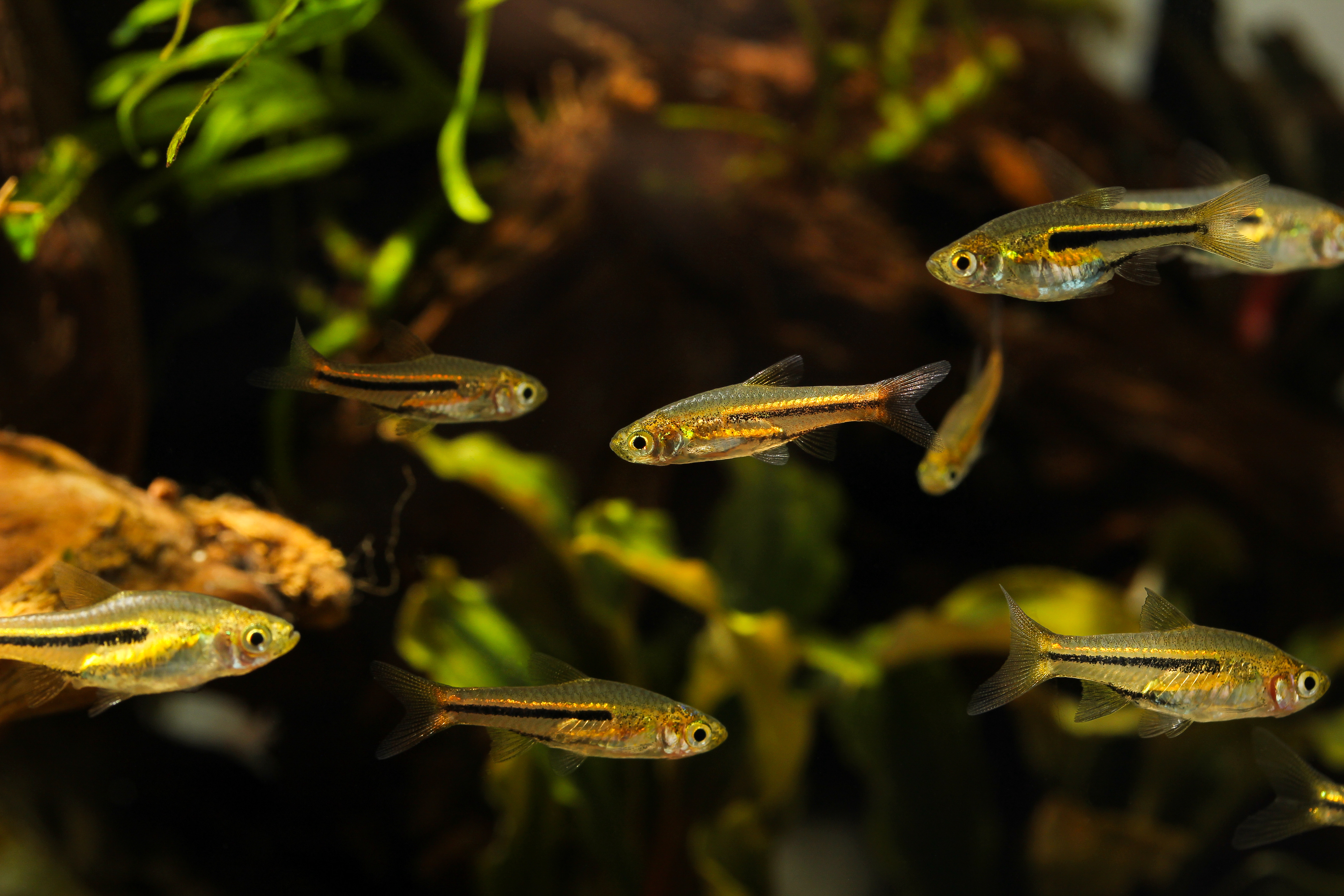
The Somphong's rasbora in Alex Bell's low maintenance aquascape.
Somphong's rasbora, Trigonostigma somphongsi
This tiny, copper-hued fish lives in the heart of one of Thailand’s rice-growing regions. An area rich in diversity yet constantly threatened by human activity. Though small and seemingly inconspicuous, the Somphong’s rasbora tells a story of survival against the odds.
For two days, I would wade through flooded rice fields and even snorkel in them, facing the challenges of filming in this unique environment. Along the way, I encountered not just the critically endangered rasbora but a myriad of other fascinating freshwater creatures.
A man made ecosystem
Thailand’s rice fields are a fascinating paradox. Created by humans, yet over thousands of years they have evolved into dynamic ecosystems. These flooded landscapes regulated by the seasons, mimic natural wetlands, providing habitat for fish, amphibians, birds, and countless invertebrates.
At the heart of these ecosystems are the water buffaloes. These gentle giants are more than just farm animals, they are ecosystem engineers. As they move through the flooded fields, they create microhabitats that benefit a wide range of species.

These rice fields are a maze of flooded channels and thick aquatic vegetation. I quickly realised that finding these rasbora would be difficult. From past expeditions, I knew the hazards—plants with razor-sharp edges, hidden spikes, and the ever-present risk of leeches or even snakes.
I spent a couple hours driving, looking for the most suitable location, taking in the sheer beauty of the place. As I surveyed the fields, a pipe caught my eye, it was draining water from the rice paddies, forming a fast-flowing outlet.
Even from a distance, I could see a lot of activity below the surface. Thousands of small fish congregated there, shimmering in the morning light. The fast steady flow from the pipe created a clearing between the dense aquatic vegetation. The ideal spot for swimming if you ignore the intense flow of water.

Life beneath the surface
With my snorkelling gear and waterproof camera in hand, I ventured into the water. The current was extremely strong, so I had to keep hold of the pipe so I did not drift away.
The water was warm and somewhat clear; beneath the surface, life was everywhere. Schools of small fish darted in and out of the vegetation. Their silver and red scales catching the faint sunlight filtering through the water.
Most of the fish appeared to be cherryspot rasboras (Rasbora rubrodorsalis) and red-tailed rasboras (Rasbora borapetensis). These are two almost identical species found in this region. Their vibrant colours added a striking contrast to the otherwise muted tones of the water. At first, I thought they were all one species but upon reviewing the footage it is clear that these shoals were of mixed species.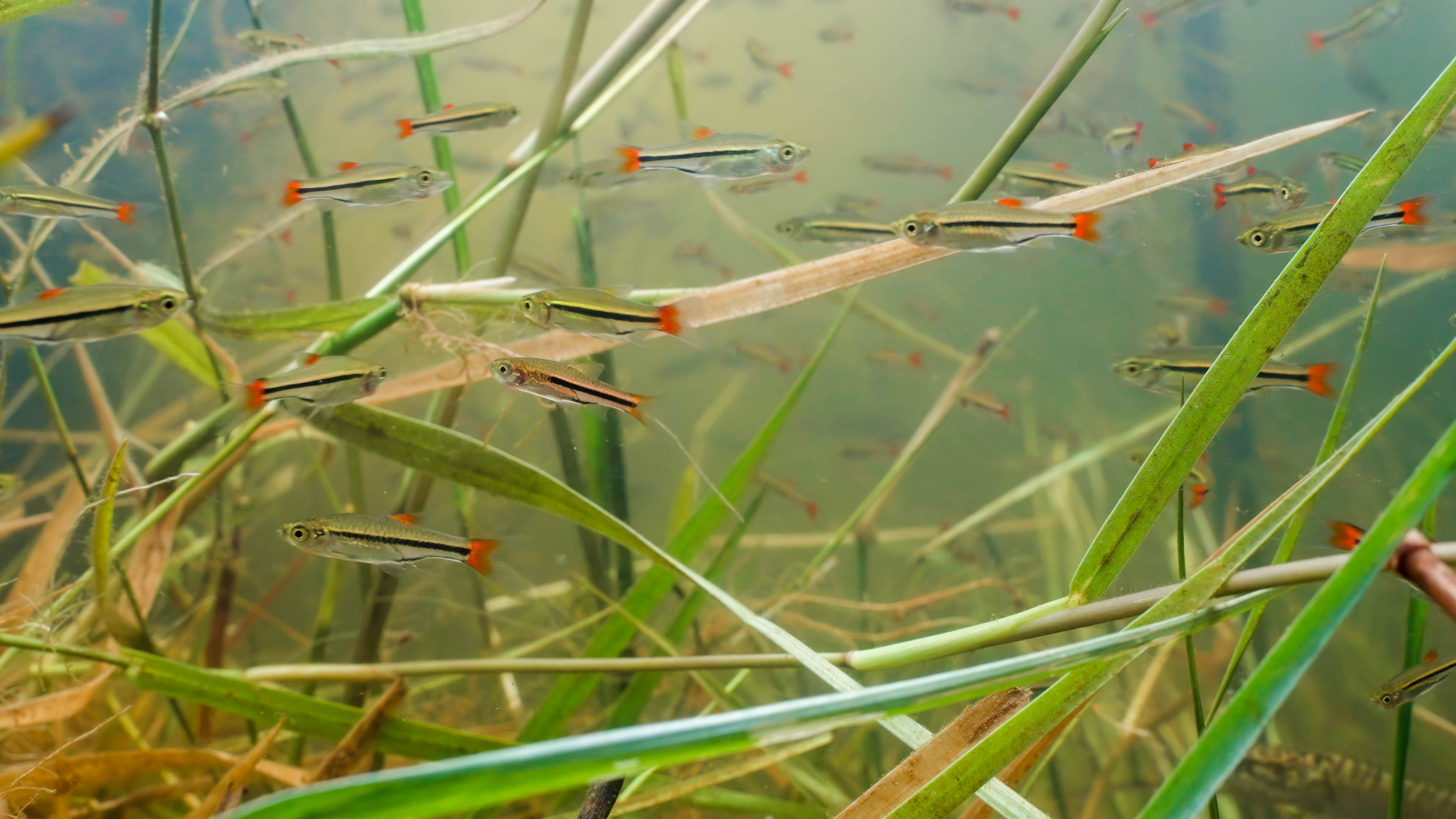
One Somphong's rasbora can be seen fairly central in the above image.
I reviewed my footage later that night, which was when I realised I had captured something extraordinary. Among the more common species was a tiny fish with a distinctive coppery sheen and a black lateral stripe. The distinctive markings of Somphong’s rasbora.
Not many individuals swam in these waters. They were shoaling with other similar looking species, making it hard to spot them while snorkelling. A great predator avoidance strategy when you don't have hundreds of relatives to group with.
Unfortunately, my calibration attempts all failed, so I was unable to measure the water conditions during my visit.
A tiny endangered gem
First described in 1958 and nearly lost by the 1980s. This was because of urban expansion, habitat destruction, dam construction, and pollution.
In 2012, the IUCN listed it as one of the world’s 100 most endangered species. A miracle occurred in 2014, when scientists found a small wild population within Thailand’s central floodplains. Unfortunately, humans continued to damage the natural world leading to the demise of this population.
Today, a fragile population persists at a second site, but the future remains uncertain. For a species with such a tiny population, even minor disruptions can be devastating.
The individuals I filmed were smaller than I expected, measuring just a few centimetres in length. This species was smaller than all the other rasboras in the field.
Males were particularly striking, their copper hues shining brightly even in the low light. Females displayed less colourful marking, but were still equally fascinating.
Their behaviour is very different from other Trigonostigma species that I have filmed. For instance, T. espei shoal in groups of hundreds and maybe even thousands. However, these nano rasboras swim in small groups of 1 to 5 specimens, together with other small fish species.
In these shoals you will find a diverse mix of tropical fish, some of which are common sights in fish stores. The two Rasbora species mentioned earlier are often present, along with Boraras urophthalmoides, Esomus metallicus, Amblypharyngodon chulabhornae, and Parachela oxygastroides. A lot of these look similar to one another, making it difficult to identify through the snorkelling googles. With so many species present, the experience was like snorkelling in an overstocked aquarium.

Larger fish inhabited the waters too!
Of course, thousands of small fish in one place attract the attention of larger fish. Predators like the striped snakehead (Channa striata) patrolled the waters, their sleek, striated bodies camouflaged against the vegetation.
These apex predators play a crucial role in maintaining the balance of the ecosystem. They keep populations of smaller fish in check, helping to increase the biodiversity just as the buffalo do.
Some of these striated snakeheads have even figured out a clever hunting technique. Small fish move from one field to another as the water flows through the pipe. The unsuspecting fish pour out of a small gap in the middle of the pipe, straight into the waiting jaws of the snakeheads!
Other species of fish live here
Somphong’s rasbora is just one piece of the intricate puzzle that is the rice field ecosystem. Sharing its habitat with numerous other fish species, each uniquely adapted to this dynamic seasonal environment.
Sparkling gourami (Trichopsis pumila) and croaking gourami (Trichopsis vittata) added flashes of blue to the water. These fish can produce clicking sounds, which they use for communication and courtship. While three-spot gouramis darted in and out of the aquatic vegetation.
Other notable species included the climbing perch (Anabas testudineus) and the Malayan leaffish (Pristolepis fasciata). Some of the fish here were masters of camouflage. The princess carplet (Amblypharyngodon chulabhornae) and Parachela oxygastroides both have nearly transparent bodies. Their ability to blend into their surroundings because of this made them tricky to spot.
Plants for a Thailand Biotope
The most obvious plant species was the rice plant, as expected based on the crop choice of local farmers. However, tons of marginal aquatic grasses that I couldn’t identify also dominated the shallows. In terms of fully aquatic plants, I identified Utricularia aurea, Nymphaea rubra, Nelumbo nucifera and Eriocaulon setaceum.
You could utilise Cyprus helferi or any Eleocharis to mimic the marginal plants for your biotope creation. Many of our favourite aquarium plants originate from Thailand. So, with a little artistic licence, you could create a rather stunning planted tank.

Where two worlds collide
The rice fields are as vibrant above the water as they are below. The relationship between land and water is a defining feature of this ecosystem. A place where species from different realms meet, interact, and depend on one another.
Despite the richness of life in these wetlands, the threats they face are immense. Agricultural practices, while vital for feeding a growing population, can have devastating effects on species richness.
Pesticides and fertilisers seep into the water, altering its chemistry and impacting aquatic life. Damns and irrigation canals can alter the natural courses of water affecting the species that depend on them.
Climate change adds another layer of uncertainty. Shifting rainfall patterns and rising temperatures could disrupt the delicate balance of these ecosystems. All combining to push species like Somphong’s rasbora closer to extinction.
Efforts to protect these habitats are underway, but they require collaboration between scientists, government, and local communities. Farmers, in particular, play a crucial role in the future of this species. By adopting sustainable practices, they can help ensure that rice fields remain a haven for a diversity of lifeforms.
Why not create a biotope based on this ecosystem, share this habitat with the wider world. Hopefully, the more awareness we can create, the more people will have a desire to save this tiny fish.

Fish Factfile
Somphong’s rasbora
Scientific name: Trigonostigma somphongsi
Size: 3cm (1.2”)
Origin: Thailand, exact locations are not widely publicised.
Habitat: Floodplains and rice paddies with dense aquatics vegetation with generally slow moving to stagnant water. Often found in large mixed shoals with other rasbora species.
Tank size: 45x30x30 (18x12x12”) <Tank size 40l>
Water requirements: Soft and acidic water is required for this species to thrive, a pH below 7 and a <8°H
Temperature: 22-26°C (72-29°F)
Temperament: A peaceful community fish that can be shy if not kept in groups. Due to the shyness and small size larger and more boisterous fish should be avoided. Given its rarity, and price tag, for now it is better suited to breeding projects and biotopes to help raise awareness and its availability.
Feeding: In the wild they generally feed on small zooplankton, worms and insect larvae. They readily take to prepared diets in captivity but live and frozen foods will help to condition the fish.
Availability & cost: Rare to find, specialist retailers may be able to order them in for you. Expect to pay around £7 per fish.
This article was first published in the February 2025 issue of Practical Fishkeeping. Click here to see our latest subscription deals.