


Editor, Alex Bell, outlines why he believes fish from the liquorice gourami (Parosphromenus genus) are a brilliant option for your first botanical method aquarium.
A love for blackwater
For someone with a reputation of enjoying ‘brown fish, in brown water,’ it may be of little surprise that the liquorice gouramis (Parosphromenus spp.) are now a firm favourite of mine. Although, I strongly disagree with my wife, saying they are ‘brown’, I do know plenty of people that agree with her. Yet, under closer observation- which is perhaps why she doesn’t see it as I don’t think she would stare at them like I do- you will soon realise these are not boring fish, but are little bullets of colour that you will only see when the fish want you to see them. However, it did take several years of keeping blackwater aquariums before I picked up my first pair, so why would I now recommend them to people as their first blackwater inhabitant? There are a few reasons, but first let me explain why it took me so long to keep this beautiful group of fishes.

My journey into botanicals
I utilised fallen leaves in aquariums for years before I created what I consider as my first ‘botanical method aquarium’. I would occasionally throw a handful of leaves into a ‘South American planted community tank’, or use some to feed my shrimp colonies, but never to the extent that the water was properly stained, or the substrate became littered with detritus. In doing this though, I became very comfortable with the idea of things decomposing in my aquarium, allowing funguses, moulds and other such microorganisms to appear. So, when it came to doing a tank full of this, I was confident I would love the result. As such, when the time came, I went with a far larger aquarium than many would for their first try at a new niche. An aquarium more suited to dwarf cichlids and characins than tiny gourami, and so this is what I stocked them with. This continued for many years, opting for larger tanks, larger species and usually conforming to my then main interest, which was South American fishes.
This all changed when I got a racking system for my first fish room, as I had some smaller tanks to fill. This was when my interest expanded across to South East Asia, where the Parosphromenus inhabit. I soon realised that I had been missing out.
Related article: How to style yourself on botanicals
Why keep liquorice gourami?
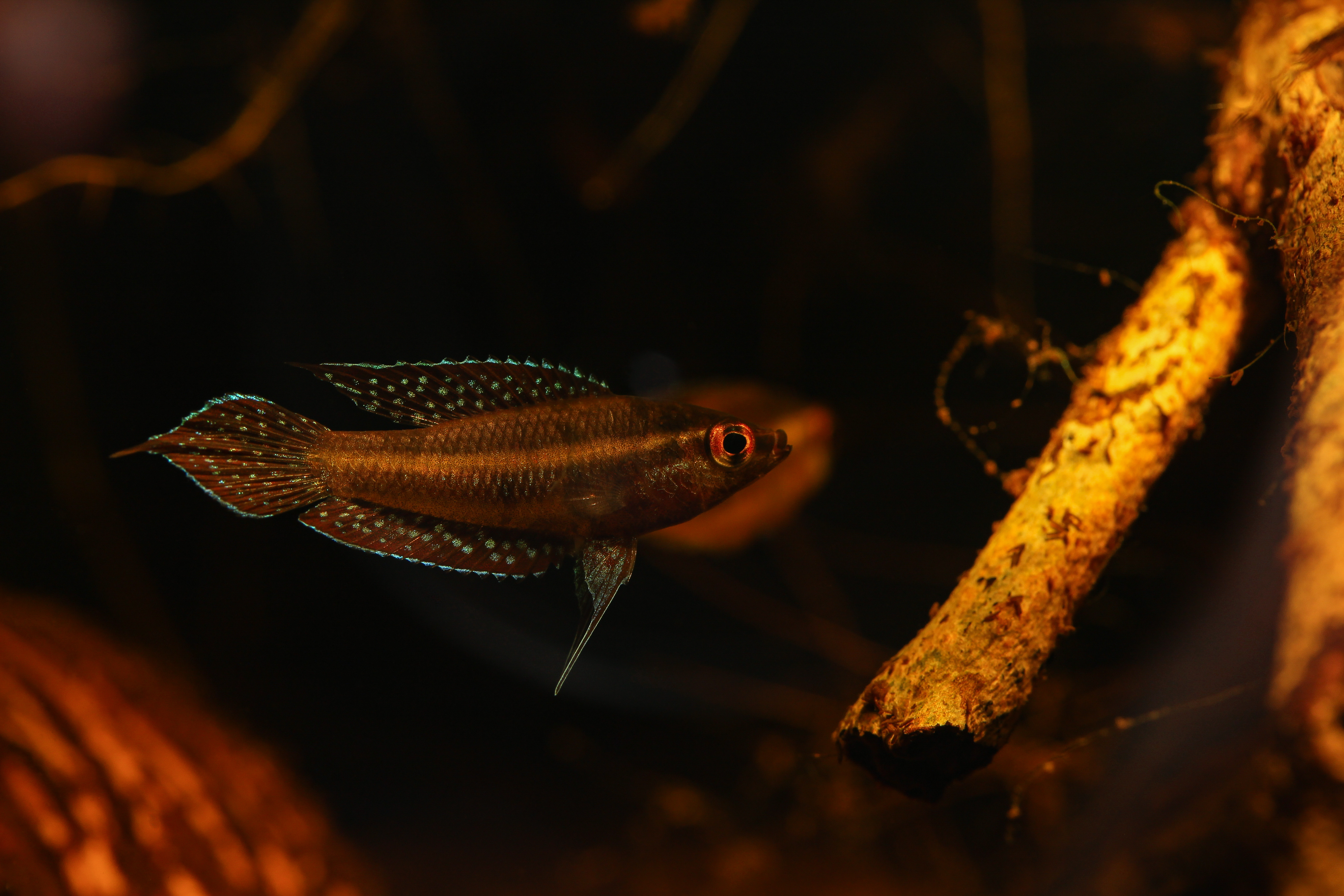
One of the main reasons I believe licorice gourami are well suited candidates for being the chosen species for your first foray to the dark side is their size. The majority of the species available will do well as a pair in a tank as small as 20litres- meaning you don’t have to have a big aquarium. This is obviously advantageous as I am fully aware that not everyone can see the beauty in detritus, tinted waters with floating debris, and fungal growths. So there is always a chance that you try this method of fishkeeping and don’t like it, and no one wants an expensive, large aquarium that you grow to hate. Instead, you can set up a nano aquarium, requiring less botanicals and smaller equipment (meaning it is cheaper!) and it takes up less of the valuable space within your home. Of course, if you end up loving this aquarium there is nothing stopping you from going larger next time…
Behaviour of Liquorice Gourami
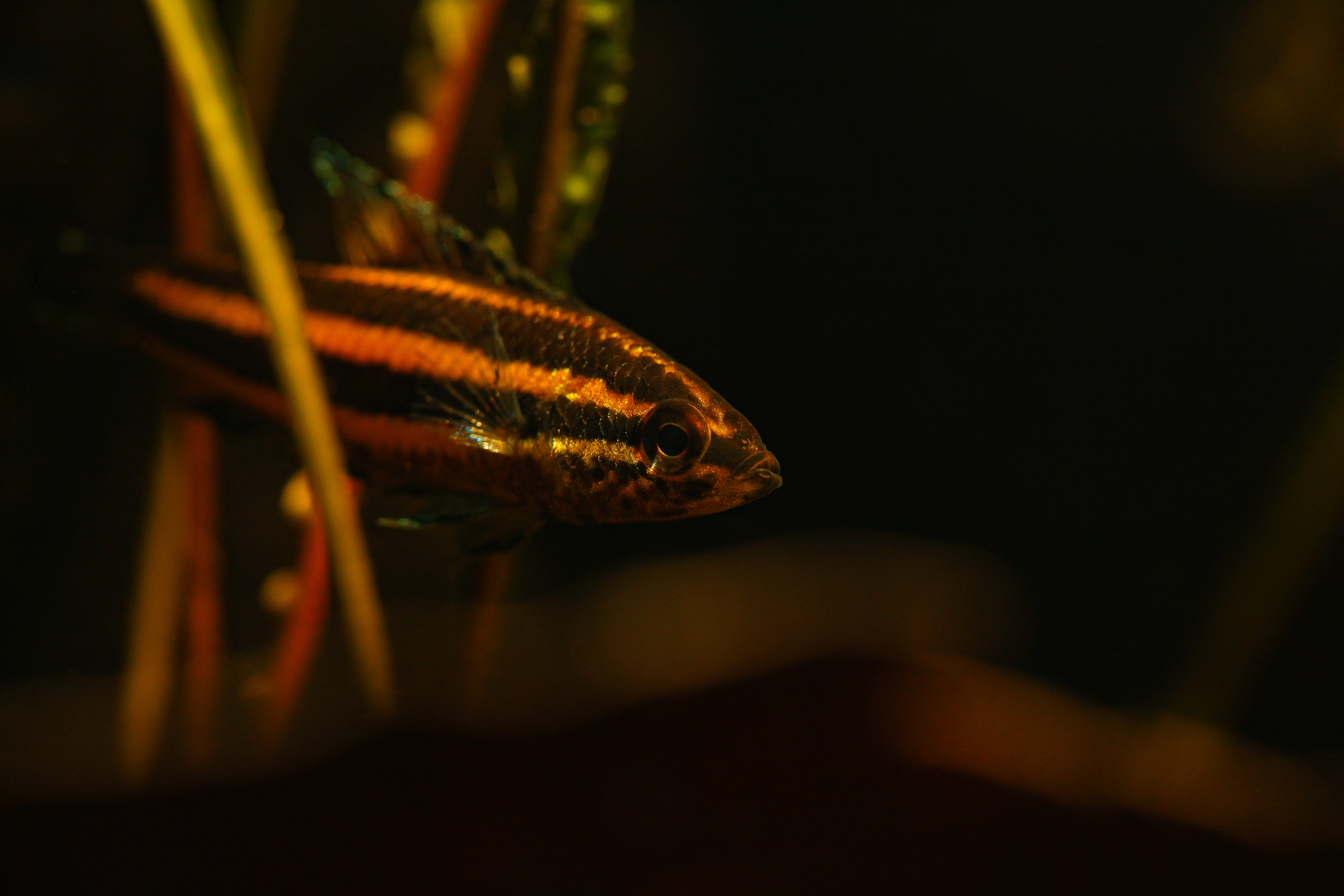
Next is their behaviour. They are fascinating to watch, and not just when courtship occurs. They typically stay close to cover, skulking through the leaf litter hunting for tiny organisms to eat. You’ll occasionally see a flash of colour from the deep layer of botanicals when they suddenly move to catch the daphnia that swam too close. For a small fish, I really do believe you can see some of their individual personality, after time a pair of mine would even greet me at the front of the tank like a domesticated betta, or large oscar would do. It is rare to get such a ‘pet’ like personality from a small fish. If keeping a group, the males will spar, chase and defend territories adding to the drama of the aquarium, all without causing any significant injury to one another, although, a larger tank would be required to allow for this behaviour. Ok, yes, none of this quite compares to their ability to switch colour and ‘turn it on’ to attract a mate, but that really is the icing on top of an already very sweet cake.
Impressive courtship displays
The most impressive part apart this group of fish is their courtship displays, and there are some differences between the species. Generally speaking, each species will sit within one of three groups: head up, head down or horizontal, with these being named after the position in which the male does his courtship routine. The most common is the head down position, with all species from the bintan and harvey family plus the attractive P. filamentosus (a species on my wish list) performing in this way. The male will, as the name suggest, point the head towards the substrate and flare out his impressive fins allowing the light to reflect and the true colours shine. Whereas, P. paludicola, P. deissneri or P. quincedim perform their similar displays with a much more horizontal body position.
The final group are the reason I said earlier that the majority of the species do well in pairs in 20 litre aquariums. This group of liquorice gourami need a little more room than this; they are the head up species. Belonging to this group are P. parvulus and P. ornaticauda and these have a rather frantic swimming pattern included with their head up display, which can spread over a rather impressive distance, circling around the female of choice. Yet, one fish doesn’t quite fit the rules, and that is P. sumatranus. The body shape and head up display position would put it firmly in this last group, yet it does not perform the erratic dance, and it possesses the classic striped flanks as with the majority of the other species in the genus.
Whichever species you pick, I am confident that you will certainly be impressed when you see your first displaying male.

Challenges of keeping liquorice gourami (Parosphromenus)
Keeping this fish is not ‘easy’ though; there are some challenges ahead should you decide this is the route for you. Most notably when it comes to breeding them. With Parosphromenus being an endangered group of fish, it really is encouraged that we should be trying to raise some offspring where ever possible. Plus, this is when you get to see the fascinating courtship behaviours, so why would you not want to try and breed them! To do this you really need to mimic blackwater habitats, and not just the colour of the water; these fish thrive in acidic conditions, with pH values of below 6.5 a necessity. Some species require as low as a pH of 4 for their eggs to develop and hatch and at these low values, the aquarium really no longer functions like any other. With bacteria failing to thrive, and the nitrogen cycle no longer functioning as we are initially taught, it’s far from a standard community aquarium and can be a lot to relearn. We know that bacteria and the nitrogen cycle is important because without it, high levels of ammonia will build up and kill our fish. However, this is actually not the case when the pH is this low, the free ammonia in a low pH environment becomes ammonium ions, which are less toxic to fish and is actually a favourite source of nitrogen for many plants. So as long as we maintain our aquarium correctly for the species, we should not need to worry too much about nitrogen wastes. Especially if you combine the botanicals with floating, emergent and low light tolerant aquatic plants that will enjoy ‘snacking’ on the ammonium ions produced.
For a more detailed look into filtration in low pH aquariums check out our guide to aquarium filtration.
To get this low pH value you will need almost non-detectable carbonate hardness which likely requires you to utilise an alternative water source. For those that really get the botanical bug, you are likely to invest in a reverse osmosis (RO) unit for your home, reefers will know all about these but they are effectively a way to purify your tap water. Alternatively, many local stores will happily sell you RO water by the barrel, just make sure it is RO water and they haven’t added salt to it for their marine customers; the price will be a dead giveaway with salted RO costing a lot more. A final option to consider is, if you live in a rural, pollutant free area is to use rainwater. It is always good to store, filter (I’d recommend activated carbon or similar products) and heat (in winter especially) this before use.
Feeding the small gouramis
Another somewhat challenging aspect to keeping these fish is feeding, but I would hazard a guess that if you are keen to try botanicals in an aquarium, you’ll be open to providing the correct food too! When you first purchase your licorice gourami, they are highly unlikely to accept prepared foods, and instead only show interest in live and frozen fares. These should make up the majority of their diet even if you get your fish to begin taking small pellets after they have settled in as a varied diet is often key to success with these trickier species. Both live and frozen daphnia, cyclops, appropriately sized brine shrimp and insect larvae will all be appreciated. If you are happy to give worm culturing a go, many of these will be enthusiastically consumed too.
A benefit of this style of aquarium keeping is, that over time the aquarium will build up its own ecosystems with things like freshwater copepods, detritus worms and rotifers just appearing in your aquarium all of which can help to sustain your fish in between feeds. You can even pre stock your aquarium with some cultures of these organisms to reproduce in there before you add your fish.
A word of warning though, if feeding organisms cultured in salt water, you need to very carefully strain any fluid as over time the addition of which would cause the concentrations of salts in the water to increase and subsequently the pH too. As we know, this is not so ideal when we aren’t playing with a typical nitrogen cycle as any ammonium ions present may convert back to the toxic ammonia.
Are liquorice gourami worth the effort?
Like I said earlier, this is not for everyone, but for those of you that want to try something new, and explore a new niche of the aquarium hobby, this is a great entrance. Yes, there is some learning involved, and yes, these fish can be rather sensitive, but if you were already open to decorating your aquarium like an autumnal pond, I don’t know why you wouldn’t want to push it one step further. Use this new aquarium as an opportunity to keep a species many aquarists never get to experience, and potentially, you’ll even be helping to preserve an endangered species in doing so. There is a whole lot of information about the genus available at the Parosphromenus project website.

FactFile
Moonspot Liquorice gourami
Scientific name: Parosphromenus linkei
Size: To 3.5cm
Origin: Endemic to Borneo
Habitat: Inhabits peat swamps with slow moving waters, layers of dead terrestrial materials and detritus.
Tank size: 40x20x25cm (16x8x10”)
Water requirements: Very soft and acidic water; 3.0-6.5pH, 0-4°dGH
Temperature: 23-28°C
Temperament: can be shy and outcompeted by larger boisterous fish, not suitable for standard community tanks.
Feeding: Requires live and frozen small invertebrates such as daphnia and cyclops initially but can sometimes be weaned onto prepared foods also this should supplement not replace the above.
Availability and cost: Difficult to source, will usually need to be ordered in specially by your local store, prices from around £8
Check out our magazine subscription offers for more fishkeeping tips, guides and reviews!