


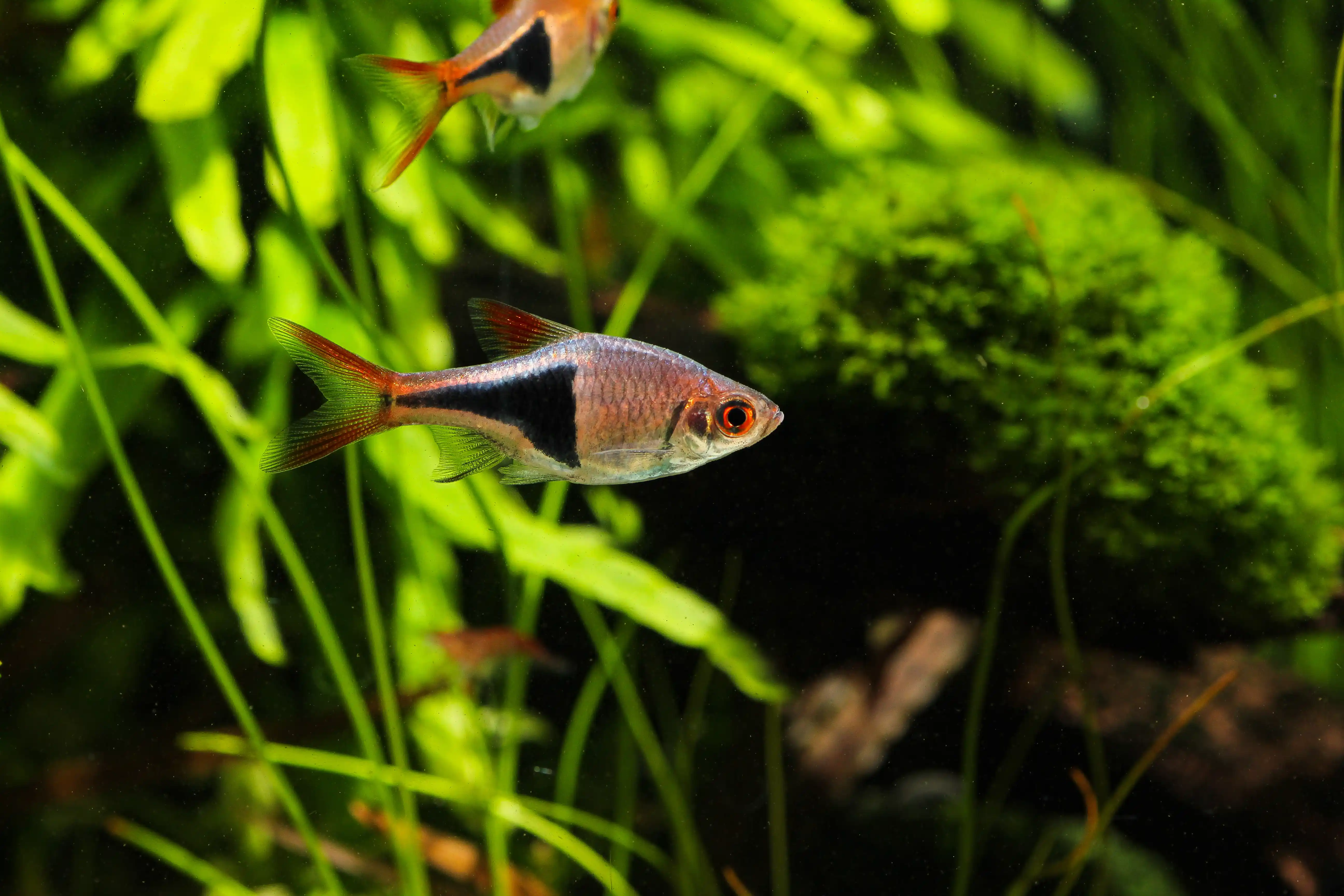
A genus of small freshwater fish that has some incredibly popular species within community tanks and aquascaping. Alex looks at all the species within Trigonostigma.
Many aquarists will recognise the fish from the genus Trigonostigma. Walk into almost any local fish store and you will probably see at least one of them present. This is because their small size and their peaceful demeanour mean they have long been a popular community fish. They are adaptable fish, that feed on the usual prepared and frozen foods that we feed our community aquariums.
In this article I will investigate the whole genus, working through each species one by one. Hopefully, this will help you choose the best species for your community or planted tank.

True harlequin rasbora lack colour in the anal fin.
The classic harlequin rasbora
This is the species that everyone will know, it is a common and popular shoaling fish, and for good reason. Harlequins go by the scientific name of Trigonostigma heteromorpha, and occurs in the wild in Southeast Asia. Here it dwells in the freshwaters of the Malay peninsular, Singapore, Sumatra and several smaller islands including Bangka.
This fish naturally inhabits slow flowing forest streams with aquatic vegetation, notably various species of Crypts. Some slight staining is common in these waters from the release of tannins. The pink- orange colouration and dark black triangular marking make them stand out against a background of live plants. However, should you fancy a different colour, there are captive strains available, including the rather unique purple harlequin rasbora.
This species reaches a manageable 5cm (2") meaning you can keep a small group in a 60cm (24") aquarium. Since the majority of fish in the hobby are captive bred, they are quite hardy fish. As long as your water is not extremely hard, and the pH sits at or below 7.5, they will thrive.

Lambchop rasbora
Copper harlequin, or lambchop rasbora
When not in full colour, this fish can look similar to T. heteromorpha. However, get them settled in a planted aquarium and there is no mistaking Trigonostigma espei. They have vivid copper hues that surround the thinner black triangular, that is almost 'lambchop' in shape.
They stay smaller too, reaching a maximum of 4cm (1.5") in length. I would still recommend sticking with the classic 2 foot aquarium recommended for the true harlequin though. Instead, increase the group size a little as their smaller size can make them a little less brave than their larger relatives.
Their native range stretches across Thailand and Cambodia. Here they occur both in the typical slightly acidic forest streams and in alkaline, limestone pools. The latter is only in the Krabi province of southern Thailand. This natural distribution means they are well suited to a wide range of water parameters.
Related article: How to set up a Cambodia Biotope aquarium
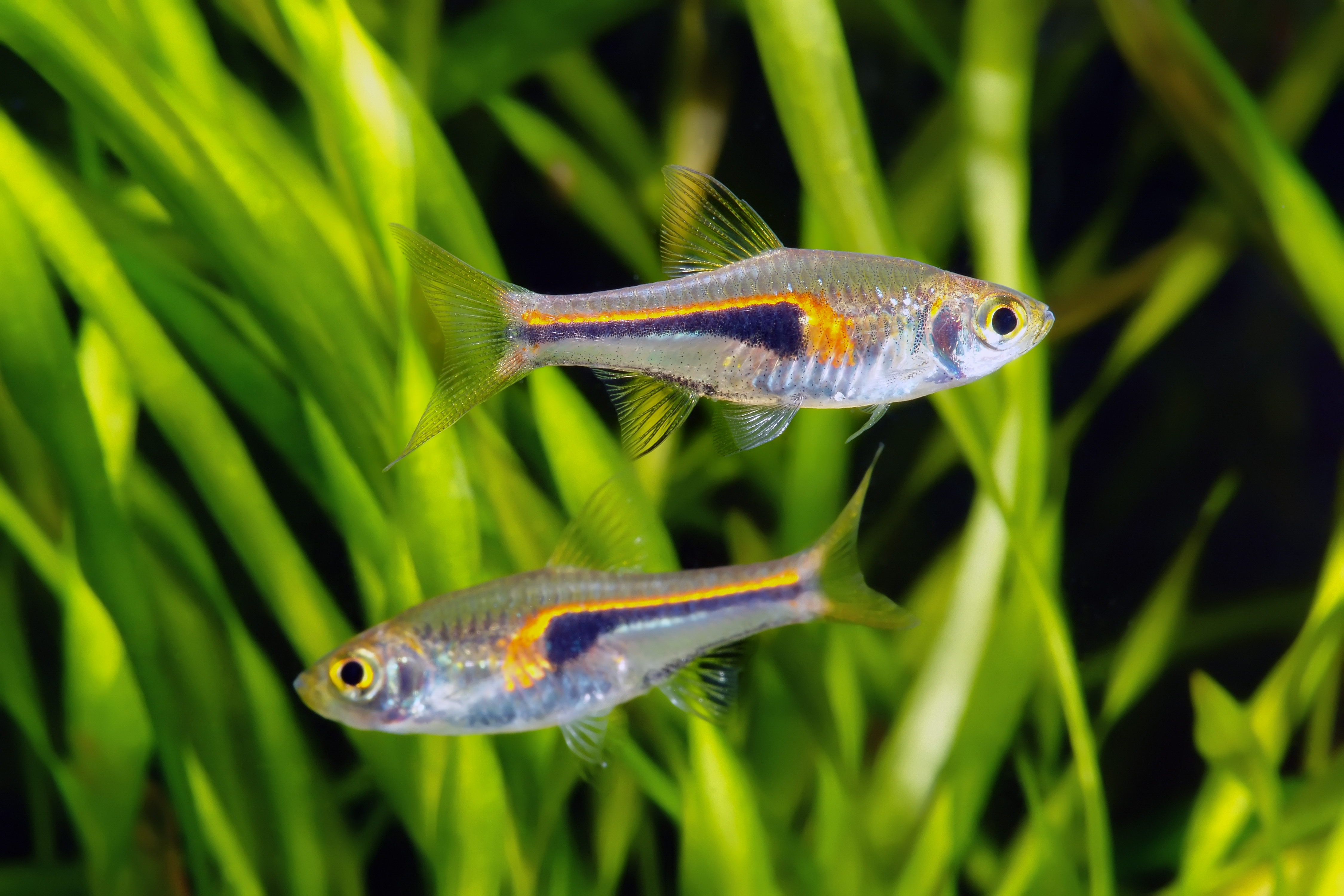
Glowlight rasbora photo by shutterstock
Glowlight rasbora
This species may lack the bright colours of the first two species, but it still makes for a brilliant addition to your fish tank. Trigonostigma hengeli displays a rather pale, almost grey base colour. However, they do have a distinctive bright orange stripe along the upper edge of the typical black marking on their flanks. This stripe is incredibly eye catching, especially when in a shoal, so don't overlook this species as an option.
They inhabit similar habitats to the harlequin rasbora, and occur in Sumatra and Western Borneo. Meaning aquatic plants, botanicals and fallen branches and submerged roots would all make for a good biotope inspired aquarium.
This is another small rasbora, typically reaching a little over 3cm (1.2") in length. Therefore, they are suitable for aquariums holding around 60 litres (13 gal) of water. Although, smaller tanks would work for a species only set up or for breeding purposes.
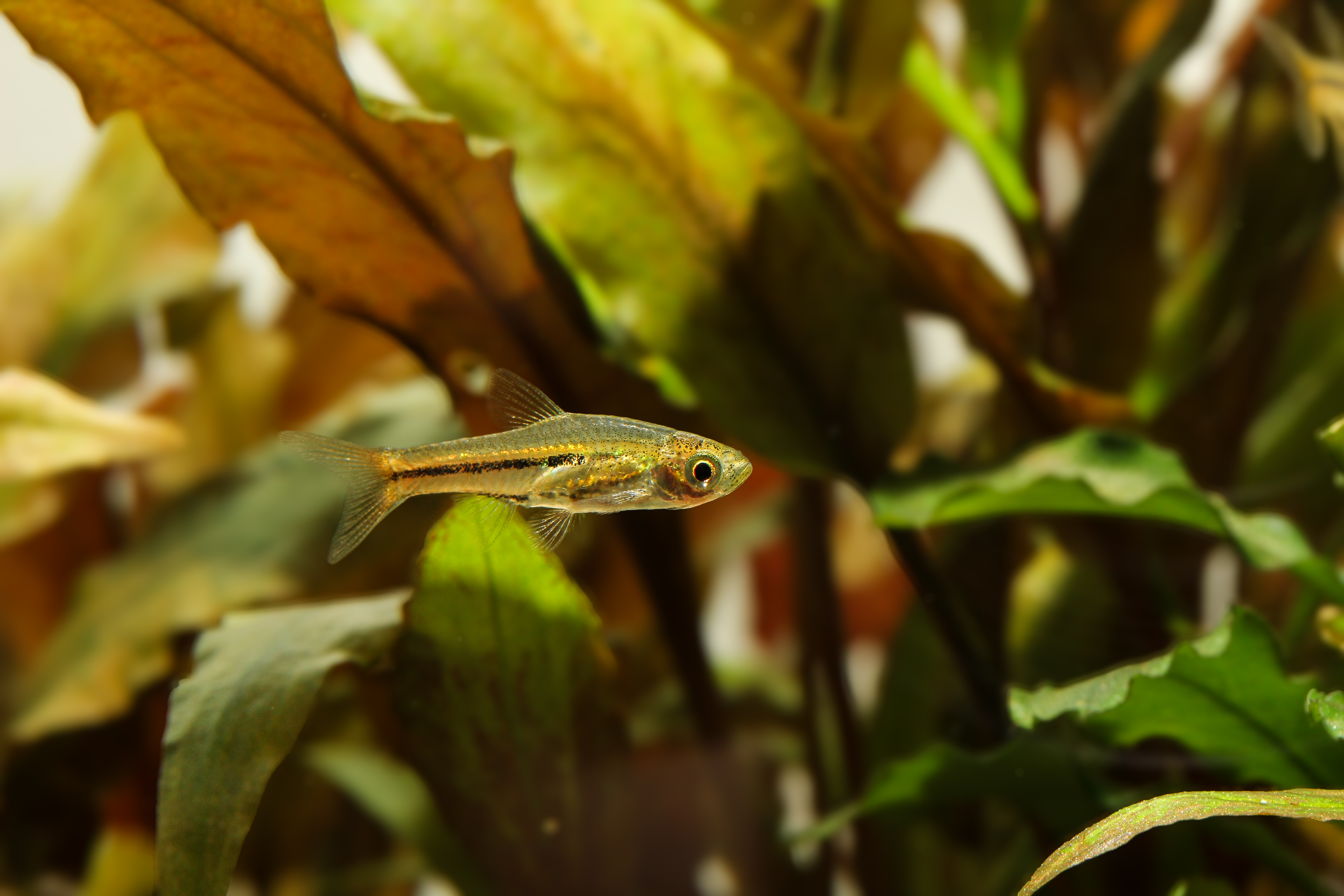
Trigonostigma somphongsi
Somphong's rasbora
This species lacks the triangular/lambchop shaped black mark. Instead, they possess a dark lateral stripe, which makes sense as their body is not as deep as its relatives. These two features are why this species easy to spot, if you were lucky enough to see them that is. Trigonostigma somphongsi are rare in the trade, with commercial breeding limited and wild fish populations on the brink.
They are listed as Critically Endangered by the IUCN, and are only found in small pockets of flooded fields in Thailand. You can learn more about their natural habitat by reading Rodrigo Issac Silva's piece about visiting the area.
They are well suited to life in an aquarium, in fact they are good fish for aquascaping. Their neutral colours and shoaling behaviour complement planted aquariums rather than distract from them. I used them to great effect in an Asian Inspired aquascape created by George Farmer. You can read more about this tank in the May 2025 issue of Practical Fishkeeping.
Males remain smaller than females, but even they stay small. Reaching a maximum of 3cm (1.2") they are probably the best choice within the genus for smaller tanks of 45cm (18"). They are slightly less tolerant of alkaline water though, so keep the pH below 7 for success with this species.
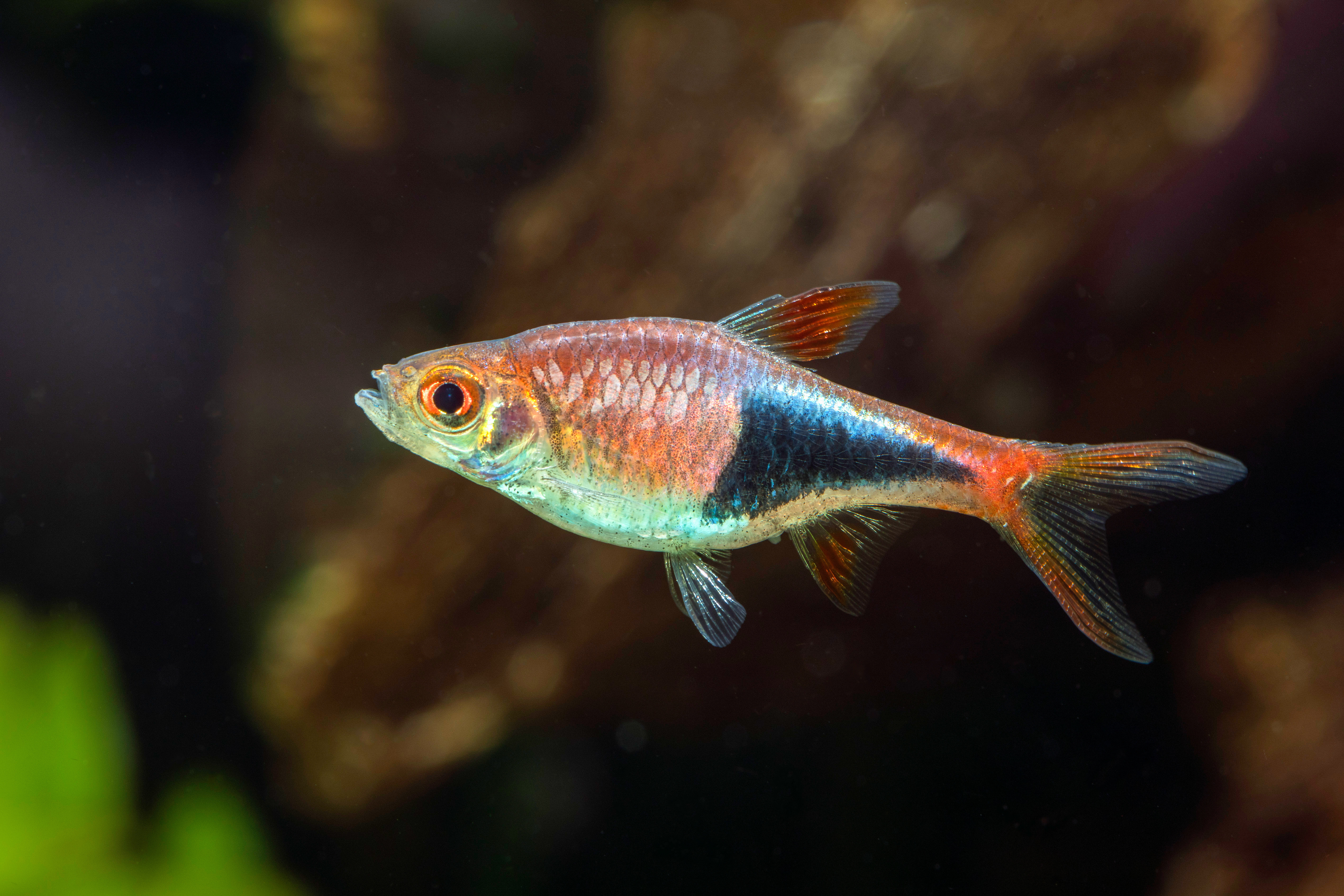
T. truncata, note the colour on the anal fin and black mark stopping before the tail. Photo by Shutterstock
The new kid on the block, Trigonostigma truncata
Until recently, 2020 to be exact, the list would have ended with the Somphong's. But a new species joined the genus after Dr Tan Heok Hui described it, you can read the original paper here.
Trigonostigma truncata look incredibly similar to the common harlequin rasbora. They have likely been in the hobby for a while, but just incorrect labelled as T. heteromorpha. The differences are subtle, so it may take some time for you to become confident in spotting them.
That black mark on the flank of all these species extends right down to the caudal peduncle (where the tail meets the body). However, in this new species it does not, it is "cut off", or truncated, hence their name. They also appear to have a blue sheen when settled into an aquarium, and an orange anal fin.
The species occurs in lowland swamp streams from Southern Thailand to the Malayan state of Terengganu. Here they live alongside some other common aquarium inhabitants. This includes the least rasbora, three-spot gourami, croaking gourami and Betta imbellis.
Related article: Rasboras: The Spartacus fish
Below is an image by @Tan Heok Hui of T. truncata that as published in the original paper describing it. This fish is in tannin stained waters meaning the colours are less obvious than the image above.

Photo by @Tan Heok Hui