


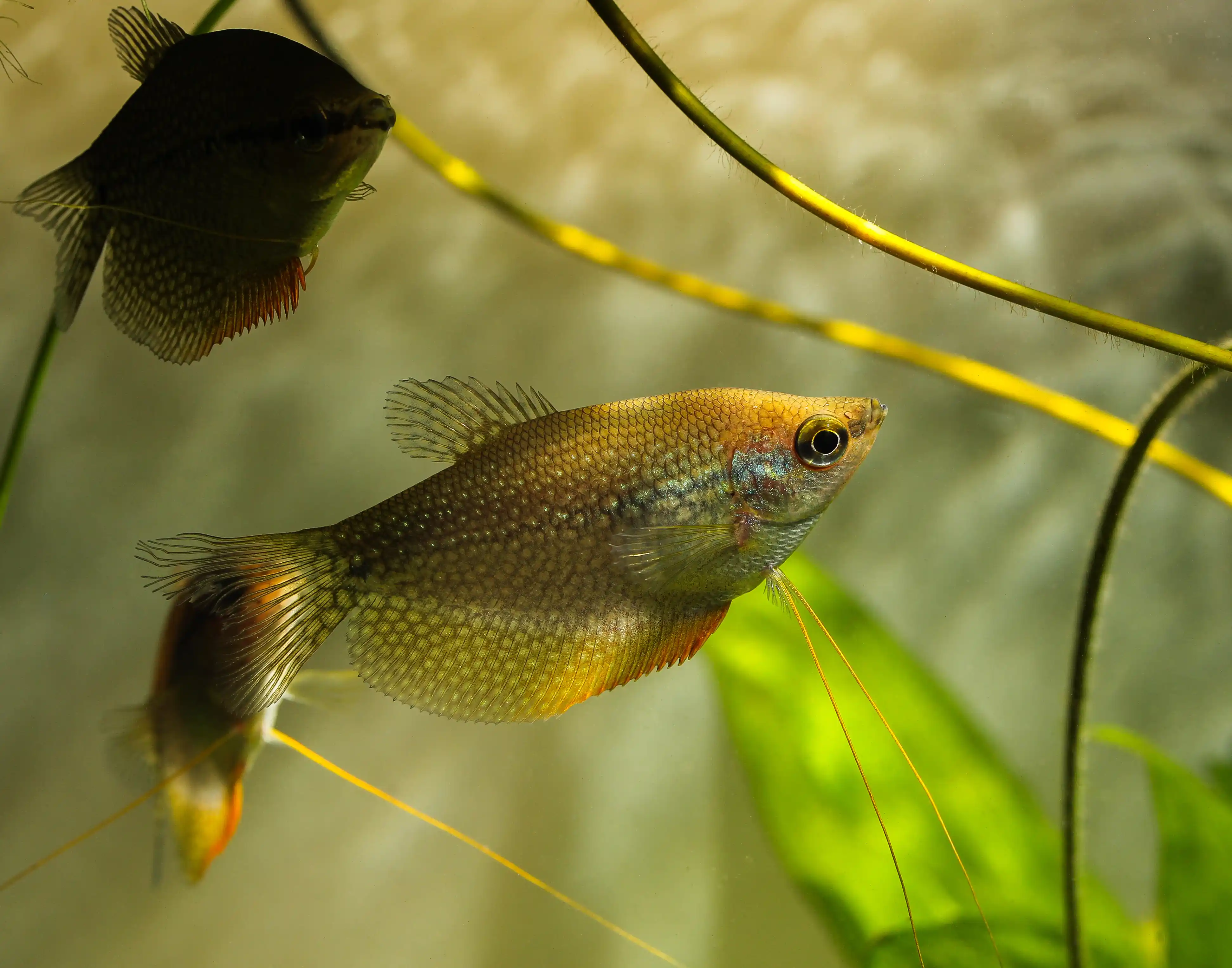
Are pearl gourami, Trichopodus leerii, good additions for your community aquarium, and what do they need to thrive in my tank?
Are pearl gourami aggressive?
While male pearl gouramis (Trichopodus leerii) can be a little territorial towards one another, they are far less aggressive than their relatives, Trichopodus trichopterus. This species is available in several colour morphs (gold, blue, opaline and three spot) that are all commonly seen in the hobby, and have all terrorised community aquariums. They are best avoided and pearl gouramis are often suggested as an alternative by some fish shop staff.
Pearl gouramis are actually more at risk of being bullied than being the bully, and care should be taken when choosing tank mates as they can become reclusive with overtly aggressive fish being present. Their long fins are also at risk of being nipped to species like tiger barbs are not good companions. Otherwise, the pearl gourami can make a good relatively peaceful additions to larger community aquariums.
What water chemistry do pearl gourami need?
In the wild, Pearl gouramis are only known from very acidic blackwater habitats (with a pH of 4.0–5.0). The fish we see in shops however are all tank bred and are robust enough to withstand less acidic conditions.
However, it is still best to maintain them optimally in soft, acidic water with a temperature of 24-30°C (75-86°F). The orange colour in males is significantly enhanced when pearl gouramis are maintained in tannin-stained water, which can be created using botanicals in your aquarium.
How many pearl gourami should I keep in my aquarium?
While more placid than their close relatives, it is still advisable to stock more females than males (as males are the more aggressive, territorial of the sexes). I would look to get 2 males, and 4 females as a good starting point for a 120cm aquarium, this will spread the males attention and you will get to see more interesting social dynamics keeping them in a good sized group.
The different genders can be identified even in young adults as females have a more rounded dorsal fin. Mature specimens are even more obvious, as the males develop a vibrant orange throat.
Where do pearl gourami come from?
Pearl gouramis originate from Southeast Asia, across Malaysia, Thailand, Borneo and Sumatra. They are typically found in the slow moving streams, peat swamps and lowland flooded forests with abundant surrounding vegetation. They have been found in rather shallow water for their body size in water depths of just 30cm (12").
Their populations in the wild are decreasing and are therefore listed as as Near Threatened on the IUCN Red List. Those that make their way into aquariums are almost all captive bred, so the aquarium trade is not thought to be a major threat to the species, although, the capture of wild fish for both this and as a local food source is listed as a ongoing threat.

How should I aquascape an aquarium for pearl gourami?
As mentioned earlier, pearl gouramis can actually be timid and get bullied by their tank mates, so ample vegetation should be provided for them to retire to. Large pieces of wood, with plenty of Java fern tied to it can make a nice attractive display while providing plenty of cover. The addition of leaf litter and larger seed pods can help to create the tinted water to really show off your fish. These fish do reach 12cm (4.7") in length, so the aquarium should be at least 120cm long, giving you plenty of space to get creative with your layout!
Rocks can be included, but as these fish prefer softer water so select aquarium stones that are inert. These fish don't interact with the substrate too often, so sands, gravels and even aquascaping soils can all be utilised.
What fish can I keep with pearl gourami?
So the pearl gourami are fairly easy going in terms of not being that aggressive and being fairly adaptable with water parameters and tank decoration, but boisterous species, like some medium-sized barbs, should be avoided. Otherwise, the pearl gourami make an ideal centrepiece fish for your larger community aquarium, with ideal tank mates including:
- Dwarf cichlids as they will occupy lower areas of the tank and enjoy similar acidic conditions
- Smaller catfish like those previously known as corydoras and bristlenose plecs (Ancistrus spp.)
- Tetras, but avoid any prone to fin nipping like the serpae tetra.
- Peaceful barbs like the beautiful six banded barb (Desmopuntius hexazona).
- Various rasboras.

Six banded barbs are good tank mates for pearl gourami
Words and photos by Alex Bell