


Nano tanks continue to be popular choices, but what fish can you keep in these tiny tanks? Alex Bell outlines 10 species he loves for small aquariums.
What do you mean my tank is too small?
Something many of us will have heard a less experienced aquarist say, or maybe even said yourself, is “what do you mean my tank is too small?”. After picking out the perfect small aquarium, setting it up with whatever decorations took their fancy and allowed the filter to mature, it was time for the new aquarist to buy their first inhabitants only to be told the fish they liked were not suitable for the sized aquarium they have.
It is a frustrating minefield when all the fish in the shop are being housed in tanks of the same size, especially if the tanks of fish don’t have labels stating maximum length or minimum tank size.
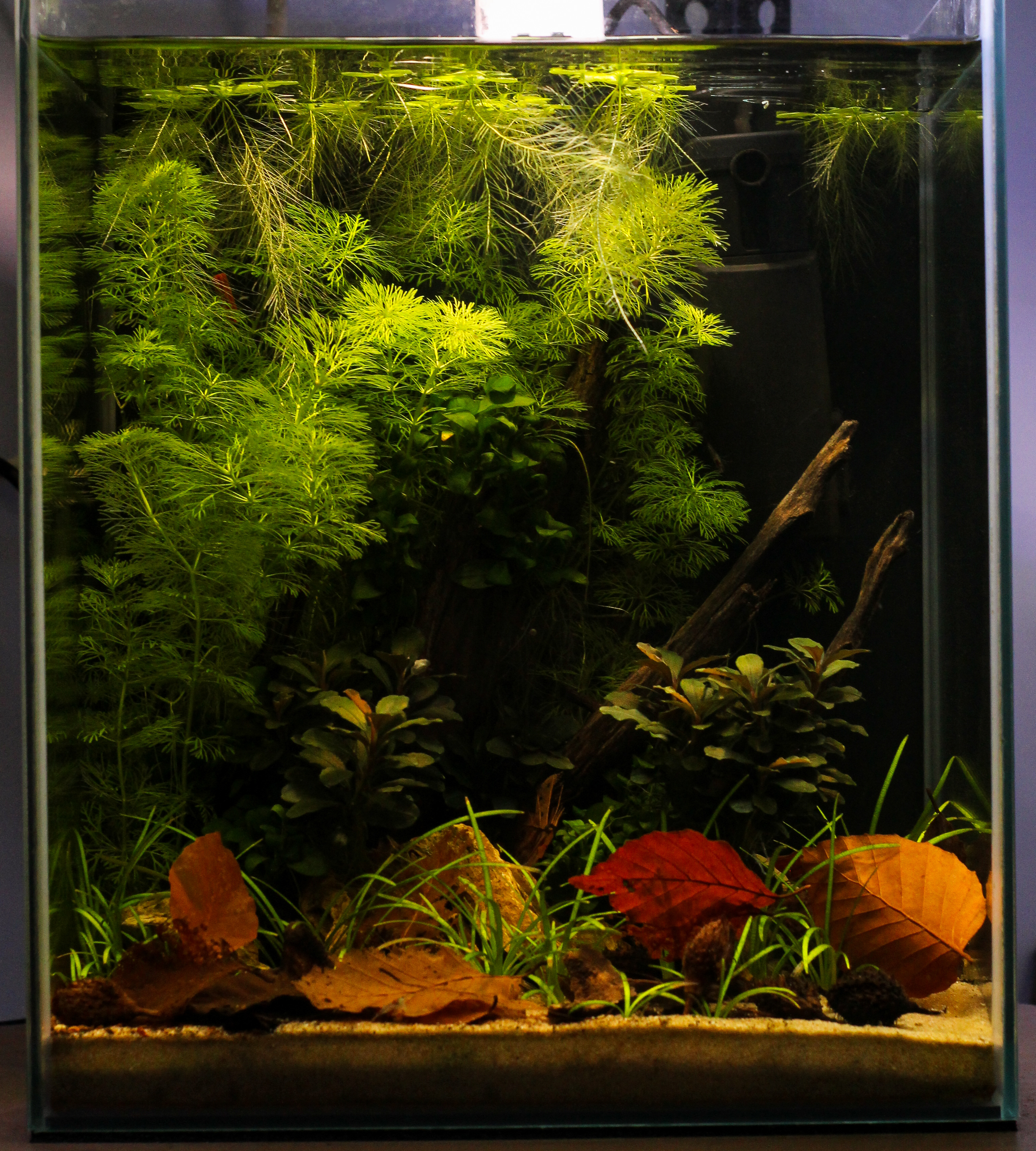
The tank pictured above is 30x30x35cm (12x12x13.7") holding just over 30 litres of water.
What is a nano tank?
The majority of aquarium manufactures all have their own ranges of nano aquariums; it is easy to see why as they can be marketed towards every level of aquarist. But these tanks seem to not have a strict definition to their size. Generally speaking, nano tanks are considered to hold between 10 to 40 litres (2.5-10 US gallons).
While there are definitely fish that will do well in tanks at the upper end of this size, the shape of the aquarium matters greatly in determining what you can keep. Tall narrow tanks reduce your stocking options dramatically as they lack the swimming space for active species, whilst not being wide enough to allow fish to defend their own territories without overlapping.
With this in mind, all of my following suggestions on what species will do well in a freshwater nano will be for a 45x25x25cm (18x10x10”) aquarium like the Superfish Quadro 40 Pro by Aquadistri as this gives the most options for stocking. This aquarium also comes with a clear glass lid so fish that are prone to jumping can still be stocked, maximising our options.
Top 10 fish for nano aquariums
So, the question remains, what animals are actually suitable for these popular nanos? Let’s take a look at some of the most beautiful options (in my opinion) that are sure to dazzle in your small slice of the underwater world.
1) Emerald dwarf danio (Danio erythromicron)
For those wanting a beautiful and active fish that is suitable for more alkaline, hard water, consider the emerald dwarf danio (Danio erythromicron). These beautiful fish do not tolerate acidic conditions so for those with soft water coming out of your taps you’ll need to buffer the water! Ensure you keep a good-sized group as they do have a reputation for squabbling amongst themselves. Areas of dense plant growth will help provide shelter for those that get picked on, with the added benefit that it may allow small numbers of fry to survive without being picked off by the adults should the fish start spawning.

Photo by Shutterstock
Fact File
Emerald dwarf danio/ Emerald dwarf rasbora
Scientific name: Danio erythromicron
Size: 2cm (0.8”)
Origin: Known from Lake Inlé of Myanmar
Habitat: The lake is typically clear with rich, fertile substrate. They are mostly found at the margins where grass and reed-like plants are found.
Tank size: 45x25x25cm (18x10x10”)
Water requirements: a pH of 7-8 and a hardness between 12 and 20°H would be suitable.
Temperature: 20-24°C (68-75°F)
Temperament: Best kept as a species only tank in nano aquariums so a large shoal can be housed to spread out and reduce any aggression between conspecifics. Aim to house 10 or more to see them at their best.
Feeding: Unfussy, likely to feed on small crusteceans in the wild but will accept appropriately small pellets and flake while live and frozen fares will also be appreciated.
Availability & cost: Commonly available although not always in stock. Expect to pay around £3.00 each
2) Sparkling gourami (Trichopsis pumila)
A firm favourite of mine in terms of nano fish is the small and mighty sparkling gourami (Trichopsis pumila). Related to the croaking gourami, this fish can also communicate with one another during displays by producing a wonderful croaking sound. However, these displays can still get physical with it not being uncommon to see individuals with some nipped fins. As such, for a nano tank I would recommend trying to source a sexed pair to house and add in some small dither fish like Boraras spp. to go with them. These fish are not safe to be housed with shrimp as they are very good at drastically reducing your population of colourful crustaceans. Read our guide on what you can house with shrimp.
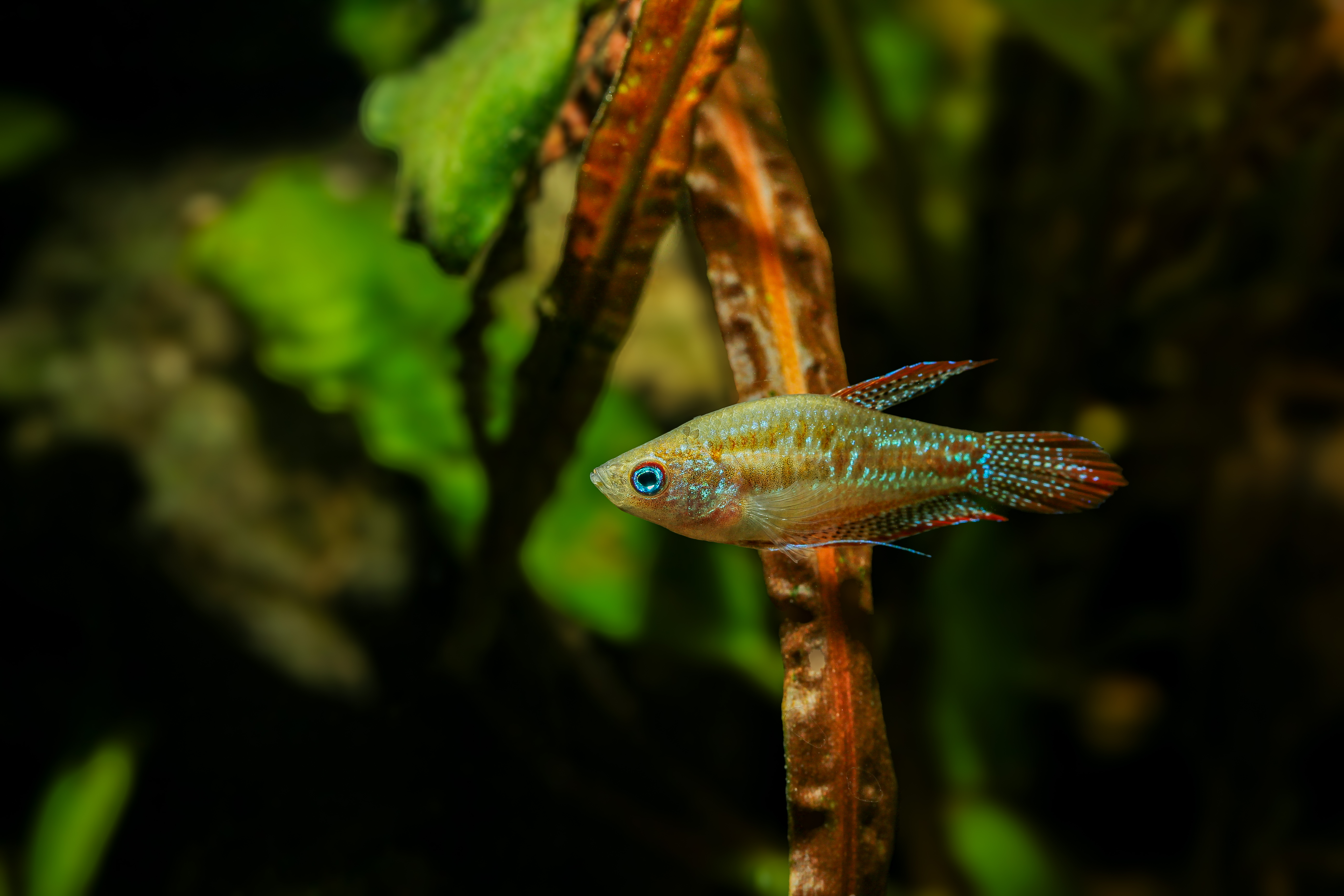
Fact File
Sparkling gourami
Scientific name: Trichopsis pumila
Size: 4cm (1.5”)
Origin: Found across Cambodia, Thailand, Vietnam and Laos within the lower Mekong River basin
Habitat: Found in a range of habitats including but not limited to: floodplains, canals, small tributaries, roadside ditches and peat swamps. Shows a preference for areas with dense aquatic or marginal vegetation.
Tank size: 30x30x30 for a pair (12x12x12”)
Water requirements: 6-7.5 pH with less than 15°H
Temperature: 22-28°C (71-82°F)
Temperament: A generally peaceful fish although males may squabble, suited to a community of small fishes. Easily out competed by larger boisterous fish so these should be avoided. Will eat small ornamental shrimp.
Feeding: In the wild likely to predominantly consume invertebrates. In home aquariums they will readily eat prepared foods like flakes and pellets but offerings of frozen or live food should be included to well-condition the fish.
Availability & cost: Regularly available although the quality can vary so it is worth shopping around. Expect to pay around £4 a fish.
3) White-seam betta (Betta albimarginata)
While I am sure many of you would have expected the beautiful domestic Betta splendens to be included in every list of nano suitable fishes, many may be unaware of several ‘wild’ bettas that are also suitable. So, while B. splendens do make great nano inhabitants I am going to use my 3rd and 4th choice to introduce a different Betta species to you. For those that like the idea of seeing tiny fry emerge from hiding amongst leaf litter, the stunning B. albimarginata are the fish for you. These are a species of mouthbrooding Betta and the male will hold the eggs in his mouth until they hatch after about 2 weeks. Males and females can be kept together in nano tanks permanently with a pair being perfect for the aforementioned tank. While aggression is not really a concern between the pair, you may need to separate them if you notice the male is breeding himself to starvation as he does not eat during incubation. These fish absolutely need soft acidic water though, so if you don’t have this or a reverse osmosis unit, you are best to avoid keeping this stunning fish for now.
I look after B. albimarginata in a very similar way to how I care for liquorice gourami (Parosphromenus spp.). You can find out all about these gouramis by reading why I think they make great additions to your first blackwater aquarium.

Fact File
White-seam betta
Scientific name: Betta albimarginata
Size: 3cm (1.2”)
Origin: Endemic to eastern Borneo, Indonesia
Habitat: Found in shallow, flowing streams but not turbulent, in areas with thick layers of leaf litter, detritus and marginal roots.
Tank size: 45x25x25 for a pair (18x10x10”) although the height is less critical.
Water requirements: 4-6.5 pH with less than 5°H
Temperature: 23-28°C (73-82°F)
Temperament: A generally peaceful fish and in larger tanks could be housed in a calm blackwater community tank with small rasboras. Larger, or overly active species should be avoided and in nano tanks it is best to keep them as a pair.
Feeding: Feeds on small aquatic and terrestrial invertebrates in the wild and this should be offered in the form of live or frozen foods in captivity. Over time fish will settle and accept dry, prepared diets but this should not completely replace a more natural diet.
Availability & cost: Rare to find in stores unless a customer has requested it. They are fairly easy to breed once settled so it is worth asking around local clubs and stores to find a good quality source. Expect to pay £50 a pair.
4)Cresent betta (Betta imbellis)
The second of my alternative betta choices is the crescent betta (Betta imbellis). I have picked this one as it contrasts nicely with the previous species, as this one is bubble nester (just like the B. splendens!). Not only this, but it is not such an extreme acidophile being found in waters with a pH of 7.5 and even in some cases brackish swamps! So, while this still is possibly not a species for those with liquid rock, it can certainly tolerate some hardness in the water, but its best to avoid creating brackish conditions unless you know your fish originated from these locales.
The crescent bettas have been hybridised with other closely related Betta species in captivity to alter their appearance. If this bothers you and you want a pure B. imbellis they are available if you shop around. Helpfully, each collection location of this fish look slightly different, so many hobbyist breeders will label their fish with this to help keep lines correct, so should you see for example B. imbellis ‘Penang Island’ you will likely have found a non-hybridised fish.

Fact File
Crescent betta
Scientific name: Betta imbellis
Size: 6cm (2”)
Origin: Found in Thailand, Malaysia, and northern Sumatra but some feral populations have been established through ‘accidental’ release.
Habitat: Found in a variety of habitats all possess slow or stagnant water. The substrates can be composed of leaf litter, mud or sands with marginal and floating vegetation often present.
Tank size: 30x30x30cm (12x12x12”) for a lone fish, whilst 45x25x25cm (18x10x10”) is suitable for a pair should you have a spare tank in case they need to be separated at any point.
Water requirements: 5-7.5 pH with less than 10°H ideally.
Temperature: 20-28°C (68-82°F)
Temperament: Best kept as a single male or a confirmed pair in nano aquariums depending on the exact dimensions of the tank. Generally less aggressive than domestic B. splendens, although, B. imbellis lines have been selectively bred in captivity for aggression as well.
Feeding: Feeds on small aquatic and terrestrial invertebrates in the wild and this should be offered in the form of live or frozen foods in captivity. They will accept dry, prepared diets especially if captive bred, but this should not completely replace a more natural diet.
Availability & cost: Rare to find in stores unless a customer has requested it. They are fairly easy to breed once settled so it is worth asking around local clubs and stores to find a good quality source. Expect to pay upwards of £40 a pair.
5) Endler's guppy (Poecilia wingei)
While you’ll see the slightly larger guppy (Poecilia reticulata) in almost every fish store you visit, it may take you a few trips to find the wonderful Endler’s guppy (Poecilia wingei) and even then, you may actually be seeing hybrids of the two species. However, this does not overly matter as you’ll be sure to get some absolutely beautiful and colourful fish either way, well that is if you buy males. These fish are little bullets of colour growing to just over 2cm (1”) in length they never stop moving and add activity all over the aquarium. The females, however, are about twice this size and drab grey in colour.
Being livebearers, it’s always best to keep either all males (although there is some disagreement that this might increase their stress levels) or 2-3 females per male to spread out their constant harassment. Should you choose to keep both sexes, fry are almost guaranteed but some will be consumed by their parents. The addition of floating plants will help increase survival as fry natural hide at the water’s surface.

Photo by Shutterstock
Fact File
Endler’s guppy
Scientific name: Poecilia wingei
Size: Males to 2.5cm (1”), females to 4.5cm (1.8”)
Origin: Restricted to Campona and Cumana, Sucre State, Venezuela.
Habitat: Highly adaptable and found in pools, ditches, limestone springs, swamp and more.
Tank size: 30x30x30cm (12x12x12”)
Water requirements: Will accept anything but soft and acidic conditions. Somewhere between 7-8.5pH and 10-35°H will work well.
Temperature: 20-28°C (68-82°F)
Temperament: Peaceful, great in a community tank, great in a species tank.
Feeding: Omnivores, though food offered should be fine. Flakes and micropellets accepted, as are small live and frozen foods.
Availability and cost: Pure bred fish very hard to find, ‘Endler guppy’ hybrids from around £3.95.
6) Pygmy 'corydoras' (Gastrodermus pygmaeus)
While the wonderful pygmy cory is no longer a Corydoras, they still have all the character you’d come to expect from these friendly catfish… all wrapped up in a tiny body! These wonderful additions grow to 3cm (1.2”) and will inhabit both the substrate and midwaters which is unusual for many catfish. They may not have the colour of some of my previous suggestions, but as many of you will know I am rather fond of grey and brown fish so I had to include one of them!
You could keep a decent sized shoal of pygmy corydoras in a 45cm tank and decorate it with fine sand and whatever else takes your fancy as they do just as well in planted aquariums as they will in a botanical one, and to be honest I am sure they won’t mind the plants being plastic! These also make great breeding projects and following the standard cory breeding tips of cool water, water changes you should have success! I distinctly remember a mature shoal of them spawning readily in a shop’s sales takes when I was in the trade, they covered the glass and java moss in their small eggs although none survived to hatching due to their tank mates. While you could keep these with other small fishes, in a nano tank I would edge on just keeping a larger shoal of these characters, you’ll see more natural behaviours and may even see some babies emerge without really trying!

Photo by Shutterstock
Fact File
Pygmy cory
Scientific name: Gastrodermus pygmaeus
Size: To 3cm (1.2”)
Origin: Rio Madeira basin, Brazil
Habitat: Prefers pools and flooded forest to flowing water, often found in tandem with
debris and leaf litter
Tank size: 45x25x25cm (18x10x10”)
Water requirements: Slightly soft and acidic to slightly alkaline water; 6.0-7.4pH, 2-8°H
Temperature: 22-25°C (71-77°F)
Temperament: A peaceful shoaling catfish, not to be kept with fish with large mouths.
Feeding: Enjoys small live and frozen food such as cyclops and baby brine shrimp as well as small dried foods.
Availability and cost: Quite a straightforward find, if a little seasonal, prices from around
£3.50
7) Clown Killifish (Epiplatys annulatus)

While many killifish species will work in nano aquariums, I have chosen the clown killifish, or rocket panchax (Epiplatys annulatus), for my top 10 list as it is generally readily available in shops and has a decent life span unlike some of the annuals. The contrast between the vibrant and flamboyant tail and the subdued black and white body makes these fish an instant eye catcher. There is no surprise then that when I kept this fish, the photos and videos posted on social media always outperformed many of my other species.
Along with the gourami and bettas, this is a species that definitely needs a tight-fitting lid to prevent them from jumping out!
Fact File
Clown killifish
Scientific name: Epiplatys annulatus
Size: To 3.5cm (1.4”)
Origin: West Africa, including southern Guinea, Sierra Leone and northwestern Liberia.
Habitat: Found in swamps, streams and slow moving rivers often associating with aquatic or marginal plants.
Tank size: 45x25x25cm (18x10x10”)
Water requirements: Requires soft and acidic water to thrive; 4.0-7.0pH, 1-8°H
Temperature: 20-26°C (68-79°F)
Temperament: A peaceful, small, fish that can easily be outcompeted by bigger more boisterous fish. Should be maintained in a group.
Feeding: Takes to prepared diets well but the addition of frozen and live foods will get the best conditioned fish.
Availability and cost: Availability seems to fluctuate but generally available with prices from around £3.00 each.
8) Chilli rasbora (Boraras brigittae)
While any Boraras species could be added here, everyone has their own personal favourite, so I of course used my personal favourite for this list. That is the chilli or mosquito rasbora (Boraras brigittae). I have had a shoal of around 30 in one of my aquariums for the last few years and I continue to be blown away by how vivid their red colouration can become once settled. Chilli rasboras are bold and brave despite their small size, and really don’t take long to confidently strut their stuff in the middle of the aquarium adding colour and movement to planted aquariums and biotope inspired layouts. Their small size means you can keep a group of 10-15 individuals in a nano tank meaning you still get to see them at their best.
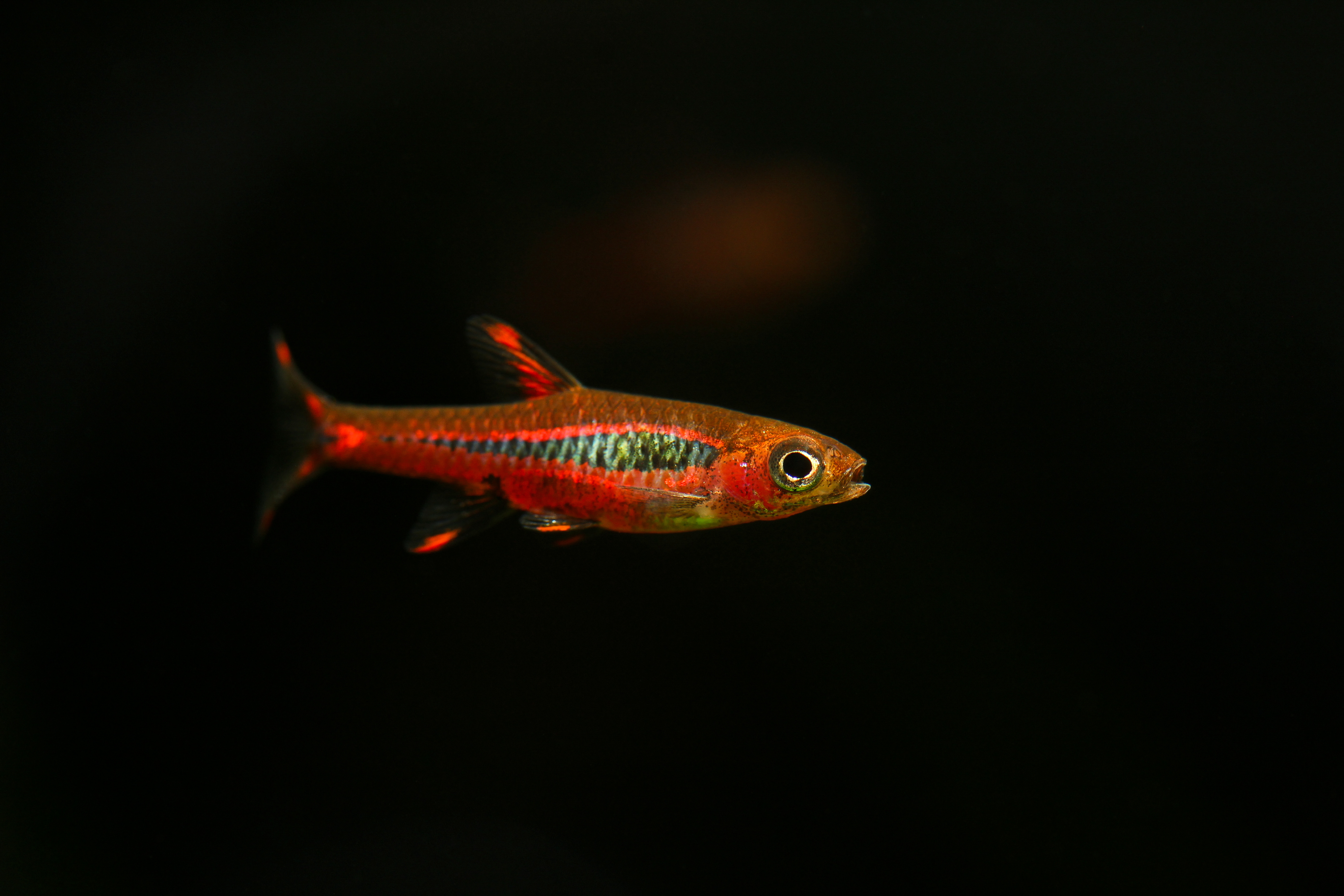
Fact File
Chilli rasbora
Scientific name: Boraras brigittae
Size: To 1.8cm (0.7”)
Origin: Indonesian (South-eastern Borneo, Kalimantan Tengah and Kalimantan Selatan).
Habitat: Found in the tinted waters of peat swamp forests.
Tank size: 30x25x25cm (12x10x10”)
Water requirements: Requires soft and acidic water to thrive; 4.0-7.0pH, 1-10°H.
Temperature: 20-28°C (68-82°F)
Temperament: Due to it’s small size tank mates are restricted to those that will not view them as food. They do make excellent dither fish for shy anabantoids and can be mixed with freshwater shrimp as only the smallest of baby shrimp will be at risk of being eaten.
Feeding: The brightest colours can be achieved with providing appropriately small live and frozen foods like baby brine shrimp. They will do well on good quality prepared diets too.
Availability and cost: Commonly seen in shops, expect to pay upwards of £3.00 each.
9) Green neon tetra (Paracheirodon simulans)
Like with Boraras, everyone will have their own favourite Parachierodon. While I can’t really argue that the cardinal tetra (P. axelrodi) has the more intense colouration, when it comes to stocking this genus in a nano tank every millimetre counts! The green neon tetra is probably the least common of the three species, and while it displays the least vibrant red pigmentation, it is the smallest, reaching a maximum of only 2.5cm. In comparison the standard neon tetra (P. innesi) can get to 3cm and the aforementioned cardinal tetra is even bigger at 3.5cm. This means, while I would probably want a 60cm or bigger tank for the two larger species, a shoal of green neon tetras can do well in nano tanks of 45cm long.

Fact File
Green neon tetra
Scientific name: Paracheirodon simulans
Size: Usually reach 1.5cm (0.6”) but females can get to 2.5cm (1”).
Origin: Found across Brazil, Colombia and Venezuela.
Habitat: Occurs in swamps, blackwater rivers, clear streams with dense aquatic plants and algae.
Tank size: 45x25x25cm (18x10x10”)
Water requirements: Very soft and acidic water; 3.0-6.5pH, 1-10°H
Temperature: 23-35°C (73-95°F)
Temperament: Peaceful, nervous fish that is a poor choice for busy community tanks
Feeding: Unfussy, but foods need to be small. Baby brine shrimp, microworms and Cyclops always appreciated alongside small pellets.
Availability and cost: Not as common as their close relatives, prices starting from £3.50 usually
Related article: How to breed neon tetra
10) Neon blue rasbora (Sundadanio axelrodi)
I could not follow the vibrant colours of a green neon tetra with anything other than another similarly bright blue nano fish. This time we are back over to South East Asia with the stunning neon blue rasbora. With a similar appearance of reds and blues working in harmony, these fish are the perfect alternative to Paracheirodon for those wanting an Asian theme rather than South American.
They also reach a little over 2cm in length and their care is similar to the rasboras from the Boraras genus we encountered earlier although, they are a little fussier in terms of strictly requiring acidic conditions. Males and females can easily be identified as the anal fin of males is pigmented and the females is clear. Supposedly the males have another difference, in that they are able to make an audible croaking noise when stressed. Like with the sparkling gourami, I have not personally heard the noises they make due to the hum of an operating fish room masking any other noise.
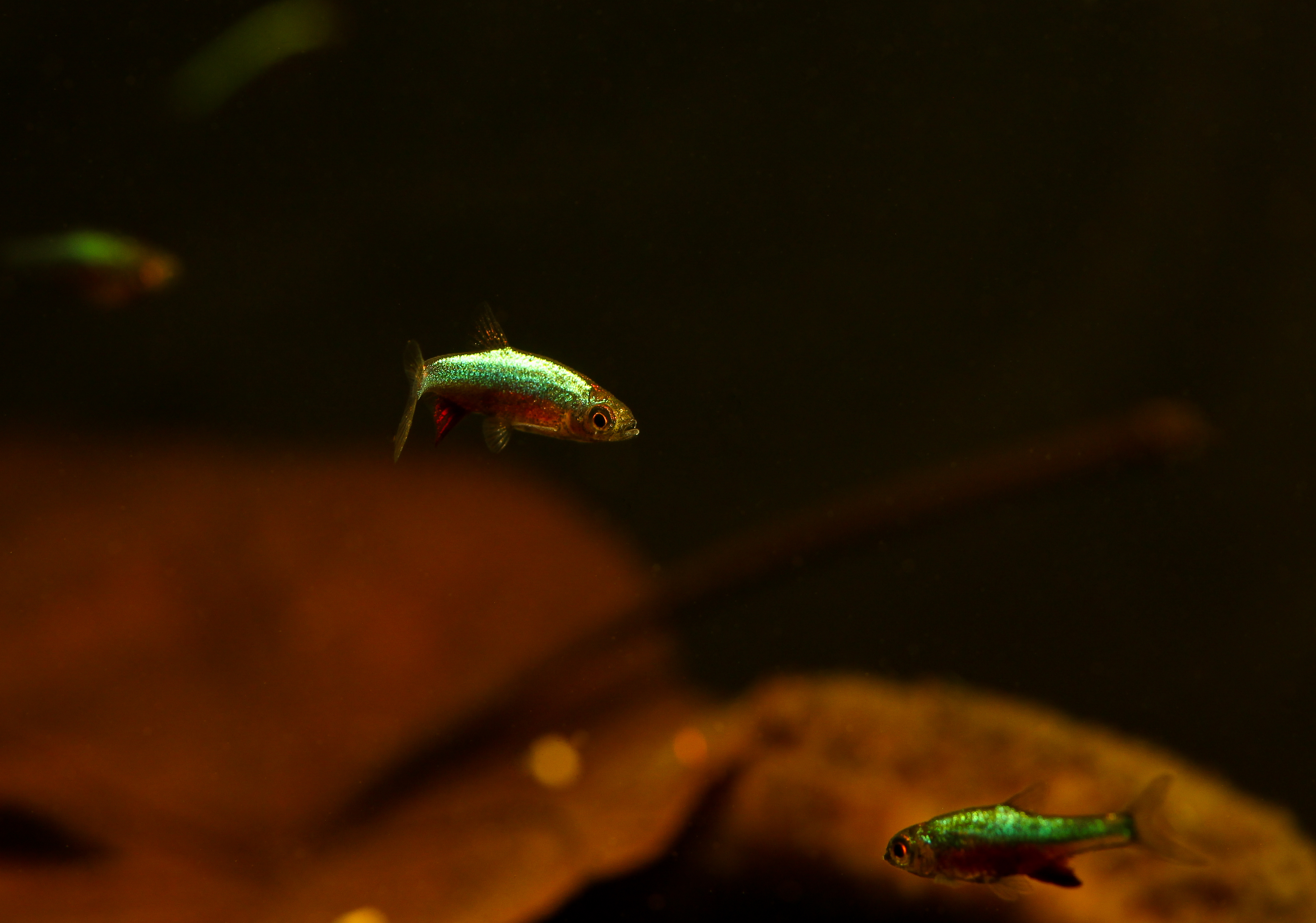
Fact File
Neon blue rasbora
Scientific name: Sundadanio axelrodi
Size: Usually reach 2cm (0.8”)
Origin: Found in Indonesia, across Sumatra, Borneo and Bangka island.
Habitat: Occurs in the threatened peat swamp habitats.
Tank size: 30x25x25cm (12x10x10”)
Water requirements: Very soft and acidic water; 4.0-6.5pH, less than 5°H
Temperature: 23-26°C (73-79°F)
Temperament: Peaceful and can be kept alongside other small, calm fish that appreciate the acidic conditions.
Feeding: Live and frozen foods are always appreciated like Daphnia and baby brine shrimp. Will usually take to prepared foods just fine.
Availability and cost: Not too common to see in shops due to their housing requirements, prices starting from £3.50 usually
Check out our latest Digital Subscription Offers to make sure you never miss an issue of Practical Fishkeeping!