


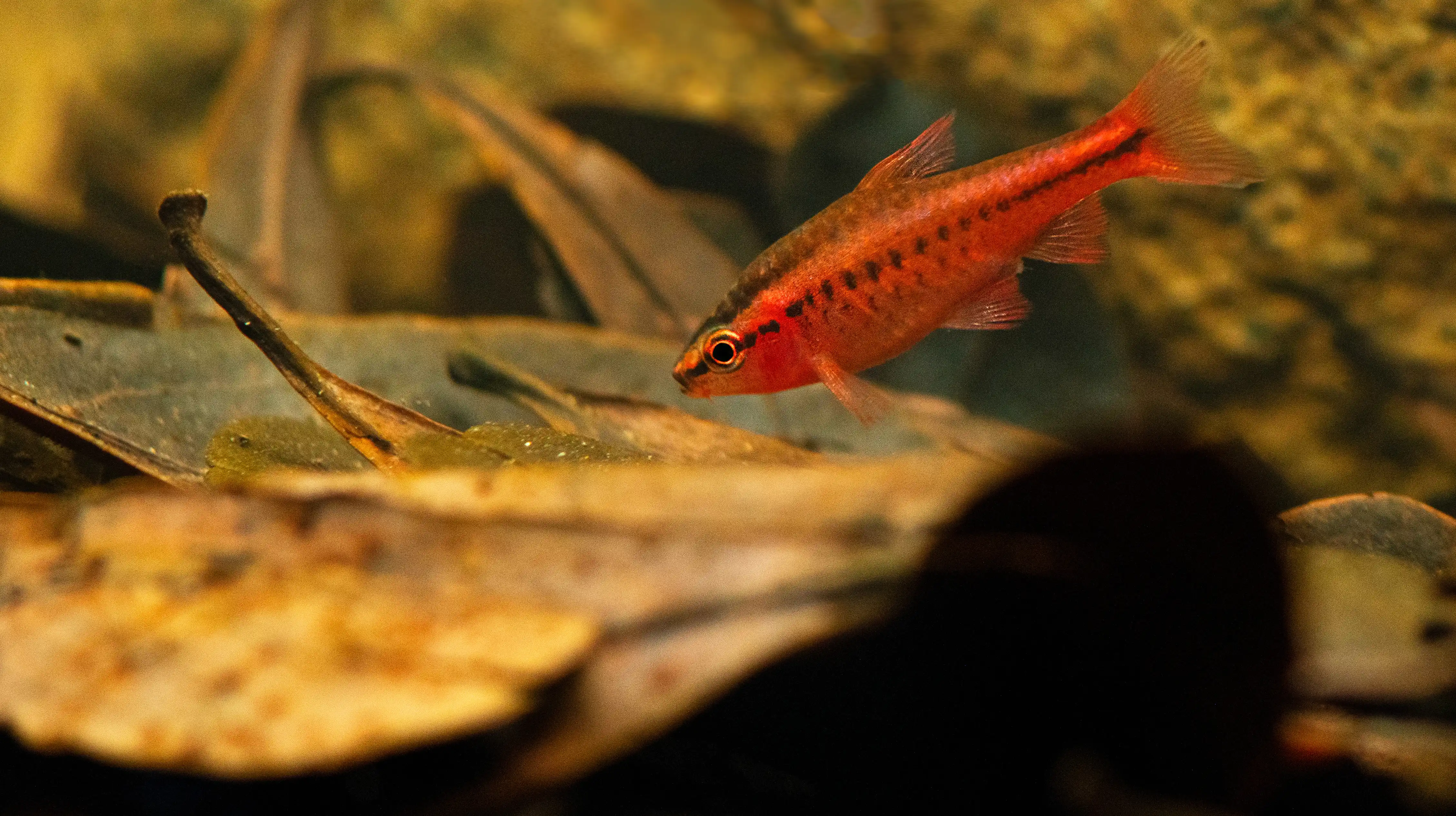
Tai helps one of our readers to design a biotope aquarium based on a Sri Lankan stream for the wonderful cherry barb.
I’m considering setting up a 125-litre (27 gal) biotope based around a Sri Lankan stream for cherry barbs. My pH is 7.4 and hardness 7-9°H. Advice would be welcome on how to set it up and some suitable tank mates for the cherry barbs please.
HOLLY ARCHER
Tai's advice on setting up a cherry barb biotope
A cherry barb biotope is a great idea! Hardy, beautiful, affordable and happy in cooler temperatures, these are wonderful fish.
Almost all the cherry barbs (Rohanella titteya), you come across in the shops are tank-bred. Therefore, they are quite adaptable to a range of water chemistries. So, as long as you slowly acclimatise them, they will be happy in your water.
My friend Hirun Nethmal kindly sent me videos of a cherry barb habitat. Here they swim over rusty brown-orange stones, with a soft, warm, fine sandy substrate and some leaf litter.
A few aquatic plants are present, which look like a Cyperus species. Along the banks large-leaved plants, like huge peace lilies (Spathiphyllum wallisii), spill into the water. I used these scenes to develop my own biotope which may be a useful template for you, and I’ve included a photo below.
Various house plants can grow out the top of our aquariums. One way of adding them is by using little plant holders which hook on or suction to the side of the tank. They keep the stems and leaves out of the water and let the roots grow submerged.

Related article: Have you kept these five underrated barbs?
Building a Sri Lankan stream biotope
In your tank, reddish round stonework, with a sandy substrate such as JBL Sansibar Orange would look authentic. Add a scattering of botanicals like magnolia, bamboo and catappa leaves to complete to look.
You could add a Nymphaea species, such as N. stellata, fertilised by root tabs in the sand, to provide cover for the fishes. Sri Lanka is famous for its Cryptocorynes species. However, these easy to grow plants don’t appear to occur much in the cherry barb’s habitat.
However, you could attempt to source C. ciliata and watch it slowly grow huge in an emersed state. These will mimic the large leaf plants that occur in these streams. Use a reptile fogger to add mystery to the display!
Cherry barbs are sociable rather than schooling fish. Males will hold territories and attempt to attract a mate. While you won't see them swimming around their tank together, they do still appreciate being in a group.
Related article: How to set up a barb and Cryptocoryne tank on a budget.
Tank mates for cherry barbs
Cherry barbs are an ideal community fish and mix well with many species. So for a standard community tank there are plenty of options. For a biotope we are a little more limited.
Possible tank mates from the region include:
- Green panchax (Aplocheilus blockii), but ensure you use a lid to avoid them jumping.
- Ceylonese combtail (Belontia signata) are an interesting options but for a group you'd need a larger tank. Males are aggressive towards similar fish. Pictured below (Photo by Shutterstock)
- Cumming’s barbs (Pethia cumingii) have more neutral pigments complementing the bright colours of the cherry barbs.
- Fire rasbora (Rasboroides vaterifloris) are uncommon in the aquarium trade but would make for a fascinating display.

For those with a larger aquarium there are a few other options to consider:
- Giant danios (Devario malabaricus)
- Garra ceylonensis
- Black ruby barbs (Pethia nigrofasciata) pictured below (Photo by Shutterstock)
- Two-spotted barb (Plesiopuntius bimaculatus)
- Slender rasbora (Rasbora daniconius).

Related article: Simple biotope aquarium ideas for beginners.
More cherry barb biotope inspiration
Some years ago, former PFK editor Jeremy Gay visited Sri Lanka. He wrote two articles for the magazine, one on the habitat and another on creating a shallow biotope display.
Both of these remain available online. Jeremy’s words and photos regarding the habitat are particularly helpful, while his biotope idea is wonderful.
You can read his feature on the Sri Lankan stream biotope here.
You can read his feature on building a Sri Lankan biotope here.

Male cherry barb top, female cherry barb bottom, Photo by Shutterstock
Cherry barb fact file
Scientific name: Rohanella titteya
Size: Up to 4cm (1.6")
Origin: Southwestern Sri Lanka in Asia.
Habitat: Shaded streams, deep within rainforests. Aquatic plants are scarce in their natural habitat.
Tank size: 60x30x30cm (24x12x12")
Water requirements: Captive bred fish are adaptable. Water with a pH of 6.0-7.8 and below 20°H will work well.
Temperature: 18-27°C (64-81°F).
Temperament: Calm and peaceful, making them perfect for community aquariums.
Feeding: Omnivore: naturally consuming detritus, algae and diatoms, small worms, crustaceans and plant matter. In aquaria, prepared foods and smaller live and frozen foods work well.
Availability and cost: Common and available in most aquatic stores, from £2.50.
Some of the links provided are affiliate links which we may earn commission from if you make a purchase via the provided link. This will not cost you extra.