


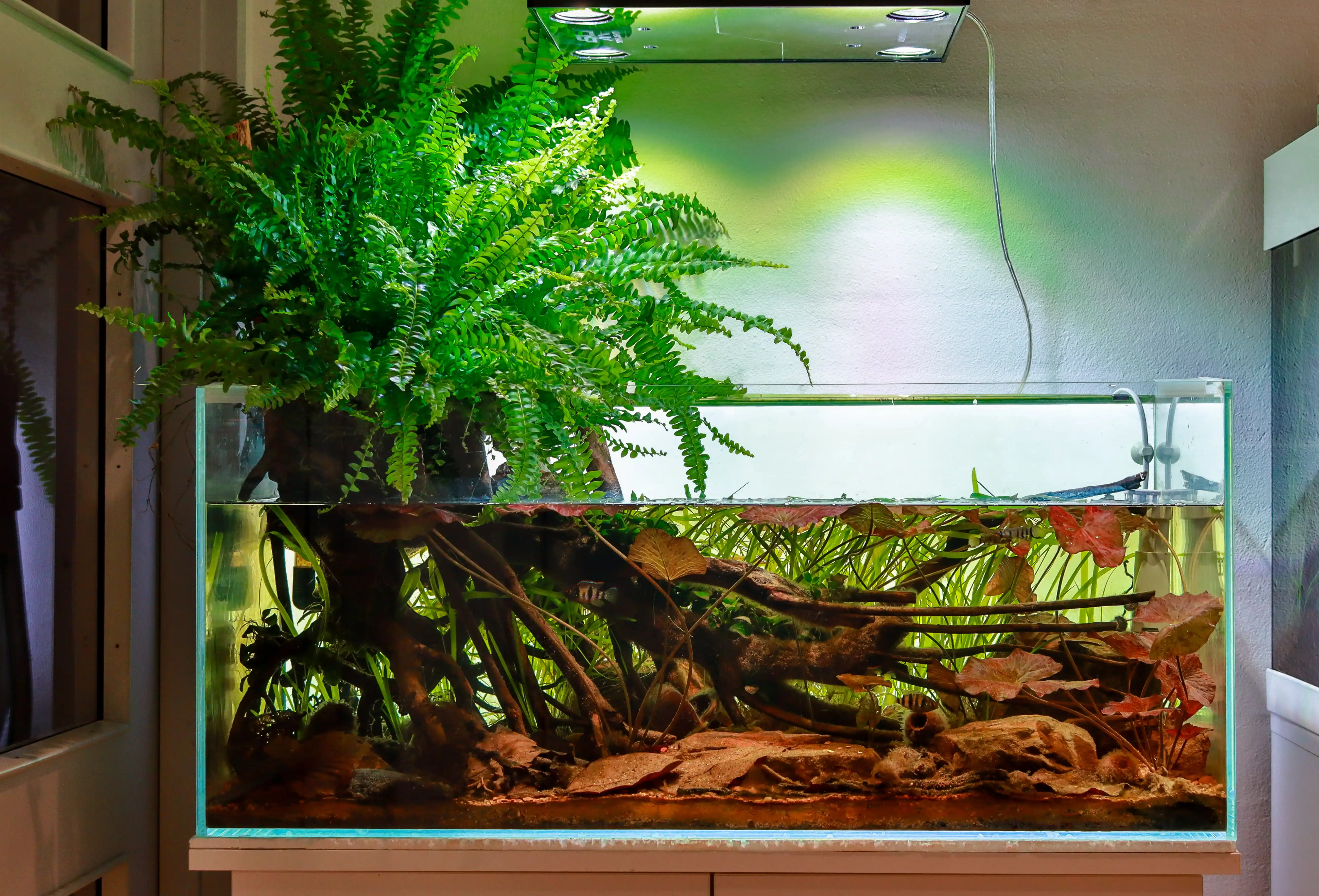
Utilising houseplants in aquariums can add visual impact and help with water quality. Alex outlines his top 5 terrestrial plants to use.
The use of bright green foliage growing out the top of an aquarium is something we are seeing more and more. You can see a stunning example by David Nørholm at the top of the page.
House plants can elevate an aquascape or better replicate natural habitats in biotope aquariums. They can also help control nutrients in community tanks , potentially improving water quality in much the same way as aquarium plants.
As their leaves are above the water, they often have brighter light and direct access to atmospheric CO2. This means they can grow rapidly, just like floating plants. If your aquarium light sits just above the water level, and the location of the tank doesn't receive much ambient light, an additional grow light above the plant may be required.
All that growth creates a demand for nutrients. Plants can take up these nutrients through their roots from the aquarium water, with nitrate and phosphate being particularly relevant to aquariums. Fast-growing plants can therefore act as a useful form of nutrient export, although they shouldn't be considered a replacement for filtration and regular aquarium maintenance.
How to add house plants to your fish tank
The process of adding these terrestrial plants to your aquarium is relatively easy.
Simply head to a store that sells house plants and browse what is available. Some aquarium and reptile stores may have a selection, as well as house plant specific shops and garden centres. There are many plants that tolerate having their roots in water, as well as the warm, humid conditions above a fish tank, but we've picked out our favourite five plants below to help give you some ideas.
Once you have bought your plants home you'll need to remove all of the growing medium, and then thoroughly wash the roots to remove any remaining soil. Next, while you've got clean water to hand, give the leaves a good wash to help wash away any dust and materials from their surface.
Equally, you can take cuttings from your existing indoor plants and they will often happily root into the aquarium. Just ensure the parent plant has not been treated with pesticides or other potentially harmful chemicals.
Top Tip
Avoid any plants that have been treated with pesticides, insecticides or other chemicals unless you know that the treatment is safe for aquarium use. Ask the shop whether the plants have been treated and, if they have, walk away and look elsewhere.

Washing off soil from the roots is an important step, Photo by Shutterstock.
You need to ensure only the roots are in the water when adding your live plants to your tank. Otherwise the upper portions of the plants, like the stems, crown and leaves, can rot when submerged. Remember these are not true aquatic plants.
You can ensure only their roots are in the water by attaching the plants to hardscape above the water line in a similar way that you would with epiphytes. Equally, you can use the following products to keep them in place:
- Plant clips are available which can hold multiple stems and clip onto the rim of your tank. These are great for open-topped aquariums but might not work if you have a thick pelmet around your fish tank.
- Airline suction cups can work in a similar way, holding a stem at the right height. Usually, these are clear, so they don't detract from the aesthetics of your aquascape.
- Hang on the back filters and breeder boxes can also be good homes for house plants. They provide an area of shallow water where you can place your plants.
Related article: 5 easy and beautiful stem plants
Top 5 houseplants for your aquascape
When choosing house plants for your tank, look for species that naturally tolerate consistently moist conditions and high humidity. Plants with a tolerance for having their roots submerged are particularly useful. Avoid plants that require their growing medium to dry out between waterings, or species that are known to be sensitive to prolonged wet conditions.
Here are my favourite terrestrial plants to use above my aquariums:
Boston ferns
I absolutely love the look of ferns; however, I often struggle to grow them in pots for some reason. We have all witnessed beautiful riverbanks covered in moss and ferns, and these can be inspiring. One of my favourite tanks is my blackwater aquarium with a dense canopy of Boston ferns.
Mine did sulk for a bit while they adjusted to life above an aquarium, but they soon began to thrive. They are native to the Americas, but are now found in many other parts of the world. Their generic fern-like appearance can evoke the look of ferns found in natural habitats without requiring a specific, hard-to-source species.
I tied mine to branching Talawa wood that reached above the water surface. I suspect part of the initial sulking was because not enough of their roots were in the water, but as the roots grew down towards the aquarium, the ferns began to thrive.

Pothos, devil's ivy
Plants from the genus Epipremnum are extremely popular for growing out of aquariums. The species most commonly sold as pothos or devil's ivy is Epipremnum aureum. Their stems are well suited to the clips and airline suction cups. They can even grow up light fixtures, adjacent shelving or hardscape structures.
Epipremnum aureum is native to the Society Islands of French Polynesia, but has since been introduced to tropical regions around the world. It is such a beautiful and adaptable plant that I wouldn't limit it to biotope-correct tanks — I can't imagine there are many Society Island biotopes around! Its generic tropical appearance works well in all sorts of biotope-inspired aquariums.

Peace lily
These plants love humidity, so what better place to be than above a warm body of water? Their wide, dark green leaves and white flowers give an attractive tropical look. Again, you can expect some sulking when they are transitioned from growing in soil to having their roots in water, but they should bounce back once established.
Spathiphyllum wallisii is native to Colombia and Venezuela so would work well in a South American themed tank, but as above it can be used in any biotope to give that tropical jungle look above the water line.
With good light and access to nutrient-rich aquarium water, these plants can grow strongly and may produce flowers readily.

Photo by Shutterstock
Ficus pumila
This is one that I have not seen used often in aquariums but I absolutely love in one of my tanks. I picked up a small plant pot designed for use in terrariums. The leaves are much smaller than the plants above, measuring around 3cm (1.2").
This small Ficus species creeps and climbs hardscape effectively and the sprawling greenery can even spread down under the water, which really does look incredible. The submerged leaves may not last forever, as it is not an aquatic plant, but it really gives the impression of a flooded forest floor.
Native to East, and Southeast Asia, but now in many other locations, this is superb for an Asian biotope.
Be careful though, breaking the leaves and stems during maintenance releases the sap which can cause skin irritation. Always wash your hands thoroughly after touching it. Similarly, it is toxic when ingested, which isn't as much of a concern for us, but it is for our furry pets! Keep it up and away from dogs or cats, and symptoms following ingestion include mouth pain, excessive drooling, vomiting, and diarrhea.
I have seen no ill effects from using it in my aquariums.

Monstera spp.
A classic houseplant, and a classic choice for an aquarium. Monsteras are available in a range of forms, including variegated cultivars that can add extra visual interest. However, if you're aiming for a strictly accurate biotope, these cultivated forms won't quite fit, as you aren't going to find a nursery-produced variegated Monstera growing naturally in the wild.
Living in tropical, humid environments, Monsteras are well suited to life around an aquarium. The genus naturally occurs in Central and South America, so it can work particularly well in a South American-themed or biotope-inspired aquarium. Of course, you don't have to restrict it to these setups – its large, lush leaves can give almost any aquarium that tropical jungle look above the water line.
For a particularly natural effect, allow the plant to climb or spread across hardscape above the water, with its roots reaching down into the aquarium. Some Monsteras are particularly large and are therefore better suited to larger displays – think discus tanks not pygmy corydoras.

Photo by Shutterstock
To learn how to also grow plants underwater, check out our beginners guide to growing healthy aquarium plants.