


Aquariums set up purely for marine fish are in decline, with many hobbyists opting for the more challenging reef environment. But this means you miss out on some of the best fish, says Jeremy Gay.
As a new marine keeper you encounter a vast array of beautiful livestock options. However, you are likely to experience store staff telling you many of them aren’t suitable for your reef tank. Most people these days opt for a reef system – but some of the best fish aren't suitable for such a set-up. I’ll take the opportunity here to highlight some of the best marine fish, that have the most character.
Easy to keep saltwater tanks
Lionfish, puffers, triggers, moray eels; they are all large, colourful fish with interesting shapes. They have loads of character and they are archetypal tropical marine fish. Yet increasingly we give them a miss in favour of reef-safe specimens that don’t have as much character. Perhaps, the only important thing is they won’t munch corals either.
However, if you think about it, a fish-only tank is the most suitable choice for some new fishkeepers. They only have to concentrate on the fish and don’t need to consider other factors that complicate life for a reefer. These include: watts per litre of lighting, calcium, magnesium and alkalinity and, well corals in general.
One of the most common problems facing new marine keepers is stocking a tank too quickly. Whether that is with live rock, fish, corals, or a combination of all three. Whitespot then develops and trying to tackle it with a weak, coral-friendly parasite treatment is a right pain.
Keep only fish, quarantine them and keep an eye on pollutants, simple. These tanks are less expensive and a lot less hectic! Despite what we think, some marine fish are actually as tough as hardy tropical fish!
With no inverts to worry about you’ll find that marines tolerate a wide range of temperatures and salinity. Some fish will cope surprisingly well with high levels of nitrate too. In fact, keep marine fish in a lower salinity and they will be far less likely to develop whitespot in the first place.
A fish-only marine tank can be just like keeping tropicals. Use filtration to deal with the waste, change the water regularly, keep an eye on health, and add salt. You can even buy ready mixed seawater!

Butterflies
I’ve included butterfly fish not because of their character, but because they are just simply not suitable for a reef tank. So, if you own a large fish-only tank you have to take advantage and keep these fish. If butterflies were reef safe they would be as popular as yellow tangs. Unfortunately, seeing as most aren’t and some are specialised coral polyp eaters, they remain exclusive.
The trophy fish has to be the Golden butterfly, Chaetodon semilarvatus (pictured above). This fish is one of the most outstanding marines you are likely to see and are sometimes available in pairs which is even better. They may not be massive on personality, but fish-only marine tank is not complete without a butterfly species!

Triggerfish
These are a group high on entertainment, colour, shape and character. The Picasso trigger (above) is one of my favourites and is hardy, colourful and doesn’t get too large. Scott Michael once said “a species for modern art lovers or anyone who desires a fish that thinks it’s a dog.“ I think this is the perfect advert for this fish.
Picassos will eat any meaty foods. Large triggers as a whole can even demolish live rock and eagerly crunch their way through purple, coralline algae. Similar looking and behaving triggers include the Arabian Picasso, bursa and the rectangular — Hawaii’s unofficial state fish. Known by the locals as humuhumunukunukuāpuaʻa, this brilliant name means ‘fish with a pig's nose’ in Hawaiian.
The undulate trigger is perhaps even more boisterous yet equally easy to keep. It won’t mix with as many other species as the Picasso though.
The Clown trigger still demands a high price even at small sizes, grows large, and lives for a long time. You can mix them with some rather large companions as they will easily hold their own. Again, they won’t be fond of any other triggers in the same tank.
Queen triggers are hardy, but grow huge and can be extremely aggressive.
Lionfish
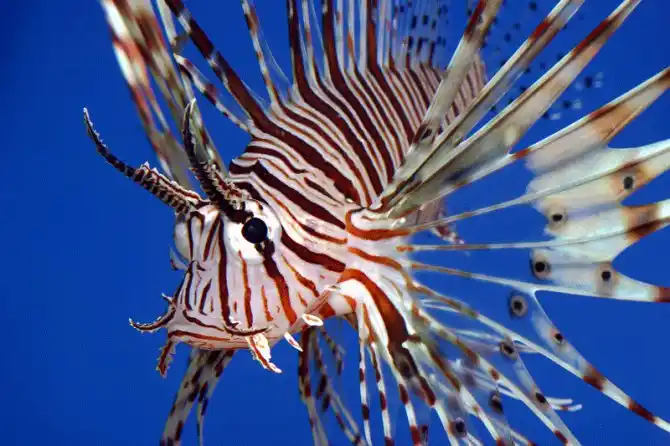
These have been in the marine hobby for as long as the hobby itself. Few fish are as well known, even by non-fishkeepers. Most familiar is the large volitans lionfish, (pictured at the top of the page) which is also one of the easiest to keep. Lionfish are always quite reasonably priced and, with their lavish fins, you get quite a lot of fish for your money.
They certainly have character, but they also have venomous spines, so you always need to treat this fish with respect. Make sure they are either at the other end of the tank or partitioned off when undertaking tank maintenance.
I kept a volitans for some time in a reef tank, just with all the small fish and shrimp removed.
As they glide over the reef they look superb and adopt a head-down posture to hunt. Mine adopted a head-up posture to take cockles as soon as they hit the surface. One day, its lunge made a jet of water shoot from its mouth and straight into the workings on my metal halide suspended above.
A loud bang followed, and the house was instantly dark as the electrics tripped out. Great fish though and one day I would like to keep a group of them.
Related article: Keeping the fuzzy dwarf lionfish

Marine pufferfish
With a massive freshwater following as well, puffers have got to be some of the best character fish. They’ve got it all — weird shape, weird swimming style, huge eyes that look comical when they face forwards and focus on prey, and some have great colour too.
If you had to choose the ultimate marine fish pet, this would be it. Interaction with owners is second to none and I have even seen them backswim, spit water and do tricks while begging for food.
Pufferfish from the genus Arothron (A. hispidus pictured above) are easier to keep than the smaller Canthigaster species. They have much more character too. Perhaps the best known of the large pufferfish is the porcupine or spiny, Diodon holocanthus.
I love spiny puffers as they are cute, colourful and entertaining, and would dearly love to keep one — but they do grow large. The books state a maximum aquarium size of around 30cm (12”). In the wild these fish can reach 91cm (36”), making them only suitable, ultimately, for public aquaria.
Other well-known puffers are the spotted dogface and panda, though newly imported fish can refuse to feed. Once acclimated they are fine, but make sure they are feeding if you fancy buying one. A. hispidus has all the familiar marine puffer traits, including sulking, begging for food, spitting. Occasionally if you put your hand in, biting — but they are hardy and remain a great fish, if large at a maximum 45cm (18”).
One my favourites is the Guineafowl puffer, Arothron meleagris. Confusingly, It may appear in the shops in two colour phases. Either bright yellow with the odd patch of grey, or jet black with tiny white spots all over. Both look stunning and large specimens command a price tag into hundreds of pounds.
They have character and are boisterous. I find that specimens of 15cm (6”) and under are more prone to starving and whitespot than large ones.
Guineafowl puffers get super excited at feeding time and press their teeth against the glass before trying to swim at full thrust. This can generate quite a wave and, with teeth like that scraping the front glass, I wouldn’t want to risk keeping one in acrylic. These are stunning display fish for the largest marine fish-only tanks.
Related article: How do puffer fish inflate?

Wrasses
Many species of wrasse are available and lots are suitable for a large tank of character fish. The harlequin tuskfish is a highly-prized member of the wrasse family and looks stunning. The birdmouth wrasse (above) is a bizarre-looking species with large, green, males. They are an active species and almost flap around the tank with their pectoral fins.
Dragon wrasse are often available in shops as juveniles. They would be an interesting addition to the larger fish-only tank as they can change pattern completely when mature.
Wrasses from the genus Thalassoma make great fish-only additions and are active and hardy.

Large angelfish
l used to practically collect dwarf angelfish species in my marine tanks. I loved them so much, but the larger species can be even better.
The flagship large angel must be the iconic emperor angel (juvenile form pictured above). Although, the queen angelfish is not far behind on the list of iconic species.
My full list of favourites include: blue face, regal, blue ring, and even the subtly coloured six-banded. I love them all and always struggle to pick a personal favourite.
They may be aggressive and territorial towards other angels. If they decide to start picking on each other the loser may die. I had the misfortune of watching an adult emperor thumping a smaller species in a shop tank and it wasn’t nice.
The body shape and character of large angels is quite cichlid like. They definitely help to make a stunning fish-only display. Most average at 25-30cm (10-12”) in the aquarium, but the French angel is one to avoid as it gets massive.

Moray eels
I don’t think I am alone in having a healthy fear of moray eels. I have had the good fortune to keep and feed a few of them, and seen on many occasions how they take their prey apart. The most suitable species is the snowflake, colourful, stays a reasonable size and gets on with other fish.
Their iconic shape and behaviour endears them to me as much as their character. They either move at speed around the tank, or have their body tucked away in a cave barely moving. Their heads stick out observing everything going on around them.
What drives this fish’s character though must be its feeding behaviour.
I always feed morays using tongs as their dentition could seriously damage you. I lowered a set of these tools once into a deep display tank with some whitebait on the end. The fish took a second to observe the food before stretching beyond to try and take my hand instead! Take caution, as when they grab prey they can also start a death roll.
But again, it’s a great fish that deserves its place in the large fish-only tank, and one that will make a great conversation piece.
On the subject of moray eels, I reckon I have found one extremely hardy specimen. On a Merseyside shoptour in October 2006 we visited Wavertree Nook Aquarium. A great shop that recently refitted after a fire. Owner Hugh Thomas showed me the one survivor from that incident — a yellow head moray eel, Gymnothorax fimbriatus.
This amazing fish survived extreme heat, cracked tanks, toxic fumes, no power and even an extended dose of fresh water from the fire hoses. And who said marines were difficult to keep?
Related article: Why has my moray eel stopped eating?
Large marine fish to avoid!
Some fish-only species are available in the shops but make bad additions because of their eventual size. These include batfish, sharks, panther groupers, lyretail groupers, pilotfish, harlequin sweetlips and even boxfish. Always research the size and requirements of all potential purchases before you buy. Use a good reference book like A Pocket Expert Guide to Marine Fishes, by Scott W. Michael.

Setting up a tank for large marine fish
Some of these large marines can be hardy and easy to keep, but it isn’t fair to keep them in too small or polluted housing.
I like to keep tropicals and marines in a tank six times the length of the fish and at least twice as wide. This means that a 30cm (12”) angelfish or lionfish deserves a 180x60x60cm (71x24x24”) tank or larger.
When feeding large meaty foods like cockles, prawns and whitebait, expect plenty of waste to come out the other rend of your fish.
You can use a Berlin system with live rock, strong flow and a protein skimmer. Equally, simply install an external filter and protein skimmer in combination, with no live rock.
For sump systems, either go for lots of biological media and a skimmer, or live rock and a skimmer. Using lots of biological media will result in lots of nitrate.
The standard, old-fashioned way to control nitrate is with water changes, and plenty of them. You can, if you can fit it in, install denitrifying equipment. The natural denitrifying way is to install either a deep sand bed, a mud bed or an algal refugium. With omnivorous angels in the tank above, you could also feed the spare macro algae to them, forming a nice cycle.
Phosphate control is up to you. Low levels of phosphate are not harmful to fish, as they are to corals. However, nuisence algae can grow when phosphate is present in the water. Phosphate-removing resins may help in these instances.
Fish-only systems will also benefit from ultra-violet sterilisation. They keep disease pathogen numbers down, which is good for whitespot-prone puffers. With no live rock in the system you could even run a parasite treatment containing copper. This works as a preventative treatment.
Copper is not safe for any marine invertebrate, be it sessile or mobile. While some fish species like harlequin tusks are copper intolerant too. Always follow manufacturers’ instructions.
Above all, if keeping larger marine fish you must have a large tank and the equipment to cope with their waste. In a fish-only system you cannot over mechanically and over biologically filter, and you cannot over skim.
Aquarium décor
These large marine fish have few décor requirements other than plenty of swimming space or, if an eel, a cave to hide in. Coral sand, ocean rock, barnacle clusters, lava rock, tufa rock or even replica rock and fake corals will work.
If you include any grazers like angels, tangs and butterflies they will do a lot better with good quality live rock to pick from. If you have large triggers or puffers they may demolish your live rock, so keep it in a sump or don’t use it all.
So to aquascaping. You rarely see a great looking, aquascaped fish-only tank, which is a real shame. You just need to treat it like any other aquascaping venture and use lots of décor to create atolls and overhangs.
Lighting is unimportant, as you aren't trying to grow photosynthetic corals. Higher light levels may help algae to thrive.
Blue light is popular in fish-only displays and LED lights casts eyecatching beams of light and ripples across the tank floor. The fish are the main focus in any fish-only marine tank, though they will look much better against a well aquascaped backdrop.
Feeding
The highlight of the day is going to be feeding time. These clever fish will need some environmental enrichment so make it a challenge to get to the food. Plus, you'll get to enjoy watching a large wrasse, trigger or puffer breaking into something still in its shell.
Cockles are available in shell and I noticed mussels in shell at my supermarket the other day. Also look at crabs, prawns — anything with a bit of crunch. You just can’t beat the awesome spectacle of a large puffer or trigger crunching through crab claws with ease.
For more omnivorous fish like large angels offer a whole range of foods. Try a mix of dry pellets, flakes, meaty foods, and vegetable-based foods and see what they enjoy. Enrich large frozen foods by stuffing them with pellets, or soaking them in vitamin supplements.
Wild butterflies and angels get their fantastic colours from diets that we simply can’t provide. To compensate, we need to offer them as much variety as we can to try and keep the colours vibrant.
Here’s your shopping list
What you need for a fish-only marine set-up:
Tank and cabinet
Filter (either sump, external or live rock)
Protein skimmer
Salt
Hydrometer (or refractometer)
Substrate (coral sand or coral gravel)
Décor (ocean rock or replica rock)
Test kit (marine version, of course)
Thermometer
Lighting
Water conditioner (if using tapwater)
Food