


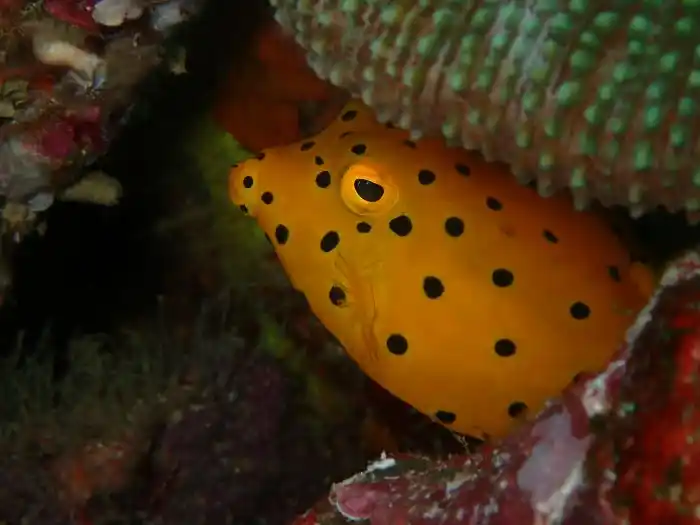
New contributor Marijke Puts tells us all we need to know about a cube shaped fish, the yellow boxfish. Its suitability for a home aquarium is questionable but a very cute appearance means it has fans all over.
Words by Marijke Puts
As far as names go, few are as to-the-point as that of the yellow boxfish. Indeed, this species truly is extraordinarily cuboid for a fish, as well as exceedingly yellow. A member of the order Tetraodontiformes, therefore closely related to pufferfish, it was described in 1758 by Carl Linnaeus, the Swedish biologist responsible for the introduction of the binomial nomenclature system that we still use today. Linnaeus, like everyone else, was clearly struck by the sheer boxiness of this fish: he promptly named it Ostracion cubicum, which can be translated roughly as ‘little cube-shaped box’.

Why are yellow boxfish a popular choice for reef tanks?
Its unique, and strangely adorable looks make the polka-dotted yellow boxfish a favourite among scuba divers. During one of my dives around the island of Koh Tao, in the Gulf of Thailand, my guide directed me straight to a specific patch of Acropora coral. He knew a yellow boxfish called this particular stretch of the reef home, and since I carried my trusty underwater camera, he knew I’d be delighted to photograph it. When we arrived, more divers were waiting as their guides scoured the coral for its well-known inhabitant. A chorus of muffled underwater cheers went up when they eventually found it leisurely scouring the rocks for algae, apparently unaware of its status as a local celebrity.
Aquarists, too, tend to find the yellow boxfish hard to pass up when it makes an appearance at their local fish store. The species is usually sold in its juvenile form: bright yellow and covered in black polka dots, with the typical puckered kissy mouth, but little larger than a sugar cube. Its eyes move independently and it swims in the typical manner of the Tetraodontiformes, practically seeming to hover as it zooms across its tank. However, as we’ll see later, there are some caveats to keeping this spotted superstar in your reef tank.

The natural habitat of the yellow boxfish
Ostracion cubicus boasts a wide distribution in the Indo-Pacific, where it can be found in tropical waters from the Red Sea all the way east to Hawaii. It mainly inhabits reefs of a depth up to 75m; the youngsters, like the specimen I spotted in Thailand, appreciate the relative safety of branching Acropora coral and are quite secretive. The bolder adults, which can reach 45cm in length and trade their bright yellow juvenile colouration for a more modest brown, also roam areas of flat seabed.
Boxfishes of the family Ostraciidae (also including the trunkfishes and cowfishes) are generally solitary beings, and the yellow boxfish is no exception. Although they may form small harems during the breeding season, these fish spend most of their time on their own. They feed mainly on algae, but is far from picky, scooping up anything from worms to sponges. Even crustaceans and molluscs occasionally make the menu.
Related article: Eastern smooth boxfish (Anoplocapros inermis) Species Guide
Characteristics of yellow boxfish
One of the unique characteristics of the Ostraciidae, including the yellow boxfish, is the fact that they’re basically swimming shields. Their hexagonal, plate-like scales have evolved over time to fuse into a bony carapace, which limits their speed but makes it almost impossible for other fish to make a meal out of them. Boxfish skeletons reveal their boxiness to be more than skin deep: their entire body is encased in solid plating.
As built-in armour apparently didn’t offer enough in the way of protection, boxfish are also toxic, a characteristic clearly signalled to predators through their bright colour and eye-catching pattern. Unlike pufferfish, which keep their toxins in their tissues and aren’t dangerous unless one consumes the wrong organs, the yellow boxfish can actually secrete potent neurotoxins through its skin mucous. Undoubtedly chuckling at their own wittiness while doing so, scientists named one of these incredibly potent toxins ‘boxin’. Another, which is found in all boxfish, is known as pahutoxin.

Do yellow boxfish make good tank mates?
Their boxin and pahutoxin explain why a charming species like the yellow boxfish isn’t a more common sight in the aquarium hobby. This is an absolutely delightful fish to watch, but how are you supposed to maintain a reef in the presence of what is basically a swimming weapon of mass destruction? Sources note—often rather dramatically—that when they feel threatened or stressed, boxfish can ‘nuke’ the tank with their toxins, leaving nothing but death and destruction in their wake. Additionally, when they die, all the boxin and pahutoxin are supposedly released, meaning instant obliteration.
The good news? While it is technically true that a yellow boxfish can wipe out the contents of an entire aquarium, the chances of it happening appear to be overstated. Although detailed studies are still lacking, most aquarists who have kept boxfish state that they haven’t experienced much in the way of problems. The idea that boxfish release boxin upon their deaths is now generally thought to be a myth. It certainly does happen in times of intense stress, but the mayhem can often be limited by means of large water changes and carbon filtration.
Would I keep a yellow boxfish in a community aquarium myself? Probably not, although many have done it, especially in combination with non-offensive tankmates that don’t stress the boxfish out. Would I consider setting up a single-species tank for one? Heck yes! Not only is it hard to overstate how adorable these fish are, many aquarists also consider them a breeze to care for in terms of feeding and compatibility.
With the looming danger of boxin obliteration eliminated by keeping the boxfish alone or with peaceful tankmates, we’re left with a fascinating, personable fish that eats pretty much anything. Aquarists report their boxfish learning to recognise them, begging for food, and even spraying water at their owners to catch their attention. Although yellow boxfish can’t be labelled as 100% reef-safe because they do tend to annoy corals in their search of tasty algae, they’re not known for causing significant issues and can be kept with some sturdy corals just fine. Most invertebrates, except for tubeworms, are also safe in the presence of these boxfish so long as they are well fed.
Related article: Marine starter fish to avoid

What size do yellow boxfish grow to?
What you do have to keep in mind is this species’ adult size. It’s a common refrain in the aquarium hobby: that endearing little sugar cube will eventually grow into a monster fish measuring almost half a metre in length. A 500-litre system should be considered the absolute minimum, especially because yellow boxfish produce a lot of waste and don’t respond well to low water quality. That’s a lot of tank for just one fish, but if you’re willing to set up the private digs required to keep a yellow boxfish without running the risk of it murdering its neighbours, you can enjoy one of the wackiest and most fascinating species our oceans have to offer right inside your own home.
Did you know: Engineers around the world are fascinated by boxfishes, which sport a sturdy but streamlined profile and are thought to be highly aerodynamically effective.
Indeed, in 2005, DaimlerChrysler modelled a concept car for Mercedes-Benz named the Bionic after today’s subject; a 2020 Chinese study explored the effectiveness of the yellow boxfish shape to reduce bionic drag on box girders, a structure used for building bridges.
Whether all of this truly makes sense is debatable, as studies have found that boxfishes aren’t actually all that aerodynamic. In fact, they’re pretty unstable, but the use of their fins combined with their shape does make them highly manoeuvrable.