


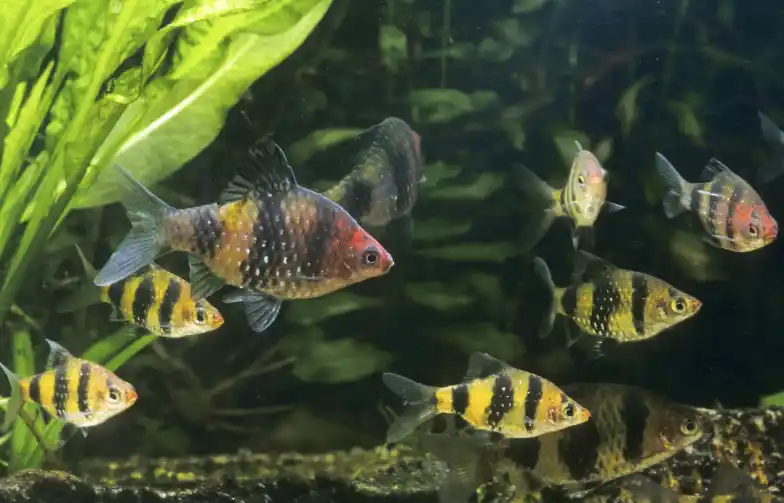
 The Black ruby barb, Pethia nigrofasciata , is a gorgeous fish for the temperate aquarium.
Bob picks out some colourful fish that are suitable for temperate aquariums despite often being sold in the tropical tanks of the local fish shops.
WORDS: BOB MEHEN
When people think of colourful coldwater fish, the ones that usually spring to mind are fancy goldfish. All eyes, pot bellies and diaphanous flowing fins in bright orange and red.
The fact is that many of the fish we see in the ‘tropical’ section of our local fish shop are from more temperate climates. While perhaps not as varied in temperature as the UK, they still swing high and low with the seasons.
These fish are best described as ‘temperate’ rather than ‘coldwater’. Year round chill will not be to their liking. However, if you live in the average, centrally heated UK house they should thrive.
Some more switched on stores have been quick to cotton on to this trend. They already have a temperate section filled with some of the hardy regulars often associated with tropical tanks. The once ubiquitous goldfish, fat fancies aside, have increasingly moved out into the pond section. Here they can thrive and grow to their full potential.
Instead, we see the aquarium friendly faces of white cloud mountain minnows, zebra danios and variatus platies.
Related article: How to set up a temperate tank that looks tropical.
Beyond zebras
We probably all know the amazing toughness and adaptability displayed by the zebra danio (Danio rerio). These hardy little fish are a species regularly recommended to beginners. Often ending up innew, biologically dead aquaria in the unnecessary practice of ‘fish-in cycling’. They are tough, adaptable and while not strikingly colourful, offer pattern and movement.
Related article: Frequently asked questions on fishless cycling.
What many people don’t realise is that some of their close cousins have many of the same characteristics. However, these display a more vibrant livery.

Orange-finned danio
Boasting the same pinstripe perfection of its zebra brethren, Brachydanio kyathit lives up to its common name of orange-finned danio. With a black barred body set off wonderfully by deep, burnt orange fins. Like the classic zebra danio, a spotted form is also often available.
Scientific name: Danio kyathit.
Size: 4cm (1.5").
Origin: Myanmar.
Water chemistry: pH 6.5 to 7.5. Soft to moderately soft water.
Temperature: 16–26°C (60–78°F).
Minimum tank size: 80L (17 gal) with a footprint of 90x30cm (36x12").

Pearl danio
The pearl danio (Danio albolineata) is a fish most will see regularly, but perhaps be unaware of its temperate potential. These glossy little fish are exquisite, changing colour like a film of oil on a puddle as their flanks hit the light. They move from metallic blue, then green, violet, pink and gold. They can look like a washed out danio version of a glowlight tetra, but given good food, water and lighting they truly shine.
Scientific name: Danio albolineata.
Size: 5cm (2").
Origin: Widely distributed across south-eastern Asia.
Water chemistry: pH 6 to 8. Soft to hard water.
Temperature: 16–25°C (60–77°F).
Minimum tank size: 80L (17 gal) with a footprint of 90x30cm (36x12").

Glowlight danio
Arguably even more delightful is the diminutive glowlight danio (Danio choprae). Like the pearl, these fish shine and glitter under suitable lighting, with their gold edged fins a real stand out feature. Again their colour changes depending on the light.
Typically there is a warm, pinkish orange hue to the fish’s body. A series of dark vertical bars contrasts nicely with this.
Scientific name: Danio choprae.
Size: 3cm (1.2").
Origin: Northern Myanmar.
Water chemistry: pH 6 to 7.5. Soft to slightly hard water.
Temperature: 16–26°C (60–78°F).
Minimum tank size: 64L (14 gal) with a footprint of 75x30cm (30x12").

Gold ring danio
The Gold ring danio (Danio tinwini) is perhaps the most boldly marked of the ‘danios’. Aa series of black spots covers their body and fins surrounded by a metallic golden sheen. All this in a small tank friendly adult size of around 2.5cm (1").
Scientific name: Danio tinwini.
Size: 2.5cm (1").
Origin: Northern Myanmar.
Water chemistry: pH 6.5 to 7.5. Soft to moderately soft water.
Temperature: 18–26°C (64–78°F).
Minimum tank size: 40L (9 gal) with a footprint of 45x30cm (18x12).
Bengal danio
Those with bigger tanks wanting some real action may be tempted by one of the wonderful species of Barilius. These fish have a large adult size, pugnacious nature and surprisingly capacious mouths. Therefore, they are best left for larger, specialist tanks with torrent like flow.
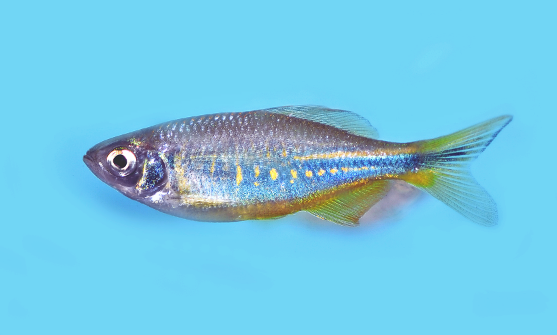
Consider instead the ‘budget Barilius’ – the Bengal danio (Devario devario). They share the same restless energy and twitchy, active nature of the smaller ‘danios’. Wwith sufficient space a swirling shoal of these deeper-bodied fish can make a striking display.
They possess metallic green-blue flanks marked with warm golden blotches. Reaching around 7.5cm (3") and their active nature means tanks of at least 120cm (48") are a minimum.
Scientific name: Devario devario.
Size: 7.5cm (3").
Origin: Northern India, Nepal and Bangladesh.
Water chemistry: pH 6 to 8. Soft to moderately hard water.
Temperature: 15–26°C (59–78°F).
Minimum tank size: 160L (35 gal) with a footprint of 120x45cm (48x18in).
Temperate tetras
In many tropical tanks, tetras rule the roost for midwater, shoaling, colourful fish. Mainstays like neons, cardinals, glowlights and lemons pack aquatic shop tanks with colour. Sadly these are all true ‘tropicals’, which like to bask in the mid 20s°C.
However, there are a couple of fish shop staple tetras that aren’t adverse to a cool shower. Let's look at some of the options.

Buenos Aires tetra
One of the most common options is the stout Buenos Aires tetra (Psalidodon anisitsi). The temperature of these fish’s natural habitat varies a lot. If kept constantly at the high end of their tolerance they can live considerably shortened lives at constant fast-forward.
Deep bodied and reaching around 6cm (2.5"), they sport attractive orange/red fins that set off their overall greenish blue body. The caudal peduncle displays a bold black blotch.
An albino form is also available which retains the fin colouration but loses all the other colours and markings. They can be ‘nippy’ so choose tank mates with care. Stocking them in groups of ten or more often redistributes these anti-social tendencies amongst their own kind.
Scientific name: Psalidodon anisitsi.
Size: 6cm (2.5").
Origin: Brazil, Paraguay, Argentina and Uruguay.
Water chemistry: pH 5.5 to 8.5. Soft to hard water.
Temperature: 16–28°C (60–82°F).
Minimum tank size: 80L (17 gal) with a footprint of 90x30cm (36x12").

Bloodfin tetra
Not as common in the shops, but well worth keeping an eye out for is the Bloodfin tetra (Aphyocharax anisitsi). These are smaller, slimmer fish than Buenos Aires tetra, topping out around 5cm (2").
They share the same bold red finnage against a metallic blue body. Once again, minor aggression can be an issue, so stock them in a generous group. Don’t confuse these fish with the similar looking, but smaller, more delicate and truly tropical glass bloodfin tetra (Prionobrama filigera).
Scientific name: Aphyocharax anisitsi.
Size: 5cm (2").
Origin: Argentina, Brazil, Paraguay and Uruguay.
Water chemistry: pH 6 to 8. Moderately soft to hard water.
Temperature: 18–28°C (64–82°F).
Minimum tank size: 65L (14 gal) with a footprint of 75x30cm (30x12").
Balmy barbs
The Cyprinids (carps and minnows) are the largest family of fish. So, it’s no surprise that they include many ideal temperate subjects beyond the goldfish.

Odessa barb
The stunning Odessa barb (Pethia padamya) is a fish so brightly coloured that due to the manner of its less than conventional introduction to the hobby – from Myanmar via the then Soviet dominated Ukraine – it attracted claims that it was a man-made hybrid or artificially dyed.
Thankfully all this was cleared up with the discovery of wild populations so we are now able to appreciate them for what they are – one of the best temperate choices of fish available.
Scientific name: Pethia padamya.
Size: 4.5cm (1.8").
Origin: Myanmar.
Water chemistry: pH 6.5 to 8. Moderately soft to hard water.
Temperature: 16–25°C (59–77°F).
Minimum tank size: 65L (14 gal) with a footprint of 75x30cm (30x12").

Black ruby barb
For tiger stripes, there are a plethora of banded beauties among the barbs. While many of these fish are either too belligerent or too tropical to be considered for temperate tanks a noteworthy exception is the handsome black ruby barb (Pethia nigrofasciata).
In the shops these often look like a washed out tiger barb. However, once settled, with a good mix of sexes, males develop a deep purple-black body colour fading to ruby red around the head, speckled with metallic silver scales. Females remain simply boldly striped, but their presence encourages the male’s best colour and courtship displays.
Scientific name: Pethia nigrofasciata.
Size: 5.5cm (2.2").
Origin: Sri Lanka.
Water chemistry: pH 5.5 to 7.5. Soft to moderately hard water.
Temperature: 18–27°C (64–80°F).
Minimum tank size: 65L (14 gal) with a footprint of 75x30cm (30x12").

Rosy barb
If you’re a sucker for goldfish but don’t have the space, the Rosy barb (Pethia conchonius) is the obvious choice. All the charm and colour of the goldie but with an adult size seldom exceeding 8cm (3.2"). Selective breeding over decades means a range of colour forms are available.
Scientific name: Pethia conchonius.
Size: 6.5–9cm (2.5–3.5").
Origin: Pakistan, India, Bangladesh and Nepal.
Water chemistry: pH 6 to 8. Slightly hard to hard water preferred.
Temperature: 16–24°C (59–75°F).
Minimum tank size: 80L (17 gal) with a footprint of 90x30cm (36x12").

Red-lined torpedo barb
A barb that took the hobby by storm: the Red-lined torpedo barb (Dawkinsia denisonii). Their striking, shark like silhouette, attractive, bold colouring and peaceful nature has seen them rise to the heights of aquarium ubiquity alongside neon tetras and angelfish.
However, what is not so well known is the fact that these fish aren’t best served in the permanent summer of tropical tanks. In these warm temperatures their metabolism is on fast-forward and their lifespan shortened as a result.
In a temperate aquarium they will keep pace with seasonal changes and live longer, more natural lives. As with most barbs, they do best when kept in larger groups. They look especially impressive holding station with just a sporadic flip of their forked tail against the steady current of a flow pump.
Scientific name: Dawkinsia denisonii.
Size: 15cm (6").
Origin: Southern India.
Water chemistry: pH 6.5 to 7.5. Moderately soft to hard water.
Temperature: 15–25°C (59–77°F).
Minimum tank size: 160L (35 gal) with a footprint of 120x45cm (48x18").
Sub-tropical substrate huggers
Once you’ve packed the upper layers of your tank with colourful barbs, danios or tetras you’ll probably want to balance things out with some bottom dwelling species. Plenty of candidates from the ‘tropical’ section will appreciate cooler conditions.

Panda garra
My personal favourite is the comical panda garra (G. flavatra). These boldly banded beauties will eat some algae but should never be bought for simply this purpose. They do best in groups of five or more where their hierarchical tussles make fascinating viewing.
Scientific name: Garra flavatra.
Size: 8cm (3.2").
Origin: Western Myanmar.
Water chemistry: pH 6.5 to 7.5. Soft to moderately hard water.
Temperature: 18–27°C (64–80°F).
Minimum tank size: 80L (17 gal) with a footprint of 90x30cm (36x12").

Yo-yo loach
The classy looking Yo-yo loach (Botia almorhae), is another unexpected temperate treat. These handsomely marked fish get their common name from their juvenile markings which appear on many fish as a series of black-brown y’s and o’s over a cream background. As the fish matures the patterning breaks up to a more regular reticulation, but is still lovely. Like most Botiid loaches they are social and should be in groups of at least five.
Scientific name: Botia almorhae.
Size: 14cm (5.5")
Origin: India, Nepal and Bangladesh.
Water chemistry: pH 6 to 7.5. Soft to slightly hard water.
Temperature: 18–27°C (64–80°F).
Minimum tank size: 160L (35 gal) with a footprint of 120x45cm (48x18").

Red-spotted goby
If you’re after a real character fish for your tank then look no further than the Red-spotted goby, (Rhinogobius rubromaculatus). These charming little micro-predators are always on the look-out for something to eat.
Males in breeding colour are gorgeous. They display a lovely soft powder blue covered in scarlet spots with the edges of their fins highlighted in bright white. Females are more washed out, with pale yellow fin edges.
Without a mix of the sexes you won’t see the fantastic head shaking, ‘gaping’ displays as males spar with each other and try to woo interested females. These gobies require good levels of dissolved oxygen and are evolved to live in areas with strong water flow.
Scientific name: Rhinogobius rubromaculatus.
Size: 5cm (2").
Origin: Taiwan.
Water chemistry: Moderately soft to slightly hard water.
Temperature: 15–25°C (59–77°F).
Minimum tank size: 50L (10 gal) with a footprint of 60x30cm (24x12").
Cool cats
Few tanks are complete in my book without a catfish or two. Many of us will know that the peppered cory (Hoplisoma paleatum) will get along nicely in temperate tanks.
Related article: What is the best substrate for corydoras?
Three-lined cory
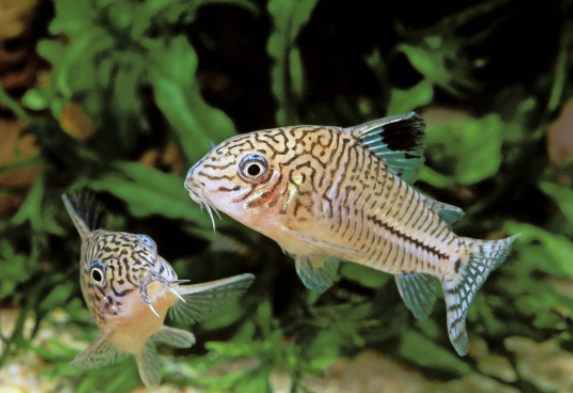
Less well known is that the three-lined cory (Corydoras trilineatus) which is often mis-sold as the Julii cory. This species is also well adapted to cooler water.
Scientific name: Hoplisoma trilineatum
Size: 5.5cm (2.2").
Origin: Amazon basin in Peru, Brazil and Colombia.
Water chemistry: pH 6 to 7.5. Soft to slightly hard water.
Temperature: 16–25°C (60–77°F).
Minimum tank size: 50L (10 gal) with a footprint of 60x30cm (24x12").

Bearded cory
Add to this their flashy big cousin the bearded cory (Scleromystax barbatus) and you have a couple of nice alternatives to peppered corys.
Scientific name: Scleromystax barbatus.
Size: 10cm (4").
Origin: South Eastern Brazil.
Water chemistry: pH 5.5 to 7.5. Soft to slightly hard water.
Temperature: 16–24°C (60–75°F).
Minimum tank size: 50L (10 gal) with a footprint of 60x30cm (24 x 12").

Hoplo catfish
For larger tanks or more robust midwater fish that might intimidate corys, look instead at those seemingly indestructible, animated armoured sausages, the ‘Hoplos’ (Megalechis thoracata). These are easily able to deal with bolshy barbs and cooler temperatures.
Scientific name: Megalechis thoracata.
Size: 15cm (6").
Origin: Brazil, Peru, Trinidad, Guyana, Martinique, Venezuela and Paraguay.
Water chemistry: pH 5.5 to 8. Soft to hard water.
Temperature: 17–28°C (62–82°F).
Minimum tank size: 160L (35 gal) with a footprint of 120x45cm (48x18").
Cool – but not cold!
While all these fish can make a fantastic display at lower than tropical temperatures it is vital they don’t get too cold. Even in modern, centrally heated, homes things can cool off considerably at night so adding a heater, set at the lower end of your chosen fishes’ range is a wise precaution.
Similarly, just as some of these fish will suffer if kept permanently at the high end of their tolerance, they will not all appreciate being kept at the bottom end constantly. Who wants to live in a permanent state of winter?
Consider creating an artificial summer or dry season period where the temperatures are elevated to the upper end of the fishes’ range. In the majority of UK houses this will happen naturally each summer even in our often less than tropical weather!