


Jeremy Gay explains the various types of pond filter available to help you decide which to buy for your next fish pond.
The first question you might ask is why do we need to filter pond? Well, we filter ponds for two main reasons - to clear the water so that we can see the fish, and to keep the pond fish alive and healthy. So if you plan to add fish to your pond, you'll need to also instal a filter and there are some great options to choose from.
Box filters
Box filters, also known as black box filters, are as the name suggests, large black boxes that sit on the edge of the pond.
A pond pump which sits inside the pond, usually in the deepest part, supplies water through some pipework to the filter. The water then sprays over several layers of sponges, coarse through to fine, then over some plastic biological media. The now clean water falls back into the pond by trickling out of the bottom of the box via a short pipe.
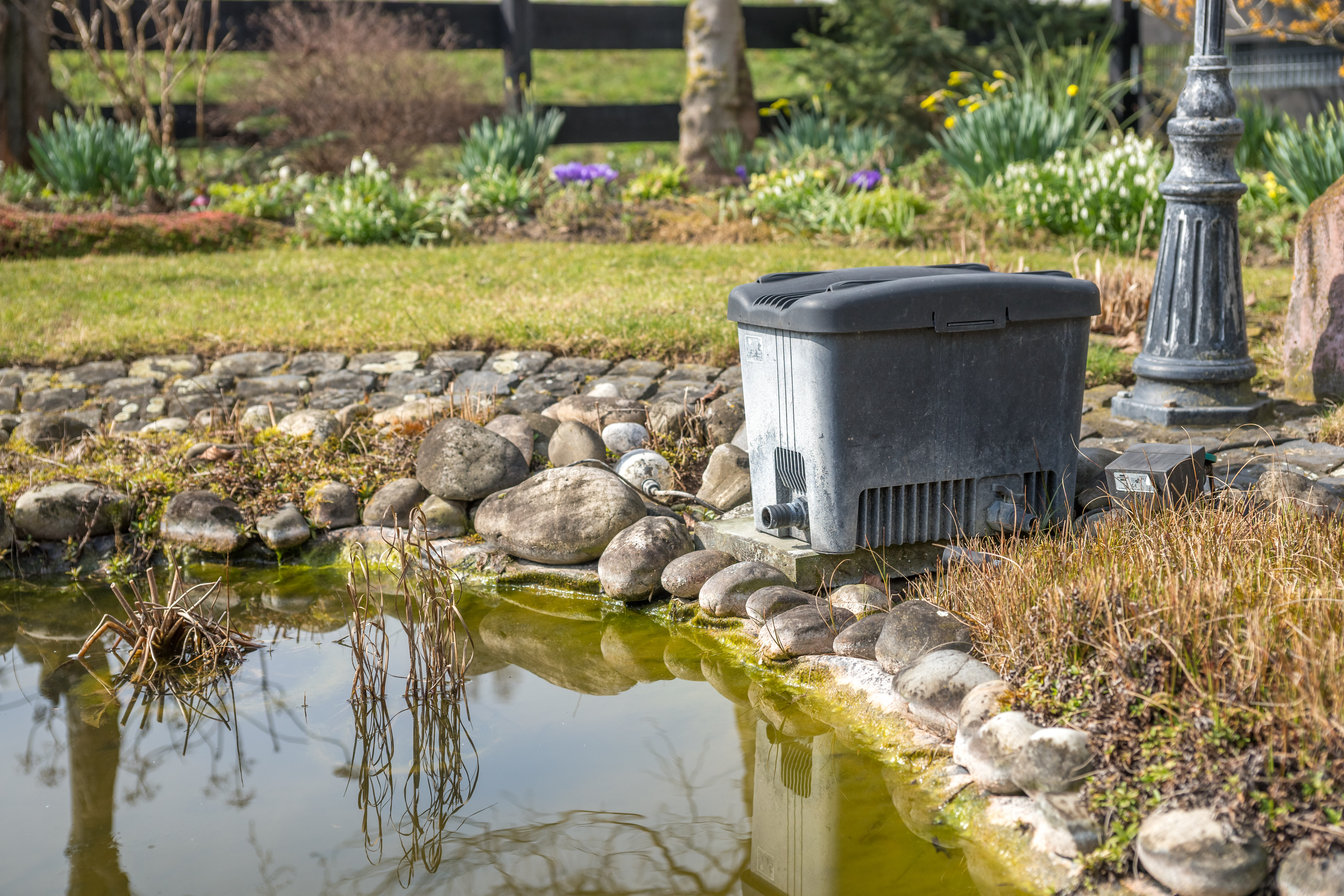
Black box filters are the cheapest form of pond filter. Their large size makes them effective mechanical and biological filters. Many come with built in ultraviolet clarifiers (UVC).
The green pond water passes the UV first, clumping the algae cells together. This increases the size of the algae particles allowing the sponges below to capture them.
Most box filters have a built-in bypass for if the sponges block when you’re not there. Without this, the water could start overflowing, emptying the pond into your garden.
Box filters must sit above the water line so the water can flow back into the pond via gravity. Because of this, and their size, they can be unsightly. If you intend to run a waterfall, this box needs to sit right at the top of it. Clever landscaping and planting can negate many of these negatives though.
Related article: Frequently asked questions on ammonia.
Pressurised filters
Pressurised filters are small dustbin-shaped pond filters with a rubber seal and a tight-fitting lid. Inside are a series of round sponges and plastic biological media, a lot like a box filter.
However, unlike a box filter, the sealed lid enables water to enter and exit at the same pressure. This means you can place a pressurised filter some distance away from the pond. This enables you to hide it by burying it in the ground up to the lid and the water can still return to the pond.
Apart from being discrete, the major advantage of these filters is that the exit hose can run up to the top of a waterfall. Pressurised filters are available either with or without UVC. A built in UVC means you again get a small, discrete, algae killer built into the unit, saving you some valuable space.

One disadvantage to pressurised filters is that they can need frequent cleaning to keep the filter media from clogging. Some may even need dismantling and the sponges cleaning by hand, yuck! Luckily, many have handles which squeeze the sponges for you, and a valve for sending dirty water into the garden or down the drain.
Pressurised filters are great for medium-sized fish ponds. For dedicated koi ponds people often choose a larger, heavier-duty alternative which we will get to shortly.
All-In-One filters
All-in-one pond filters combine pump, filter and UVC into one small, compact package. Unlike most pond filters, the pump and filter media for these filters are both inside the same submersible unit.
They often have a tiny UVC bulb as well to help reduce issues of green water. Plus, the units are usually only require one plug. Remember, the plug will not come with the filter in the UK, as this is illegal.
The whole unit sits in the water, in the middle of the pond. The pumps draws dirty water in through the pump casing and clean water returns via an adjustable fountain attachment.

The major advantage of all-in-one pond filters are their small size. This makes them good for smaller ponds, troughs and large water features. They are all-in-one filtration system to keep water quality optimal in small bodies of water.
The downside is that you need to remove the whole unit for maintenance. Remember to tie some sort of rope to help you to drag it up from the depths of ponds, unless you fancy reaching in to grab it. What you should not do is pull it up using the power cable, as this can damage it rendering the unit unusable over time. The small UVC bulbs and small quantities of filter media also limit them to small ponds with limited fish stocking.
Koi pond filters
Get into koi keeping and it can be an aquatic hobby all on its own. Koi carp can reach four feet in length so everything must be giant to care for them properly.
Koi may eat plants so most “serious” koi fish ponds are free of pond plants. Koi ponds are large, and typically need to be at least four feet deep.

Unlike all the other filtration methods listed above, koi ponds are often free of pond pumps. Instead they use a “gravity-fed” filtration system. Water leaves via a bottom drain and surface skimmer, before entering the large filtration system of choice. A pump sits near the filters which pushes the water through all the long, rigid pipework that connects it all together.
These filters need to operate more like fish farm filters or waste water treatment plants. A good koi filter traps solid waste and flushes it away regularly, so that it doesn’t clog the filter media. After this, water enters the biological filter. At this stage oxygen is critical, so many filters will have powerful air pumps.
These koi filters have two main advantages. Firstly, they can process huge amount of waste, which is important when working with koi.
Secondly, you can maintain them without getting your hands wet or dirty. In many cases, all it takes is turning some valves. Many operate a constant water change system as well!
The negatives are the large size, high cost, and the need to have a bottom drain and surface skimmer professionally fitted. A black box filter will deal with the waste from a few ghost koi. However, enter the world of Japanese koi and filtration can become as much of an obsession as the fish.
Related article: Can I get some koi for this pond?
Filters for wildlife ponds
In sharp contrast, a true wildlife pond should not contain fish (unless the pond is extremely large and they got there naturally). It also shouldn’t use a pump, a filter, or an ultra violet clarifier.
Wildlife ponds are essentially solar powered. The sun feeds phytoplankton, which feeds zooplankton (like Daphnia), which then feeds predatory insect larvae, tadpoles, and everything else. UVC will effectively remove green water, and mechanical filtration will remove tiny invertebrate life from the water. Breaking the ecosystem.
Wildlife ponds don’t need be large, deep, or even permanent, as it is natural for some ponds to dry out in the wild. Just don't add any filtration or fish!

Picking the right size
Once you have decided on what type of filtration you want, there is one last thing to do. You need to pick the size of pond filter you need. Most filters, no matter what type, have a variety of sizes available on the market.
If you don’t already know how much water your pond holds, try to calculate an estimate using the average width, length and depth. If you need assistance, take these with you to your local fish store, or garden centre, and ask for advice from the staff. They’ll be more than happy to help work out the size of your pond with you, and can then show you some of the suitable models of filters that they have in stock.
This is an extract from a full article which featured in the May 2025 issue of the magazine. You can subscribe here so you don't miss an issue!