


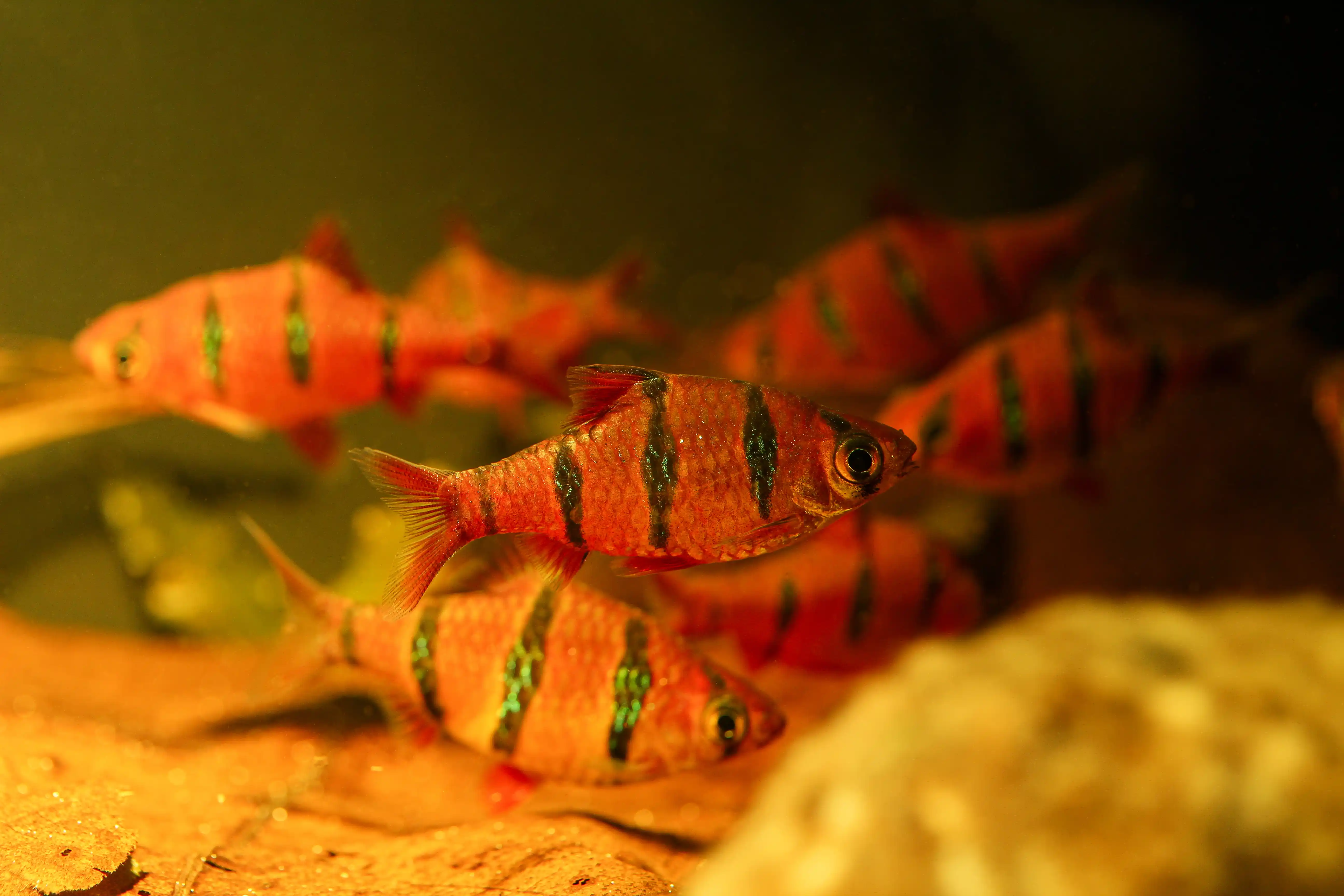
Alex Bell takes a look at how to care for the stunning 'five banded' barbs and discusses whether the fish we see are actually Desmopuntius pentazona.
‘Pentazona’ barbs or 'five banded' barbs (Desmopuntius pentazona) look like a much redder and more slender version of the common tiger barb (Puntigrus tetrazona), but the similarity just about ends there. They are not as robust as tiger barbs nor are they as aggressive, and they require far more specific water chemistry to thrive. But are the fish we see in pet shops labelled as 'five banded barbs' really D. pentazona?
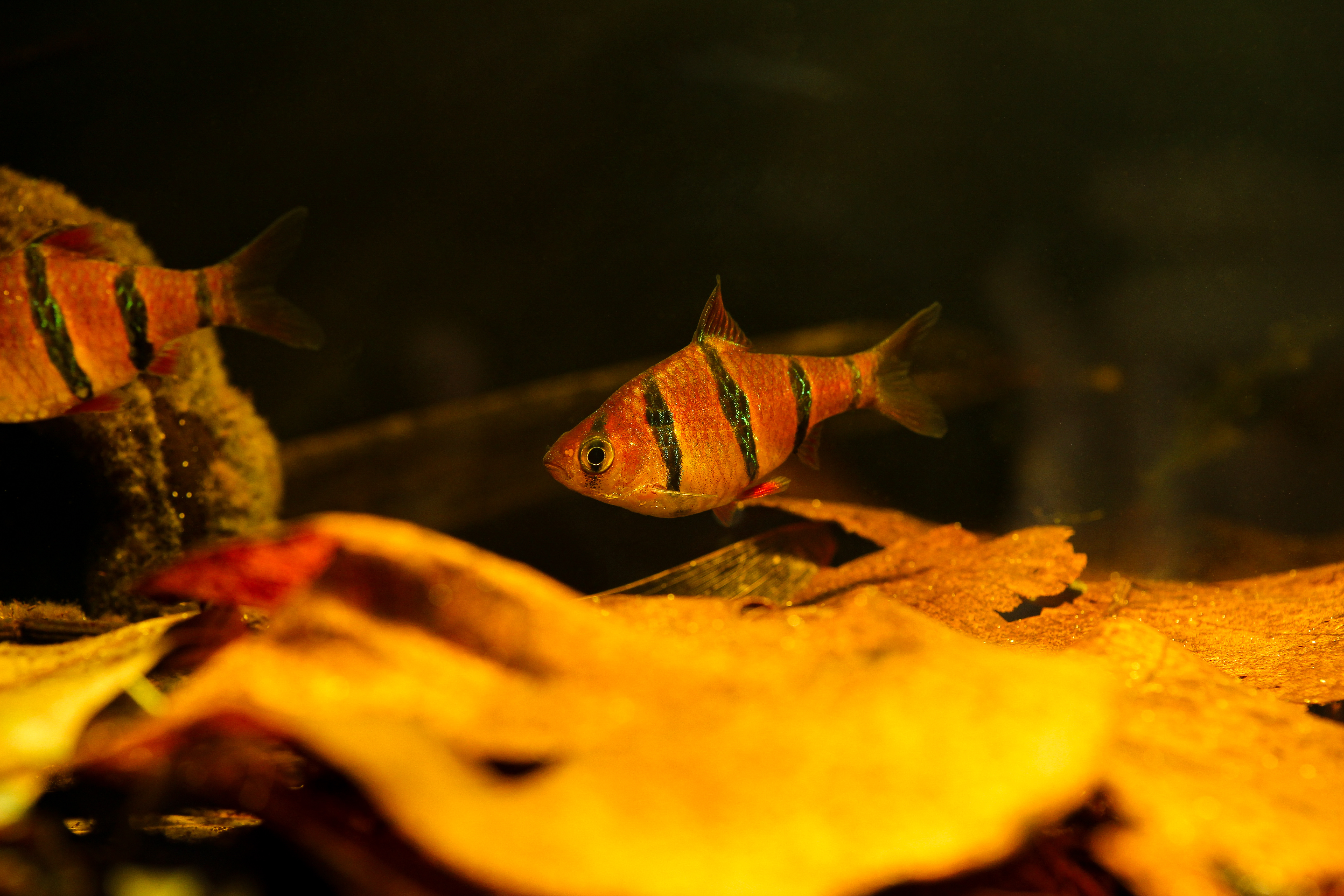
Are they D. pentazona or hexazona?
While these barbs will be called D. pentazona 99% of the time in fish shops, online and by many aquarists, this is not actually the case. Instead it is widely accepted that the fish many of us keep in our aquariums is the very similar looking Desmopuntius hexazona, or six banded barb. Luckily for us their care requirements are pretty much identical coming from very similar habitats in South East Asia. So, while we have been calling them the wrong name, we have at least been keeping them in the correct way.
So how do you tell the two apart?
While you would think, based on the name 'hexazona' meaning six zones, and 'pentazona' five zones referring to their patterning, one would have 6 dark bands while the other would display 5. This is in fact not the best way to tell them apart though, instead D. pentazona posses a dark spot just below the base of the dorsal fin which is not present in D. hexazona.
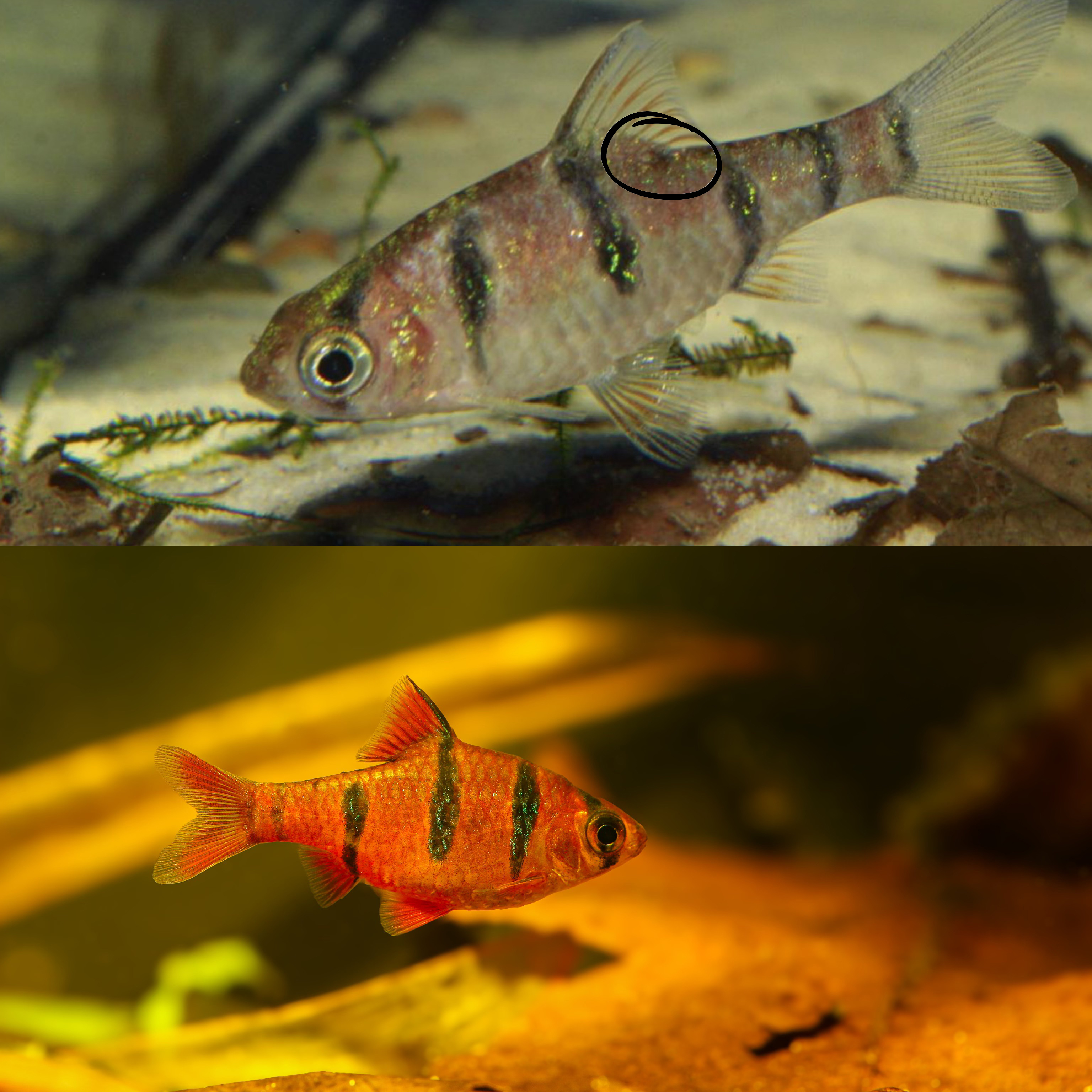
Image of D. pentazona by Max Pedley
Once you see them together it is fairly easy to tell they are not the same fish. The top fish above is actually D. pentazona as shown by the feint dark spot circled. This mark becomes more pronounced as the fish settle in and colour up, the difference in overall colouration between the fish is down to maturity and time to settle into their surroundings, not due to the different species. After years and years of only ever seeing D. hexazona it is not surprising this wrong identification has stuck in the hobby for so long.
What size aquarium do I need for pentazona or hexazona barbs?
Both of these species reach a maximum of just over 5cm (2") in size and can be quite active. Therefore, they require reasonably sized aquariums with dimensions of 80x30x30cm (32x12x12") as a minimum.

What water conditions do these barbs need?
Hailing from the peat swamps of Indonesia, it is no surprise these fish like their water to be on the acidic side of the pH scale. While their native waters may drop as low as a pH of 4, the captive bred fish that we see available in the hobby will do perfectly well as long as you keep them below 7.
To maintain an acidic environment it is also required to also have soft water with negligible hardness present. Some aquarists, like myself, may be lucky to have these conditions right out of their tap while others may need to utilise an RO (reverse osmosis) unit to remove the impurities in the water. While the use of tannins from bogwood and various botanicals can be used to acidify water that is already very soft (lacking carbonate ions), while also making a more natural home for these fish, it will not create soft water contrary to some of the advice out there might have you believe.
Historically, peat has been used to soften water and reduce pH but it is by not means the most effective way to do this when compared to using an RO unit, plus the harvesting of peat can be damaging and is not always done in sustainable ways.
Temperature wise, these fish are typically tropical. Temperatures between 22-26°C (72-79°F) will work perfectly for either of the species.
Where do they live in the wild?
The six banded barb (D. hexazona) is native to eastern Sumatra, Singapore, parts of the Malay Peninsula and southern Borneo. Whereas the five banded barb (D. pentazona) is restricted to just the northwest of Borneo.
Both species inhabit similar environments, generally being found in the tinted waters of peat swamps and surrounding streams as well as some other areas of slow moving water. They appear to have a preference for areas where there is some aquatic plant life, although this is often marginal grasses that have been inundated by rising waters rather than true aquatic plants as these often struggle in the dark waters.
Related article: Have you kept these five underrated barbs?

How to aquascape a tank for pentazona or hexazona barbs
As with other small barbs, give them a combination of ample swimming space in the foreground and enough submerged vegetation in the background. They tend to be less boisterous and brave than some of the other common species, like tiger barbs, and welcome the opportunity to hide among vegetation. To keep a South East Asian theme to the aquarium, rather than a strict biotope, I highly recommend leaning heavily on the wonderful plants of the genus Cryptocoryne. Their tolerance to lower light levels means they can work great for lower light aquarium that have some tannins present while being heavy root feeders means the water can be maintained with a fairly low level of dissolved minerals required for good plant growth (closer replicating the barbs natural waters).
For taller, or maybe longer, tanks Cryptocoryne balansae is a brilliant option, with tall thin leaves, somewhat resembling Vallisneria, they can provide a dense area of vegetation for the fish to retreat to when spooked. Once the leaves reach the surface they will trail along in the current further diffusing some of the light and drift in the current creating the feel of a slowly flowing stream.
When designing my aquarium for this species I decided to attempt to create a layout without utilising hardscape, instead depending on the botanicals and plants to do the heavy lifting. Should you include some wood or rocks (ensure any rocks are inert as any containing calcium carbonate will raise the pH and hardness which we definitely don't want for this fish) I would also include some Java fern (Microsorum pteropus) as this epiphyte will further add the Asian feel to the layout and provide more cover for the fish. More cover means they will feel more settled and you will see them more.
Other good options for plant species for lower light aquariums like this would include Anubias spp. (another epiphyte), Echinodorus spp. and various easy to grow stem plants like Hygrophila and Limnophila.
Botanicals, botanicals, botanicals...
Once you have an idea of the hardscape and plant species you want to go for, I strongly recommend that you look into adding some botanicals to your aquarium. They will enhance the natural feel of the aquarium, provide additional cover and supplementary foods for your fish and allow you to witness the natural behaviours of the barbs hunting in groups amongst the leaf litter. Should you need some convincing or would like a bit of information on what botanicals are then check out our great guide on botanicals in aquariums.

My six banded barbs can often be seen taking shelter in the buddha nut or Sterculia pods included in the aquarium.
What tank mates can I keep with these barbs?
Now you have created a beautiful home for your barbs, the obvious next step is to decide on the final fish stocking for your aquarium. These fish are actually great community fish and your options are vast! While I always like to try and keep fish from a similar region you certainly don't have to as long as they share a love of more acidic water. I have compiled two lists below which are a sample of some of the suitable tank mates. One of these has some great options of South East Asian species and one of fish from other locations that would also be suitable tank mates.
South East Asian species:
- Species from the genera Trigonostigma, Sundadanio, Rasbora and Boraras
- The similar snakeskin barb (Desmopuntius rhomboocellatus)
- Pearl gourami (Trichopodus leerii)
- Kuhli loach (Pangio spp.)
- Species of Betta, Parosphromenus, or Sphaerichthys (these are a maybe as they could be outcompeted for food)
Other species from around the world:
- Various tetras, those from the genus Paracheirodon would complement the barbs with their blue flashes.
- Species of 'corydoras' which are now split across 7 genera: Corydoras, Aspidoras, Scleromystax, Gastrodermus, Osteogaster, Brochis, and Hoplisoma.
- Otocinclus spp.
- The more robust dwarf cichlids like Pelvicachromis pulcher.
- South Asian gourami like the stunning honey gourami, Trichogaster chuna.
- Potentially angelfish, these barbs are a far better tank mate for angelfish than tiger barbs.

I chose to keep the beautiful neon blue rasbora with my six banded barbs.
Check out our magazine subscription offers for more fishkeeping tips, guides and reviews!