


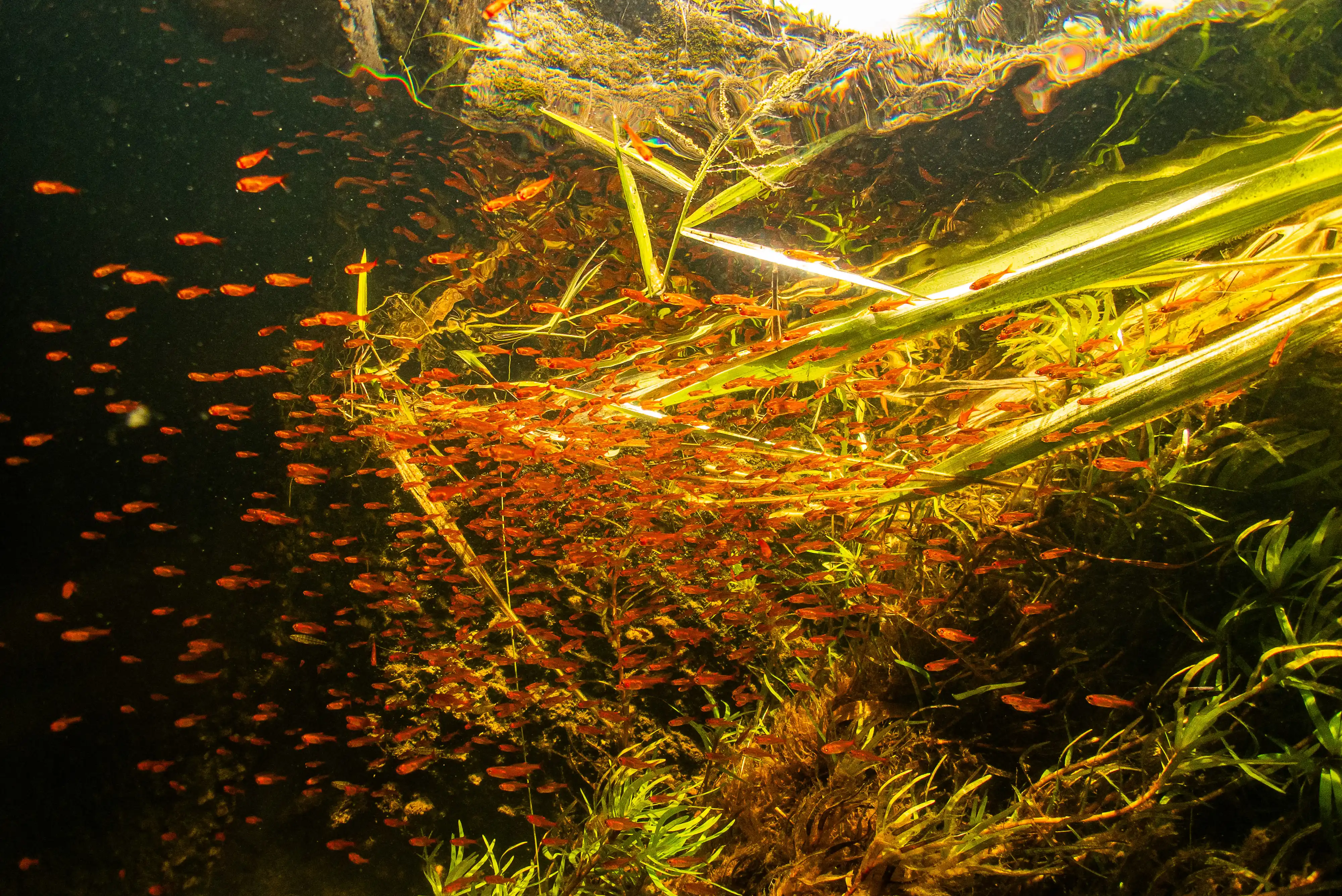
Tai Strietman explores an Araguaia River biotope in Brazil, while hunting for one of the most iconic nano fishes.
A gathering of fish enthusiasts
In January of this year, my friend Fernando Carvalho suggested I joined him in Brazil. Around seven hundred ichthyologists from Brazil, Peru and USA were attending a week-long congress. Fernando suggested I should present some of my work and so I set off to join them.
Here, I met old friends from my time studying in Brazil. Heriberto Gimenes Junior is one of them, known for his work on the fishes of the Pantanal.
I also met Fernando Henrique, an engineer and aquarium hobbyist who volunteers with Project Piaba in the Amazon. His Instagram is full of videos of native South American fishes. Speaking to him about his experiences was incredibly inspiring.

At the end of the event Fernando and I planned to head to the Araguaia River basin. In search for its most famous aquarium species, the ember tetra! Currently, there is a dearth of information regarding the habitats of the ember tetra (Hyphessobrycon amandae). My aim, to detail what an ember tetra biotope actually looks like.
The journey to Arowana
After a 800km drive south, we arrived into the tiny town of Aruanã (which translates to 'Arowana'). Aruanã sits on the banks of the mighty Araguaia River in the state of Goiás. Recently, this town has become a destination for sport fishing.
Fernando and I teamed up with Dr. Fabricio Theresa, a professor at the State university of Goiás. He is a member of Programa Araguaia Vivo. A project that studies the Araguaia River system. They study everything from water quality and small plants, all the way up to river dolphins and jaguars.
The Araguaia River is home to over 800 species of fish. It drains a watershed as large as Germany and runs for about 2300km.
One question remained, where in all this water would I find one of its smallest species of freshwater fish? I had thought that we would need to search far to the north, however, Fernando had encountered collection reports near the town of Aruanã.
The first thing we did was speak to the owners of a local fishing tackle shop. Luckily, they used to work collecting and exporting ornamental fish. They confirmed the locations of the ember tetras.
They also suggested a closer location just five minutes out of town. A private property where we might gain entry and find the tetras.

Related article: Black phantoms in the wild
Finding ember tetras
We duly headed to this location, located by a ‘manilha’. These are cuts under the road to allow the flow or draining of water. Here, flood waters were draining a swamp on one side of the road, through concrete tunnels and into a stream on the other side.
The stream formed a series of pools and sat within the grounds of the property with large, heavy gates. We called out and eventually the caretaker of the place came to talk to us. She kindly let us in, and we examined the pools.
Suddenly, Fernando shouted “Foguinhos, here, here”. This was the local name for ember tetras.
I got down on my hands and knees on the steep bank and saw…nothing. Then, I spotted the tiniest movement amongst the plants and…there! About five ember tetras appeared!
From above they were hard to see. As the sun disappeared behind some clouds the water turned near black, their dark backs helped them fade into the gloom. Still, we were elated, on the morning of day one, mission accomplished!
We strolled around the pool, and I asked the caretaker if I could get into the water. She agreed but wanted me about snakes, LOTS of snakes.
She also told us that visitors never showed interest in the stream, refusing to get in even on the hottest days. Black caiman occasionally swim through these waters, which is enough to put most people off. She also explained that in the summer, the water pretty much vanishes.
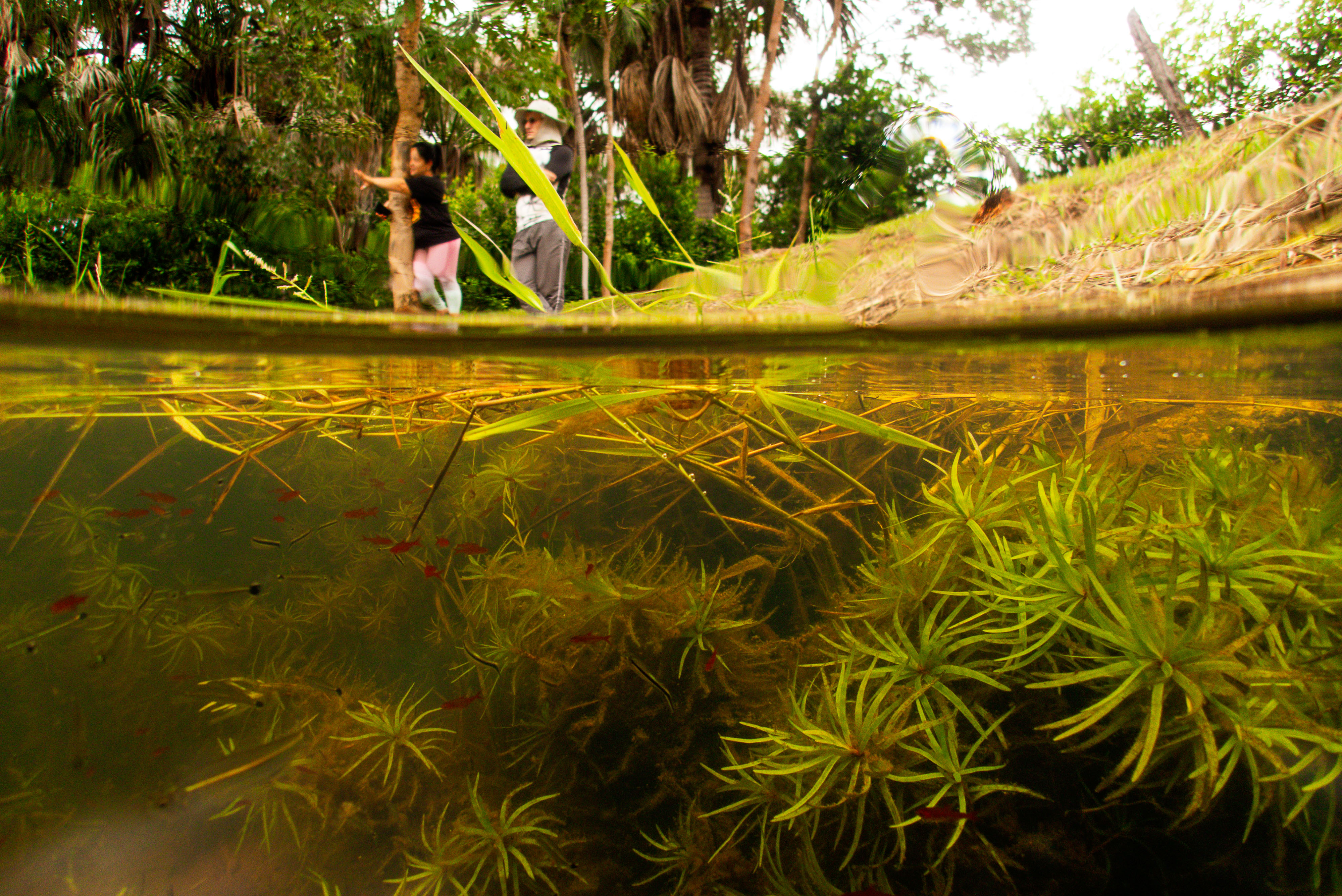
Aquatic plants of the ember biotope
The water was clear, and there was little overhead cover meaning plenty of light hit the water. This meant aquatic plants were able to dominate areas of this stream.
A beautiful green plant, Eichhornia diversifolia, thrives here. Stems of Cabomba furcata struggled for light amongst it, yet still they bloomed with purple flowers.
Here and there, stands of bright red Ludwigia inclinata, gilded with soft orange algae, grew near the bank. Crimson islands of the beautiful Ludwigia sedoides also littered the margins, anchored to the substrate by long, tough stems.
Flooded grasses screened the edges of the stream. The central channel was free from plants. Instead, this area contained leaf litter and a yellow, clay-like substrate mixed with fine gravel and sand.

What other species of fish live with ember tetras?
I slipped into the warm water and began to explore. Astyanax tetras swam around me, along with other small characins. A school of long, lean green lizard tetras (Iguanodectes spilurus) raced past my mask like glittering emerald torpedoes. Their large eyes scanned me and decided I was no threat, so they became more confident, and proceeded to glide around.
I spotted the scarlet glowing eyes of Bario sanctaefilomenae, the red-eye tetra. Then the more subdued lights of head & tail light tetra (Holopristis ocellifer).

Related article: 12 great community tank tetras.
Tiny darter tetras hovered in the midwater column. Most darter tetras prefer to zip about along the substrate. Yet, I had seen this behaviour before in the Paraguay basin.
Fernando called out instructions from the bank, he’d spotted a larger shoal of ember tetras. They were crowding around the outlets from the concrete tunnels which ran under the road.
They hugged the banks of plants before turning with the flow and zooming down the stream, crossing it, then fighting their way back. They performed this mini-relocation every few minutes and I soon understood why. Slinking about in the tall stands of Eichhornia were pike cichlids.

Other cichlids bumbled around at lower levels. Some of those I could identify included juvenile Satanoperca, young cupid cichlids (Biotodoma cupido), and small severums (Heros sp.).
Another chunkier cichlid, perhaps a form of Aequidens, foraged over concrete rubble at the base of the tunnels. Here, more pike cichlids, slenderer and slinkier than those in the plants, would slide over the curved inside of the pipes.
I turned just in time to observe a shoal of penguin tetras (Thayeria boehlkei). They charged over my shoulder and into the red swarm of ember tetras.

I have always felt a great joy at encountering species in the wild which I know from the hobby. The feeling of elation at seeing the ember tetras and finding the fishes which lived alongside them was incredible.
Even in this heavily modified habitat, native fishes found a way to adapt. I saw more evidence of our impact on this freshwater habitat. Groups of colourful, yet invasive, guppies (Poecilia reticulata) flitted among the flooded grass stems at the margins. I will leave it up to you if you include these in your Brazil biotope aquarium.
This is an extract from a full feature within the April 2025 issue of Practical Fishkeeping Magazine.