


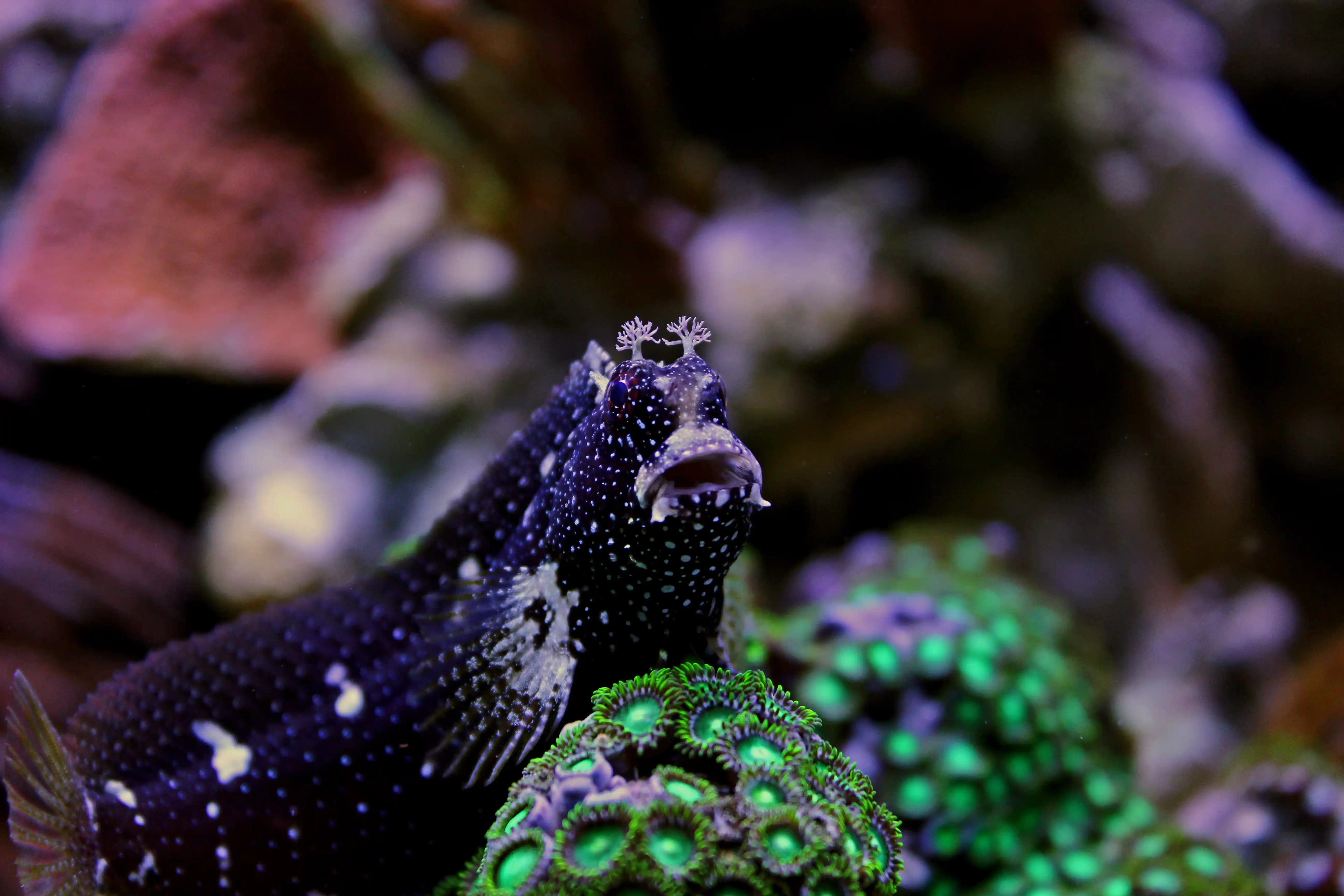
Blennies' are full of personality, and a reef tank is not complete without one. Here is our top 5 species to consider for your marine aquarium.
If you’re looking to add a marine fish with personality and charm to your reef aquarium, blennies may be the answer. Despite being usually fairly small, these marine fish have the character to match any large fish. They are popular thanks to their curious nature, expressive faces, and habit of perching all around your reef tank.
Some blennies not only add personality, but also a cleaning service. Many of the popular species are excellent algae grazers, keeping the rockwork free from green tufts. Most are fairly reef safe and adaptable to a range of diets making them quite easy to care for.
Unlike some marine livestock that spend most of their time hiding, blennies are usually quite visible. You’ll quickly get to know their individual personalities. Some blennies appear to 'smile' at you from their rock ledge while others pop in and out of coral crevices like a jack in the box. Their inquisitive nature means they interact with their surroundings, their tank mates, and even you.
However, not all blennies are have the same requirements. Some prefer grazing on algaes, while others enjoy a more meaty based diet. A few species can even be territorial, especially toward fish with similar shapes or habits. Choosing the right blenny for your marine aquarium is therefore critical.
Below are our favourite five species that could be an excellent choice for your saltwater aquarium.
All images are from Shutterstock.
Our top 5 species of blenny
Goldstreak blenny (Ecsenius stigmatura)
While reports exist that this species may nip at hard corals or clam mantles, a well fed individual can be a great reef inhabitant. Their name stems from the colourful cheek patterns, but another name also exists thanks to another defining characteristic. Tailspot blennies display a dark round mark on the caudal peduncle, where the tail fin joins the body.

Scientific name: Ecsenius stigmatura
Size: up to 6cm (2.4”)
Origin: This small blenny lives in the Western Pacific around the Philippines and Indonesia.
Habitat: They occur in shallow waters in coastal lagoons and sheltered coral reefs.
Tank size: 60x30x30cm (24x12x12”)
Temperament: Territorial towards other similar fish including conspecifics. Pairs can inhabit the same tank but generally singularly is best. Not totally reef safe, reports of nipping corals exist while other encounter no issues.
Feeding: They will peck at filamentous algae throughout the aquarium, but they won't make a significant dent in it. Supplement with other plant based foods along with the usual frozen, live and prepared diets.
Availability & cost: Fairly common, expect to pay upwards of £25.
Dot dash blenny (Ecsenius lineatus)
Coming from the same genus, the dot dash blenny is similar to the previously mentioned Goldstreak. They too may nip at sessile invertebrates within your reef, especially when underfed. However, they are larger and are more likely to keep algae at bay in your aquarium.

Scientific name: Ecsenius lineatus
Size: up to 9cm (3.5”)
Origin: Indo-Pacific occurring from Yemen to Japan and down to Australia.
Habitat: They occur in areas with an abundance of corals and shallow, clear waters down to a depth of 15 metres (50').
Tank size: 80x40x30cm (31x16x12”)
Temperament: Fairly peaceful to other species but territorial to its own kind or other small bottom dwellers. They can develop a taste for certain corals.
Feeding: Easy to feed accepting Nori sheets, flakes and wafers containing marine algae and frozen foods enriched with spirulina. Will also graze on nuisance algae around the aquarium.
Availability & cost: Fairly common, expect to pay upwards of £30.
Midas blenny (Ecsenius midas)
While a member of the same genus, this species has developed a taste for zooplankton rather than algae. They spend time hovering up in midwater above the rockwork, feasting on the tiny organisms drifting by. While they may not contribute to the clean up crew, they have a fascinating back of changing colour. That glowing yellow can become a deep orange in a flash, blending in with the species around it.

Scientific name: Ecsenius midas
Size: up to 13cm (5.1”)
Origin: Wide distribution throughout the Indian and Pacific oceans as well as the Red Sea.
Habitat: Found on the crystal clear coastal reefs and the outer slopes. Often swimming a few metres away from cover often alongside shoals of Pseudanthias squamipinnis.
Tank size: 90x40x40cm (36x16x16”)
Temperament: Typically quite peaceful but it can cause problems for similar species, like firefish. Keep singularly unless as a mated pair in a larger tank.
Feeding: Easy to feed accepting the usual frozen, live and prepared foods.
Availability & cost: A species stocked in most marine stores. Prices vary depending on size but they typically start at around £25 each.
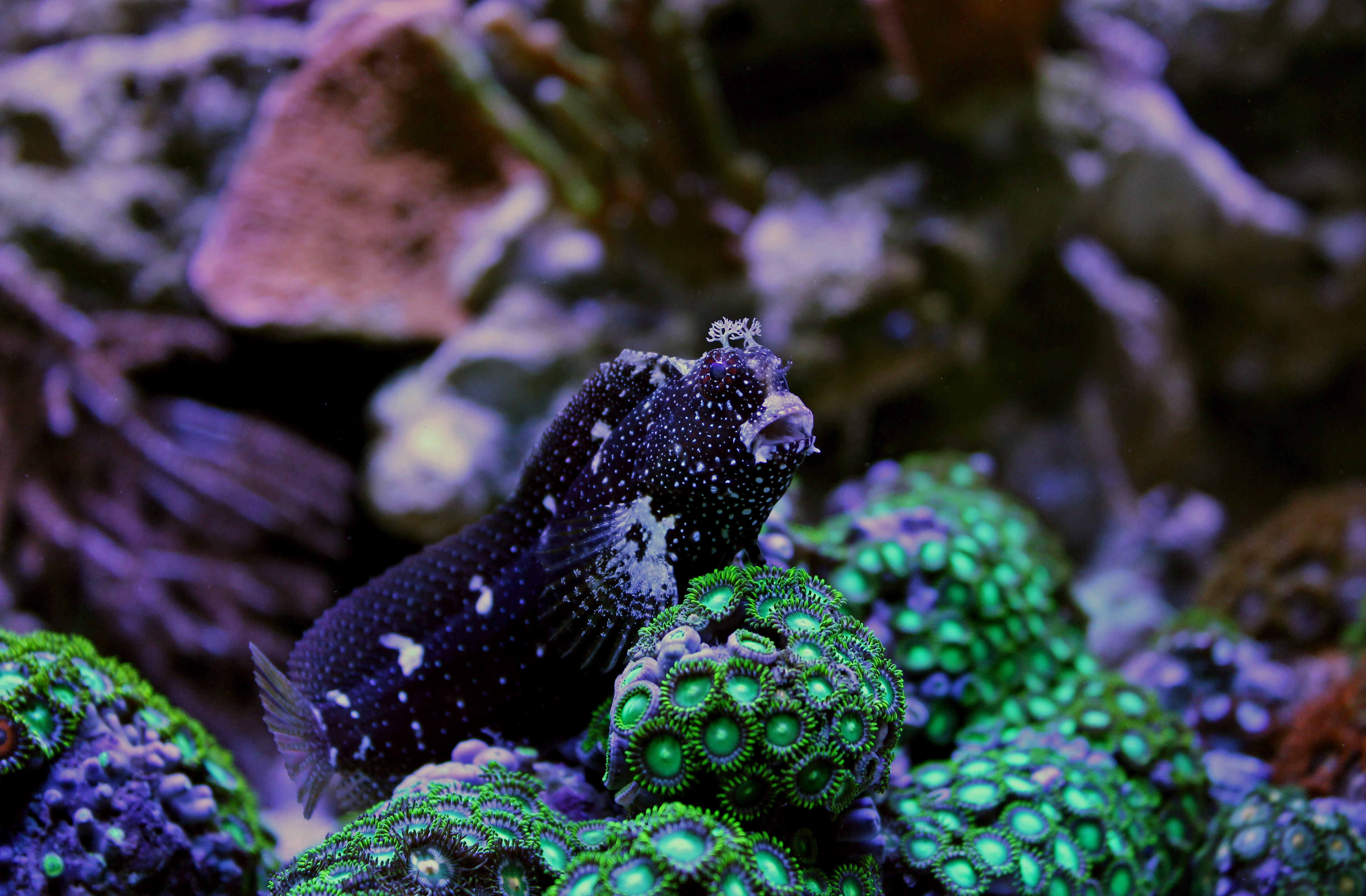
Jewel algae blenny (Salarias ramosus)
Just as ravenous towards algae as their common relatives, Salarias fasciatus, we opted for this species for colouration alone. They both reach a similar size, are equally fairly reef safe, and have similar temperaments. Their larger size and penchant for perching means they can knock over corals not fixed firmly in place. They require plenty of algae to sustain themselves, favouring filamentous types.
Scientific name: Salarias ramosus
Size: up to 14cm (5.5”)
Origin: Found from the Philippines down to Northwestern Australia.
Habitat: Lives in the protected inshore reefs in shallow waters, and across rubble zones.
Tank size: 120x45x45cm (48x18x18”)
Temperament: Can become quite protective over their favourite spots on the reef so keep singularly unless in high systems. Reef safe with caution as they may nip at sessile invertebrates and knock over frags.
Feeding: Requires a steady supply of filamentous algae growing in the aquarium. Supplement with nori sheets and other prepared plant based foods.
Availability & cost: Not as common as their relatives but still fairly available. You may encounter them as the starry algae blenny and prices start from £20 each depending on size.
Related article: Essential cleaners for the reef tank.
Striped fang blenny (Meiacanthus grammistes)
This is the only fang blenny that makes the list, although many species are wonderful and attractive. They spend a lot of time hovering in midwater, meaning you are likely to see more of them once settled.
Being a fang blenny, they are venomous, however, they are unlikely to cause you or their tank mates harm. They use their venom to protect themselves, biting the inside of larger fish's mouths when predated on. As always, approach them with caution when maintaining the tank and all should be well.

Scientific name: Meiacanthus grammistes
Size: up to 10cm (4”)
Origin: Western Pacific
Habitat: Occurs in lagoons and sheltered seaward reefs.
Tank size: 90x40x40cm (36x16x16”)
Temperament: Fairly peaceful towards other fish that are dissimilar to them.
Feeding: Feeds mostly on zooplankton so the use of frozen mysis, krill and enriched brine shrimp is a good starting point.
Availability & cost: One of the more common fang blennies, expect to pay £30 each.
Time to head to your local marine specialist store to see which blennies they have in stock. Whichever species you opt for, ensure to install a mesh cover guard or tight fitting lid. All the species listed above are great at jumping out of aquariums and we definitely want them to stay in the water.