


Torch corals are some of the most popular, on-trend corals right now. But what are they, how do you care for them? Jeremy Gay fills you in…
Torch corals are Large Polyp Stony (LPS) corals known scientifically as Euphyllia glabrescens. They are in the family Euphyllidae, which includes the beautiful but aggressive Galaxea, and Fimbriaphyllia.
Scientists moved the also popular hammer corals and frogspawn corals to Fimbriaphyllia from the genus Euphyllia back in 2017. Of course, we aquarists occasionally resist change, so you may still see these under Euphyllia in stores and online.
Torch corals are a branching hard coral. As their common name suggests, they have a flaming torch-like bouquet of tentacles coming from a bony stem. Their tentacles are typically two inches in length, or longer, when extended. Combine this with their colour and movement (two of the most desirable traits in corals) it clear to see why they’re so popular.
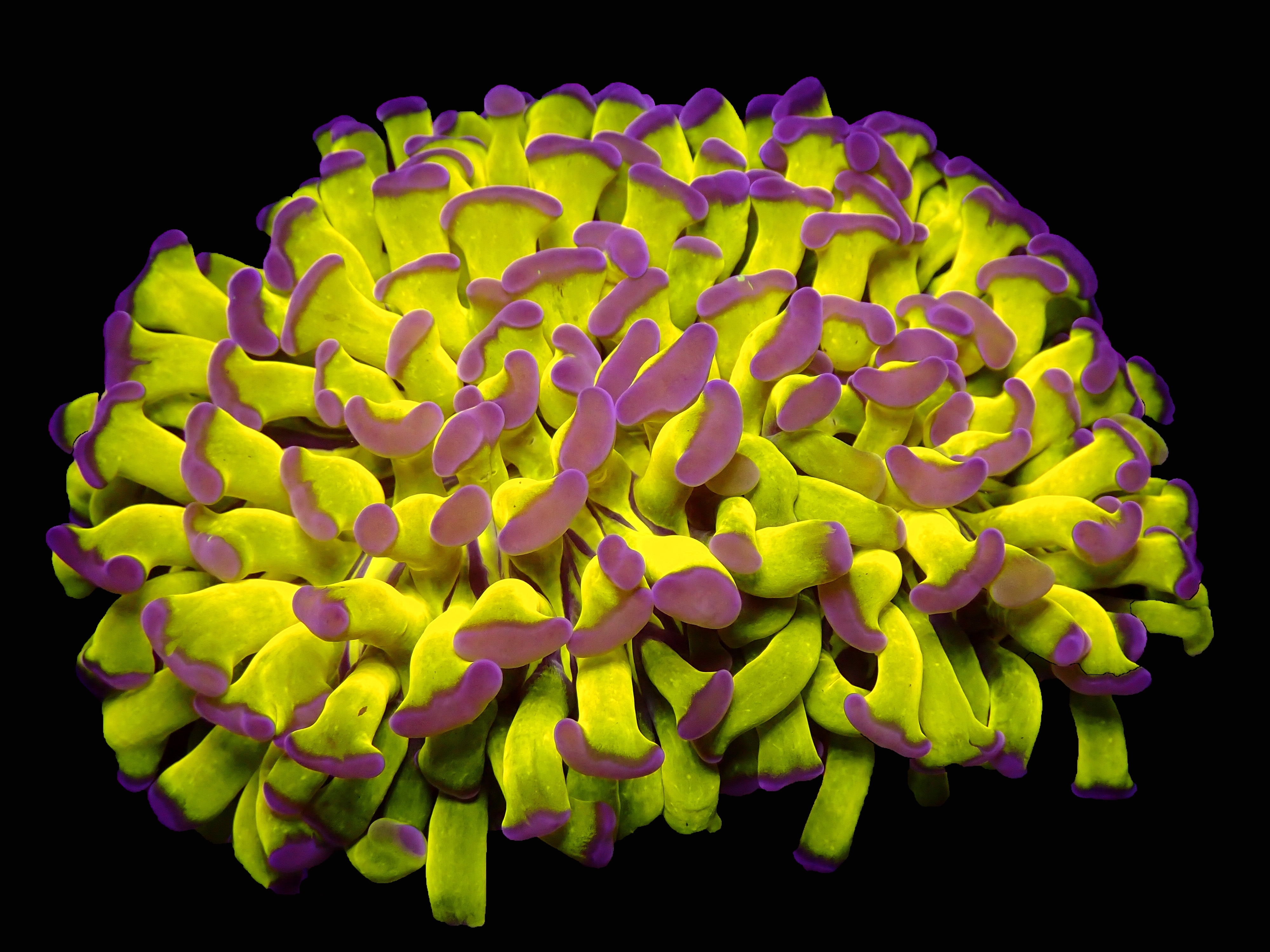
Hammer corals are no longer in the Euphyilla genus. Photos all by Shutterstock
Where do torch corals come from?
Torch corals come from the Indo-Pacific. The ones we keep either come from Indonesia, the Great Barrier Reef, or Western Australia. Although, collecting torch corals, and many other species, is not currently possible in the Great Barrier Reef.
The ones from Indonesia are typically maricultured, whereas the Western Australian ones are wild collected. Although Indonesian and Queensland torches look similar, the Western Australian ones are often darker, with shorter tentacles.
Popular Indonesian variants include ‘Dragon Soul’, ‘New York Knicks’, ‘Holy Grail’, and ‘Gold’ torches. The more colourful and desirable the torch, the more money they demand. Some torch corals may cost hundreds of pounds per polyp. Whereas, most are around £30-45 per polyp (or head.)

Torch coral care
Torch corals need water parameters similar to natural sea water (NSW). Aim to keep your reef tank with the following parameters:
- 1.025 s.g (35ppt)
- Temperature 24-26°C (75-79°F)
- KH 7-8
- Calcium 400-500ppm
- Magnesium 1300-1500ppm
- Nitrate under 5ppm
- Phosphate under 0.1ppm
Add them to a mature reef tank, and only purchase well-rested or as a frag from another hobbyist’s stock. This is because torch corals are susceptible to shipping stress when wild or maricultured. They can also sustain damage to the delicate polyps during shipping. Both good reasons to keep transport distance to a minimum.
Only buy a torch where all the tentacles are fully extended and the flesh is at least halfway down the skeleton. As a colonial coral, they may be offered as colonies containing several “heads”. You must inspect each head to see that they are healthy and not damaged. If a colony has a retracted head, with brown slime, or a totally skeleton, it's probably best avoided.

This coral's polyps are not fully extended and it appears to be sulking.
Although torch corals are desirable in terms of looks, they can be a tricky coral to master and aren’t recommended for beginners. Their cousins, the branching hammer and frogspawn corals, are easier and can be just as impressive.
Related article: Back to saltwater: starting with simple beginner corals.
Light, flow and placement of your torch coral
Those long tentacles need to be moving, so torch corals need wavemakers and at least medium flow. One Australian torch coral collector said that they actually need much stronger than most think. In the wild, the flow can be so strong that the coral retracts its polyps during the daytime.
For light, high-powered LEDs are best. Place the coral halfway up the tank to achieve PAR readings from 100-300. If the torch coral doesn’t look happy, consider moving them.
All corals can sting each other. Therefore, other corals should be far enough away from the torch so that the tentacles can’t touch, and vice versa. You can place Indonesian torches next to each other though, as they do not sting conspecifics.

They look peaceful and don’t send out sweepers per se. However, every so often they will extend a tentacle to double its normal length which can sting neighbouring corals. Leave a safety perimeter of 10cm (4”) if possible.
Fragging torch corals
Most torch corals have already been “fragged” when you buy them. Someone will have likely cut a colony of 20 heads down into smaller colonies, or even single heads.
Torch corals propagate asexually by division. An oval polyp grows and becomes a figure eight, before splitting into two.
Every polyp and corallite will have its own branch, and it's the branches that you cut to frag them, not the corallites. Ideally, you should split branches where the bare skeleton is on show. You can do this by hand, cut them with pliers, or cut with a diamond band saw.
Related article: Fragging corals: chips off the old block.
Brown jelly disease
Torch, hammers, and frogspawns are prone to a disease known as “Brown Jelly.” A brown slime forms around an already shrunken polyp, dissolving it within days before spreading throughout the colony.
Infected torch corals can infect others and wipe out valuable stock. Many theories exist as to what it actually is.
The number one cause is a stressed or weakened coral in the first place. Being damaged during transit, poor water quality, and getting exposed to infected colonies are all likely routes of infection.
The number one recommended treatment on the internet is with an antibiotic called Ciprofloxacin. The use of this without a veterinary prescription in the UK is illegal. use other legal treatments like Polyp Lab’s Reef Primer instead.
If you detect “Brown Jelly” quarantine the whole torch colony. Although most don’t have that luxury and have to treat the whole of the main tank.
Cut away and discard any dead polyps, remove and dip the whole colony. Also, try to avoid other torch, hammers, and frogspawns from being “downwind” of the affected colony.
ICP-test the tank water to ensure that water chemistry is as good as it possible can be. Check that waste nutrients are low, and consider fitting a UV steriliser to reduce the bad bacteria in the water. “Brown Jelly” is a scourge that can affect all torch owners, while at other times torch heads can just shrivel up and fade away. Like all super desirable corals, torches can test even the best reefkeepers, and catch them out when they least expect it.