


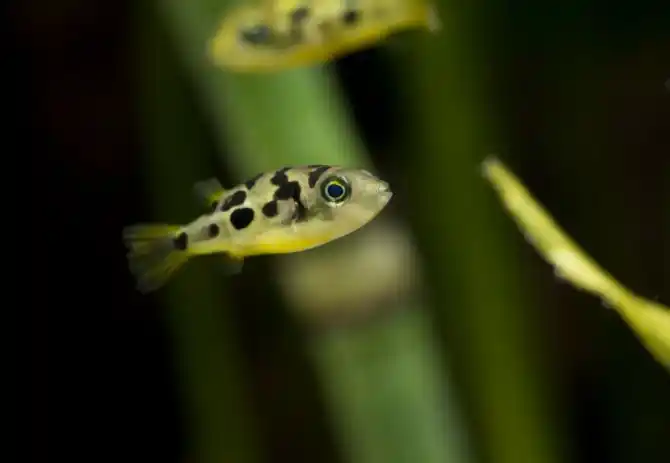
Pufferfish can evoke a smile from even the sourest of sourpusses, admits Nathan Hill. He outlines how to keep the dwarf pufferfish with a step by step tank build for the tiny Carinotetraodon.
The most enduring, admired and adored fish in the hobby have to be the many pufferfish varieties. Traditionally speaking, the challenges of keeping puffers have been split into three categories: size, salinity and temperament.
The size issue is mostly a marine problem. Huge dog-face and porcupine puffers are far and away the most appealing, but also the largest, as though their cuteness is directly correlated with their size. These bloated jesters, reaching 50–60cm/20-24" or more, are not for the starter aquarist. Nor many experienced ones.
Salt has been the bane of many puffers, mainly because there seems no 'folk wisdom' consensus on exactly which species require brackish conditions, full-blown marine or fresh. For years, there has been confusion about exactly how much salt to give a figure eight or green spotted puffer, resulting in errors, white spot and death.
And lastly, there’s temperament. Pufferfish are well armed, with slicing ‘beaks’ and a tenacious lust to bite absolutely anything that can be bitten. It’s as though they explore the world with their teeth as a primary sense organ, such is their propensity to chomp much like a young puppy. This means that almost everything that has been housed alongside traditional pufferfish has ended up either shredded or decapitated, resulting in lightly stocked tanks and heavy disappointments.
Related article: Marine puffer fish: The inflation great!

What are dwarf/pygmy puffers?
This all changed when the world’s tiniest bundle of adorable appeared in the hobby. The dwarf Indian puffers, also known as pygmy puffers or Malabar puffers were a revelation for the everyday aquarist being small, entirely freshwater and not quite the relentless psychopaths that we naturally expect of their relatives. That’s not to say they’ve been problem free though.
In some cases, enthusiastic buyers plunged them into community tanks where they immediately raced over to say 'hello' to the resident Siamese fighter in the same way my Scottish terrier tries to say 'hello' to squirrels. A little foresight regarding tank mates can go a long way.
While there are many common names used for this species, it doesn't get a whole lot easier with the scientific name either. As there are in fact two dwarf puffer species — Carinotetraodon travancoricus and C. imitator. Both are barely 2.5cm/1” when mature and distinguishing between the two is difficult. Many exporters seem not to bother, so dwarf puffers sold in aquarium shops may be either species, or a mixture of both.
Females and juveniles of both species are essentially identical, being golden brown with metallic reddish-brown speckles and blotches. Mature males of both have the keel, revealed by a dark band running along the belly of the fish. The blotches on the flanks are generally bigger and arranged in longitudinal bands. At least some males have iridescent wrinkles behind their eyes.
As for distinguishing between male C. travancoricus and male C. imitator, there seem no consistent methods. Complicating matters further is the variety of C. travancoricus traded as the Blue-spotted dwarf puffer. It’s essentially the same as the standard form, but with iridescent blue-green blotches rather than reddish-brown ones.
Avoid wild fish
The home aquarist should be mindful to try to avoid wild caught specimens when purchasing pufferfish, due to the impact that the hobby, along with other factors, is having on wild stocks. Though some researchers want to classify Carinotetraodon travancoricus as endangered, the IUCN (International Union for Conservation of Nature) Red List sees it fit to class them only as vulnerable. Overfishing for the hobby is cited as one reason, though damming in India, aggressive agriculture and deforestation all plays a part.
The figures suggest that over a five-year period, wild populations fell by up to 40%. Ask your retailer the origins of the fish before buying, as this is one situation where farmed or locally bred fish may indeed be preferable.

Buying advice
Their popularity means that you’ll find dwarf or pygmy puffers in dozens, if not hundreds, of stores around the UK. When you find them, check for plumpness and condition before buying, as some are sold in an undernourished state. If you can, request to see the fish feeding before making your decision.
Being small and readily available, expect to pay anywhere upwards from around £3.50 per fish. But remember to keep eyes open for farmed puffers over wild!
Are pygmy puffers poisonous?
Probably not. At least, not in the same sense as their larger fugu cousins. Puffer poison is well understood in popular culture and not just as a recent phenomenon. Even Captain Cook had a run in with the stuff when half of his sailors fell ill from eating puffer flesh and all his pigs died.
The poison in question is Tetrodotoxin, or TTX, a frankly horrific neurotoxin to succumb to. Eat the wrong bits of fugu and your body shuts off while you remain conscious. All the involuntary muscles such as the heart and diaphragm stop, and you die. You don’t need much of it either. As much as you can carry on the head of a pin will easily kill an adult human.
Female puffers are thought to be more toxic than males, with ovaries being able to store more of the poison than testes. Marine puffers might make their own toxin from symbiotic bacteria, however, they might gain it through eating other organisms that produce it such as the algae on the shells of certain shellfish. In the confines of a tank, without access to toxic food sources, there’s little reason why we should expect Carinotetraodon to become too much of a health hazard. That said, you still wouldn’t want to eat one. That’d just be silly.

How to set up a dwarf Indian pufferfish tank
I took the chance to rig up a Fluval Fresh 85 l/19 gal system that I have been sat on for a while for my pufferfish foray.
Once filled with sand and décor, I calculated the volume to be closer to 60 l/13 gal of water, which is perfect for a shoal of six pufferfish.
Here’s how I did it...

1. The tank is cleaned and placed on pieces of trimmed absorbent matting to balance out any irregularities between glass and cabinet. The filter and lighting are then installed.

2. Two pieces of lava rock are added at one corner to act as the foundation to build up my ‘riverbank’ edge. I have chosen the side with filter pipes to help obscure them.

3. A single central piece of presoaked Redmoor wood is added to provide an intricate structure for the puffers to explore. It is vital to soak this wood in advance to stop it from floating. If this is not possibly consider using a small amount of cyanoacrylate glue to fix it to the heavy rocks.

4. Approximately 15kg of thoroughly washed aquarium silver sand is added to the foundation rocks to create a deep bed.

5. A large flat cobble and smaller subordinate cobbles are added to the middle of the tank. They help to reduce 'sandsliding' and create a transition from flat to bank.
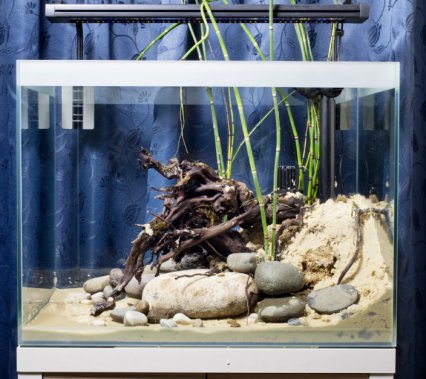
6. Loose twigs are added for effect, and the two marginal pond plants, Equisetum japonicum, are removed from their pots, the roots rinsed and then added to the bank to break the surface.

7. The tank is filled and six bunches of assorted Vallisneria sp. are divided up into individual plants and added to the display using planting tweezers, but only along the back and side.

8. The heater is added, and floating ‘nuisance’ plants and algae, taken from a retailer’s pond plant vat, are added to the surface. These help reduce the impact of the LED lighting.
Key equipment
- Fluval Fresh 85 l/19 gal aquarium with filtration, heating and LED lighting
- 15kg aquarium silver sand
- 1 medium piece of redmoor wood
- Approximately 6kg of lava rock
- 4-5kg of assorted cobbles, including one large flat cobble
- 2 x Equisetum japonicum pond plants
- 6 x bunched Vallisneria sp.
- Floating duckweed and algae
On the whole, keeping pygmy puffers is so easy you’ll be left wondering why you don’t have tanks of them all over the house. The only single, difficult aspect is feeding, but as long as you’ve got a freezer, then you can easily overcome that obstacle.
By way of return for meeting their requirements, they’ll reward you with some of the most comedic antics that any fish can muster. Give them time and they might even start to breed for you too, without any extra outside help.
Even an old sourpuss like myself has to admit that I spend way more time watching my puffers during the evening than any other fish I’ve owned, and to date I’ve never been able to second guess quite what they’ll do next. Join the pufferfish camp, and I doubt you’ll ever look back.
Feeding dwarf pufferfish
Dwarf puffers hate flake foods. Offer it and they’ll look at you with indignation. They’ll potter across for a curious scan over then let that flake slump to the base, where it’ll sit, festering. Offering the right or wrong food will make a huge difference in your success as a fish keeper.
Bloodworm is never refused, either live or frozen, and other foods are accepted according to individual fish temperaments. Some will also gorge on frozen daphnia or cyclops, some will only accept live.
The same applies to brine shrimp and tubifex. Invest in a mixed pack of frozen foods, such as a quintet with five different ingredients and see which your fish prefer.
Do I need to trim pufferfish's teeth?
Many larger puffers suffer from dentistry issues in aquaria, as their sharp beaks (actually four fused teeth) aren’t worn down from foraging food and crushing mollusc shells. Carinotetraodon succumb to this less, but it is still something to be aware of, and their diet should include creatures with a hard shell that needs biting through.
Snails are a good choice, and if you know other fishkeepers, I’m sure they’ll be happy to let you take some of theirs away. While daphnia are another option in helping keep teeth trim and you should make a note to pick up some live ones whenever you see them offered.
What sized aquarium do dwarf pufferfish need?
Their tank need not be particularly big, unless you’re housing a shoal of them, which you definitely should. Wild puffers like to move in large collectives; this is why they’re so easy to catch, and they have a migratory, cyclical lifestyle.
Despite their waspish nature to some other fish, they do enjoy the company of their own kind. Because of their adult size of a mere 3.5cm/1.4" for wild caught specimens and an optimistic 2.5–3cm/0.9-1.2" in aquaria, they’re suited to anything around the 60cm/24" long mark.
Keeping them at a density of one fish for every 10 l/2 gal of swimming space is a pretty safe bet, as long as the sex ratios aren’t skewed heavily towards males. Males will bicker and squabble, and there’s some evidence to suggest that in a young group, the first fish to take male sexual development will release pheromones to inhibit the sex changing of its contemporaries.
What filter is best for tiny puffers?
Water quality needs to be pristine, and an oversized, but underpowered filter is advised. Their wild waters are slow moving and they don’t have the body shape for turbulence. Where other fish may be streamlined and hydrodynamic, cleaving through water like aquatic gazelles, puffers tend to have all the manoeuvrability of an inebriated cow. Opt for filters that can spread any return flow to the tank over a wide area, minimising any fast torrents or eddies.
Biologically speaking, the filter needs to be big as the fish are messy. With vast appetites and an affinity for spitting chunks of food out, so expect pollution to be erratic in poorly managed tanks. Getting in to the habit of removing uneaten scraps with a net or siphon hose after each meal is good practice.

Water conditions for dwarf puffers
Water chemistry can be slightly acidic or surprisingly alkaline, with records of the fish being collected in rivers anywhere between 6.8 and 8.3 pH. Hardness is equally diverse, and anywhere between 5 and 25°GH they are fine.
Temperature should sit between 22 and 26°C/72 and 79°F, though wild samplings have revealed fish from rivers in excess of 33°C/92°F during summer months.
Related article: A guide to Asian pufferfish
How should I decorate the aquarium for pufferfish?
Decoration is where the aquarist should be indulgent. Unlike many fish that glide about like automated submarines, oblivious to everything around them, dwarf puffers need to be enraptured at all times. To them, the world is one fascinating place to be explored on the smallest level, through the medium of eyes and teeth.
Wild habitats in the Kerala region of India involve plenty of leaf litter, marginal vegetation and fallen branches, but in aquaria, anything that can be explored will keep them occupied. Be creative with caves, make dense thickets of plant mass and add as many anomalies as you like — I’ll even forgive the air-powered scuba divers — and they’ll love you for it.
Aim to break up their line of sight in case any bickering does occur. Puffers tend to be angry only for as long as they can see the object of their rage. The moment it’s gone, they’ll swan off in child-like wonderment to look at a plant stem, piece of gravel or upturned leaf instead.
Can dwarf pufferfish live with tank mates?
Anything slow or cumbersome will be nibbled, and even fast fish such as danios can receive the occasional sly nip.
Shrimps are generally a no go, unless you want them dismembered, and snails are right out; some keepers have managed it, but they’re certainly the exception rather than the rule. Unfortunately, each fish has an individual temperament, so I can only advise you to err on the side of caution. I’ve seen dwarf puffers kept with guppies, gouramis, catfish and even crabs, but I would personally only ever consider species-only tanks.
In the wild these fish can be found with a variety of others, some familiar, others less so. Typical constituents of the regional fish fauna include various barbs, danios and rasboras, halfbeaks, and predatory species such as glassfish (Parambassis spp.) and leaf fish (Pristolepis marginata). One of the relatively few Asian cichlids is from this part of the world too — the rarely traded but beautiful Canara pearlspot (Etroplus canarensis).
Breeding pygmy puffers
Dwarf puffers have occasionally been bred in home aquaria. Because of problems distinguishing the two species, it isn’t clear which reports belong to C. travancoricus and which to C. imitator, but in all probability their breeding behaviours are identical. Indeed, the overall process is very similar to other Carinotetraodon species as well.
Sexually mature males can be distinguished by their brighter colours and mature females ready to spawn will become noticeably rounded as they fill up with eggs. Males secure territories among feathery plants with Java moss and willow moss (Fontinalis sp.) particularly well favoured.
A male attracts a female by raising his keel and engaging in fluttering dance routines. Spawning is very boisterous with the eggs being scattered into the moss. He then quickly chases the female away and assumes total responsibility for broodcare.
The eggs hatch after about five days, but the fry don’t start swimming for at least another week. Once that happens the male loses interest and he should be removed. The free-swimming fry will now need to be fed tiny live foods such as microworms and Cyclops nauplii. Growth is fairly rapid and the fry will be 1cm/0.4” or so after two months.
Spawning occurs readily if dwarf puffers are given the right conditions, namely lots of live food, slightly soft and acidic water conditions and suitable spawning sites. The tricky part is rearing the eggs and fry, as the eggs are prone to fungal infections, particularly in hard water. The tank needs to be spotlessly clean and the aquarist should use a pipette to extract uneaten food and faeces.
Want more fish keeping advice like this?
Sign up to our FREE newsletter for further fish keeping advice, useful fish keeping tips, competitions, latest news and updates, straight to your inbox! Sign up here.