


Tom Ryan outlines the steps he follows when planning, building and submitting his aquascapes for the International Aquatic Plants Layout Contest (IAPLC) in which he placed an amazing 22nd in 2024.
This is the second of a series of 6 articles covering the following stages of contest aquascaping:
PREPARATION
IDEOLOGY & CONCEPT EVOLUTION
HARDSCAPE DESIGN
PLANTING, MAINTENANCE & ADJUSTMENTS
PHOTOGRAPHY
FINAL PHOTO
Josh Sim's 'Samurai'
Ideology & Concept Evolution of Contest Aquascaping
In simple terms, ideology and concept evolution is the process of idea creation before starting work. The end goal is to result in a clear overall 'theme' of a layout. The question is, how do you end up with a clear theme?
In short, there are many different ways and it is up to an individual to learn what works best for them. I've seen people use a mood board, replicate an image from nature, sketch their own image or take inspiration from past works.
Whichever method you decide to use, ideology and concept evolution is the most important step in contest aquascaping. Your aquascape will stand out and have identity should you follow this correctly.
Without an identity, a layout falls into the trap of becoming a 'jack of all trades' achieving neither this nor that. Even in contests, I see layouts fall into this trap where there is no clear 'theme' (a factor which separates the top ranks).
This is one of the steps which separates an aquarium for personal enjoyment and one made for a contest. This stage has limited or no time dedicated to it in many non-contest aquascapes. You can still achieve a beautifully planted tank without a clear theme. However, reaching the top rankings or producing something that people will remember for years to come is unlikely.
To better understand the importance of this, I like to put myself in the judges’ shoes. For one, they have 'x' number of works to assess and only a photo and a title to choose between them. The 'theme' therefore must be quick and easy to understand for aquarists and non-aquarists alike. For example, if you are creating a forest, there must be both trees and roots to capture the atmosphere.
Focusing on IAPLC
Following the IAPLC 2021 result announcement, ADA published a video with two of the judges. Shogo Yamaguchi and Yusuke Homma outlined what they want like to see in contest aquascapes in the future. They stated "we want to see works that moves people's hearts...works that have a story...and express the creator's feelings". These comments embody what ideology and concept evolution is all about.
Moving to the judging for the IAPLC, there is a primary and secondary screening. The primary screening has the sole purpose of selecting the top 100 works. The screening committee now receive guidance from the judges to aid their decision- a new addition in the 2024 contest!
The secondary screening then gives the judges an opportunity to reassess the top 100 works. Ranking them in accordance with the judging criteria. Importantly, there are three aspects of the judging criteria which directly relate back to the overall 'theme'. These account for 70 of the 100 points available in each of the screening stages!

You might ask, how does the 'Presentation of natural atmosphere in layout work' link to ideology and concept evolution? Or even the 'Recreation of natural habitat for fish' for that matter. However, it becomes a lot clearer when you look at it in a different way.
If you were to sift through the IAPLC you will be able to separate all the works into two 'camps'. These are the Nature Aquariums and the dioramas. This is nothing new or ground-breaking. The nature aquarium 'camp' should actually find it easier to achieve the above assessment criteria.
Diorama layouts typically have insane depth, perspective and strong/wild hardscapes. Nature aquariums are more subtle, featuring dense aquatic plants and having a 'zen' feeling.
However, I feel this is not necessarily the case. Many nature aquarium layouts have taken aspects of dioramas. This is muddying the waters, pardon the pun, between the two styles.
There seems to be a shift in momentum and a 'grey area' formed. The sifting process is no longer a straightforward one.
Underwater or landscape aquascapes
If we separate the works into 'underwater' and 'landscape' layouts, I find the separation process much clearer. For me, these two 'camps' more strongly resonate with the two criterion I highlighted above. They get to the crux of what I believe the IAPLC meant when deciding to include these in the judging criteria.
Both 'underwater' and 'landscape' layouts can create a 'presentation of natural atmosphere'. Yet, only 'underwater' layouts can produce a 'recreation of natural habitat for fish'.
I met Josh Sim at the Horizon Aquatics workshop earlier this year. I asked what he focusses on when creating a successful contest layout and he replied "creating an underwater feeling". At the time, I was a bit surprised thinking surely all aquascapes are underwater! But I realised afterwards that many layouts take inspiration from terrestrial landscapes.
To create an 'underwater' layout you need to be thinking about this from the ideology and concept evolution stage. You need to focus on underwater scenery and not terrestrial ones from the beginning.
We do not need to reinvent the wheel here. The aquarists that create biotope aquariums have been creating underwater scenes far longer than us! I like to refer to the layouts of the Biotope Aquarium Design Contest (BADC) as a source of inspiration.
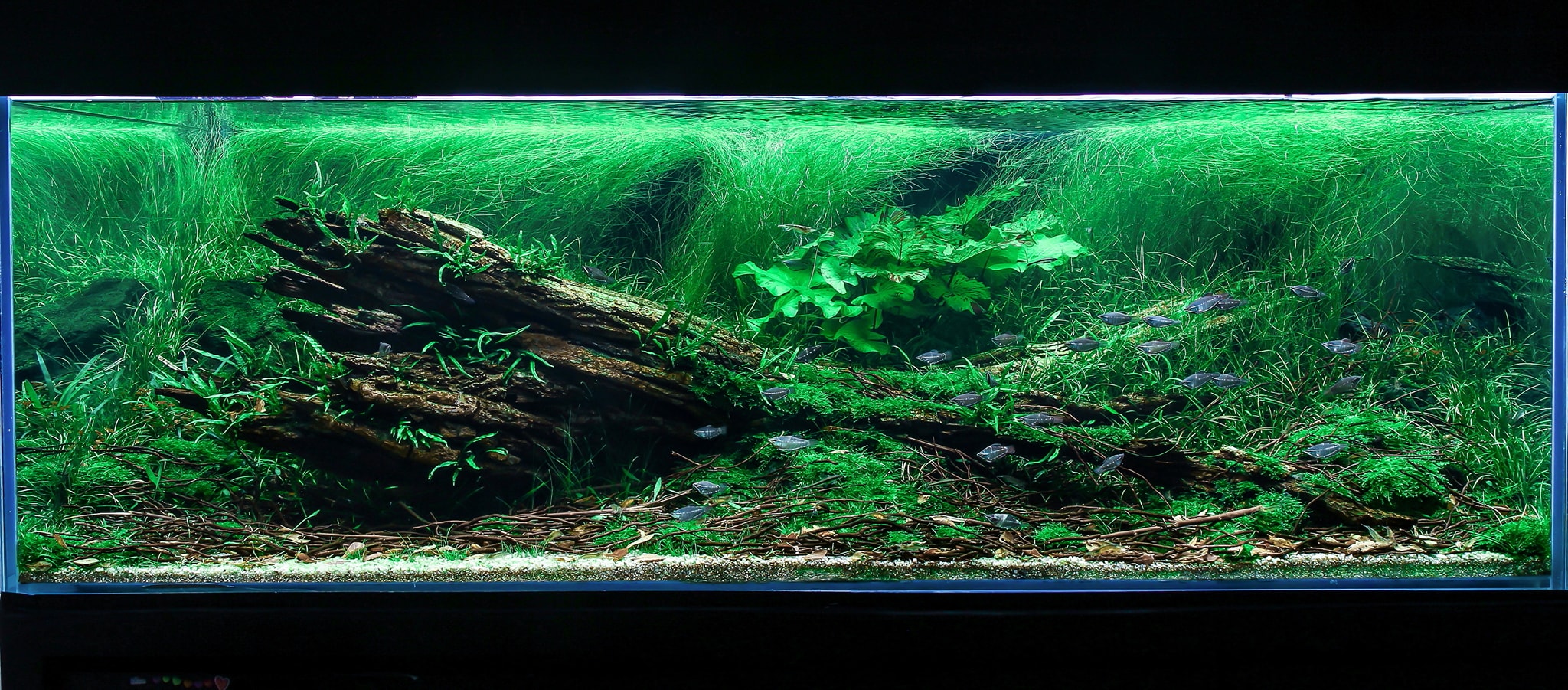
I've included my favourite examples of 'Underwater' layouts within this article.

Ismael Aguilar's 'Rolling River'
Spotlight on 'Closing'
During my ideology and concept evolution stage for 'Closing', my inspiration came from a specific combination of plants. The works of Takashi Amano are the links that connect the species of aquatic plants, not location. The plants used were Glossostigma elatinoides, Riccia fluitans, Eleocharis sp. (a classic combination seen in Takashi Amano's early works).
This is a different approach to what I've used in my past IAPLC layouts. I often started with a 'main character' (fish species) or 'specific location' (i.e. Amazon). This approach is more in line with biotope inspiration mentioned above.
In 'Closing', I knew my work would need to be a classical iwagumi. This pays tribute to the use of these plants first pioneered through the works of Takashi Amano. A constant overall theme for this contest aquascape was 'nostalgia'.
The source of inspiration: Takashi Amano's 'Complete Works' book. I knew my planting was important to create an underwater layout and natural habitat for fish. Unlike for my previous two works which arguably had more of an 'Underwater' theme.
I chose to incorporate Riccardia chamedryfolia on the rocks to replicate the passage of time. Simulating the moss found creeping over stones underwater. The surface ripples created in the final photo also enhanced this effect. The photo below from my visit to the Lake District was a good reference point.

This allowed me to step away from the 'dry' feeling of the hardscape and add a 'wet' feeling to the work. The hardscape stage is therefore not the only stage where you can create the underwater feeling. Plants, fish movement and surface agitation can also create this effect.