


Tom Ryan outlines the steps he follows when planning, building and submitting his aquascapes for the International Aquatic Plants Layout Contest (IAPLC) in which he placed an amazing 22nd in 2024.
This is the first of a series of 6 articles covering the following stages of contest aquascaping:
PREPARATION
IDEOLOGY & CONCEPT EVOLUTION
HARDSCAPE DESIGN
PLANTING, MAINTENANCE & ADJUSTMENTS
PHOTOGRAPHY
FINAL PHOTO

Hardscape Design
The hardscape is the skeleton of an aquascape. Importantly, it serves as the framework for planting. Plenty of great workshops discuss techniques on how to improve hardscape design; there are many theories around this topic.
One of my favourite workshops is Josh Sim's Green Aqua Masterclass. Rather than repeat the techniques discussed in this video in this piece you can head over and watch yourself. However, I will add my take on a few things which Josh doesn't cover in detail (with a focus on Iwagumi layouts).
Negative space
For me the crucial part of any hardscape design is the balance between the hardscape and the negative space. You may hear aquascapers say "open space" instead of "negative space.
Critically, you need to avoid the layout feeling 'oppressive'. This is the feeling of a layout being too stifling, closed or heavy in its overall impression on the viewer.
Many contest aquascapers consider the hardscape the most crucial part. Aquarium hardscape is certainly one of the key elements to create a layout with everlasting impact.
To do this, it requires large pieces of wood or stone to create a structure that fills the majority of the tank. Divide the tank into even segments: left to right, front to back and top to bottom. Each segment plays a role in the overall impression of a layout.
However, it is easy with this approach to add too much hardscape in the hope that this creates the desired impact. You will end up with the layout becoming too 'flat' with no sense of depth, perspective or layering. Think back to part 2 of this contest aquascaping guide on ideology and concept evolution. The sketching of an initial layout design would help to serve as a useful reference point to avoid this issue.
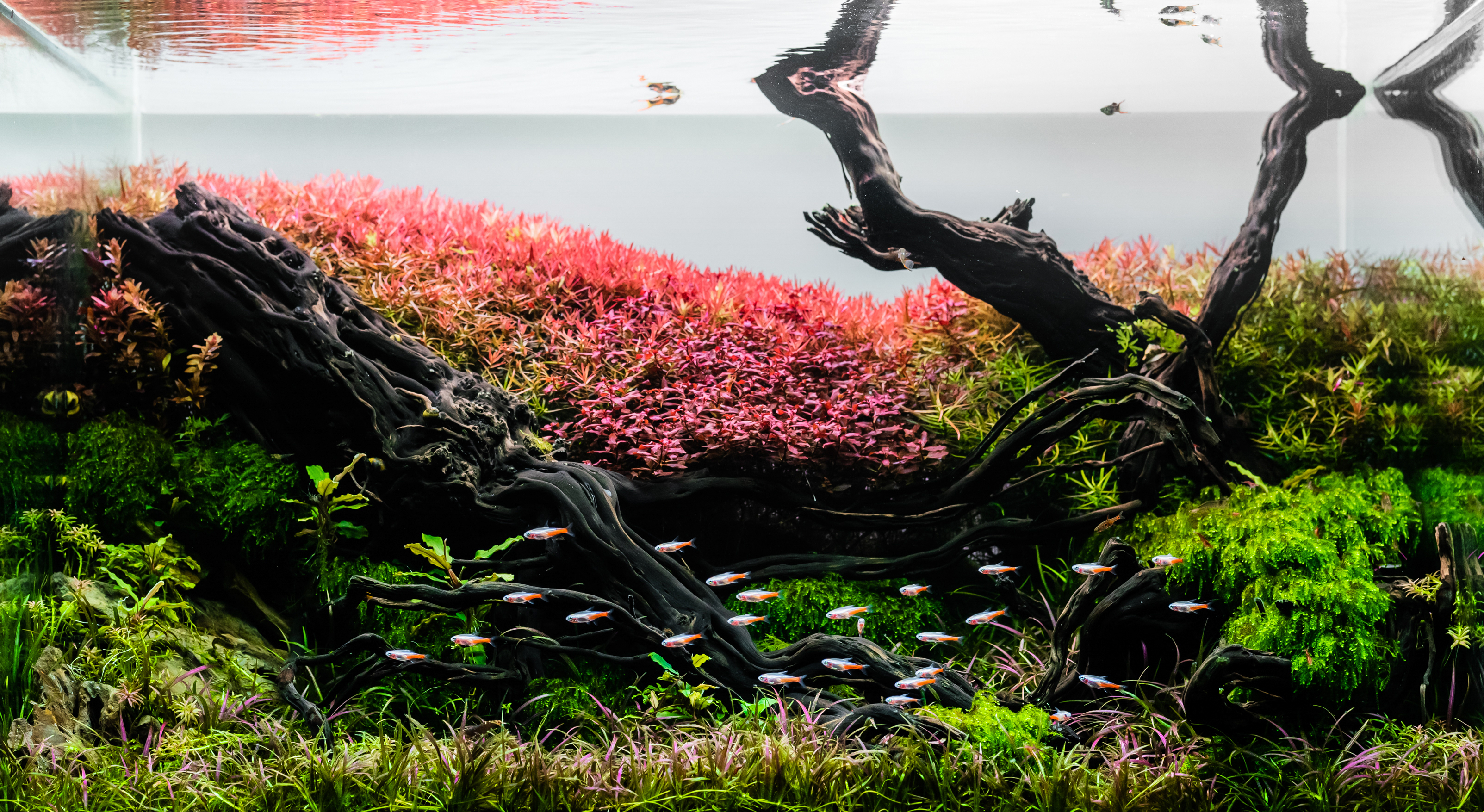
Photo by Shutterstock
However, I tend to focus on the impact created through the negative space, rather than the hardscape itself. This is because the first thing that captures the eye of the viewer is the end point of a layout. It acts as the anchor point for where they focus their attention.
Most of your effort should therefore be around the end point. Use it to create perspective and depth through the positioning of the aquarium hardscape. Use the techniques discussed in Josh's workshop to find the appropriate balance of a heavy and light hardscape impression.
For me, during this process it helps to think in extremes. You want to incorporate bright/dark, heavy/light, large/small and near/far aspects into your work to add interest and different layers. Try endless combinations in the aquascaping dojo to ensure the hardscapes best 'face' is visible. Once you are happy with it, you can transfer it to the tank.
Iwagumi aquascape
Different aquascaping styles focus on hardscape design in different ways. For classic Iwagumi layouts, less is usually more with the stone arrangement. When I say 'less' I do not mean there should be swathes of negative/ open space (this will not create impact). Instead there should be an appropriate balance between the main and supporting stones.
To understand this concept in more detail, it is important to have a grasp of the stone types in an Iwagumi layout:
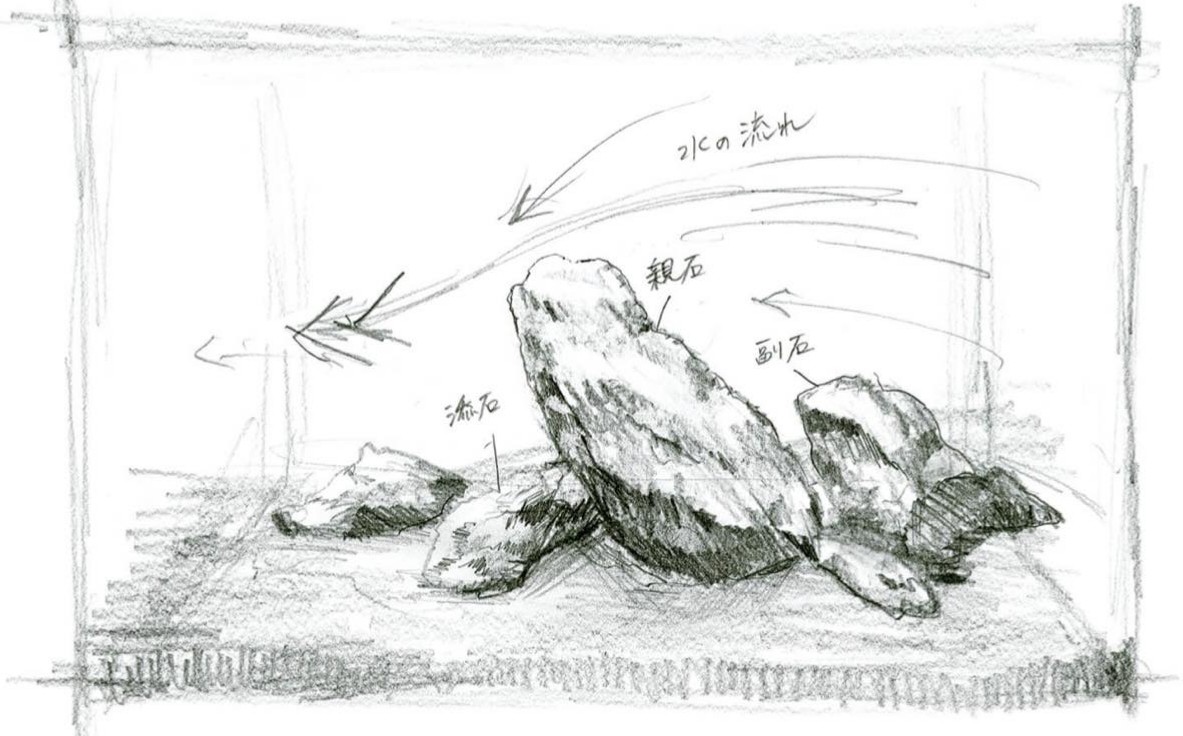
- Oyaishi: the main and largest stone of a layout. This is generally placed at the golden ratio point and should tilt in the direction of the water flow.
- Fukuishi: the secondary stone, generally the second largest. This should resemble the main stone but be smaller in size and used to balance the impact of the Oyaishi. This stone can create tension in the layout.
- Soeishi: used as the tertiary stone and usually placed alongside the Oyaishi to accentuate its power. This is the third largest stone in a layout.
- Suteishi: these are supporting stones which are not meant to stand out, but can be used to bring an overall balance to the layout.
In the ADA videos of the past, Takashi Amano would place stones and then remove them from the tank to find the perfect balance. This is a great method as the best Iwagumi layouts will have just the right number of stones to create a harmony. Too many stones and you take away from the impact/ power of the Oyaishi.
For Iwagumi, there is however a higher margin of error as every stone has its place. Each contributing in some form to the overall balance. For me, mastering this technique and knowing when to 'stop' adding or removing stones is aquascaping in its purest form.
This is notably different for wood-heavy layouts. You arguably have more flexibility, as each piece of hardscape has less of an impact on the overall impression.
One thing which helps me to understand the philosophy of Iwagumi is to refer to the 3 traditional styles. Many modern variations seen in contest aquascaping have roots in these styles.
Radial
Traditional
An Iwagumi where the stones are arranged radially from the focal point to the four corners of a layout. Radial Iwagumis are suitable for both 'underwater' and 'landscape' styles of aquascaping.

Successor
Not regularly seen or interpreted in modern contest aquascaping. The closest evolution of this style is Luis Carlos Galarraga arrangement 'Top of the World' in 2020. It creates a dynamic layout with a strong sense of perspective towards the end point. I also adapted this style for 'Closing' (something I will cover below).
Sanzon
Traditional
Literally translates as 'three-pillared rock formation', which utilises the Oyaishi, Fukuishi and Soeishi stones. Closely resembles the rock formations of river beds and therefore has an 'underwater' feeling.
Successor
The evolution of this style is seen in many ADA aquascapes. It utilises two or even three groupings of Sanzon to create a larger Iwagumi. The composition flows left-right or right-left with a strong sense of water flow.

Hilly
Traditional
Bank up the substrate high on both sides in line with the golden ratio to create the sense of a vast landscape. Place smaller stones to resemble mountains in a distant and panoramic view in a 'landscape' style.
Successor
The Brazilian-style is a modern take on this and is used commonly in aquascaping contests. The scape that came 5th in 2016 International Aquatic Plants Layout Contest is a good example of this.
Building on traditional Iwagumi styles
Understand these traditional Iwagumi styles and use them as a guideline for your work. Although, it can be a bit of a 'red-herring' to restrict yourself to their strict arrangements. The rigid rules mean that aquascapes can look similar and the layout will not look original.
You will notice the 'successors' are similar to the 'traditional' styles but add an element of complexity. This creates more of a unique layout design. This is important to achieve the top rankings, as you need to showcase something different.
Instead, I focus more on the following elements (whilst using the traditional layout styles as guiding principles):
1. Impression of the two main stones (Oyaishi and Fukuishi);
2. Direction of flow; and
3. Gravitational position of the overall stone arrangement.
The order I have listed them in is also the order of importance. For example, the third element is less important if you are creating a Sanzon Iwagumi. Tthe direction of flow means the gravitational position of the stones is relatively similar along a horizontal axis.
These three elements help me to decide the size, shape and direction of the supporting stones. Creating a balance to the overall hardscape design.
Spotlight on 'Closing'
My IAPLC layout this year was based on the guiding principles of a Radial Iwagumi.

I felt this style best suited the aspect ratio of a 90p, as it is most similar to a U-shaped composition. The downside with using a 90p for a Radial Iwagumi is the end point will inevitably be more central.
This has the tendency to create a symmetrical layout, which doesn't look natural. On reflection, I struggled to avoid this aspect when creating 'Closing'. The Oyaishi and Fukuishi were similar in size creating a form of symmetry.
An Iwagumi should incorporate Oyaishi (A) > Fukuishi (B) > Soeishi (C) and not Oyaishi (A) = Fukuishi (B) = Soeishi (C).
The positioning of the Soeishi helped me to create a heavier impression on the right side of the tank. I tilted this stone backwards to create a sense of tension.
