


Emma Turner spotlights a remarkable air-breathing loach that can survive for several hours out of water and, by its body actions, also predict storms.
Initial impressions of weather loaches are never normally one of wonder or beauty. However, their fascinating behaviour and endearing personality more than make up for such a shortcoming.
Few others can survive in little, or stagnant water — and surely fewer still are able to predict bad weather. This is truly a remarkable fish.
Misgurnus anguillicaudatus are native to Myanmar, much of North-eastern Asia and down towards central China. They inhabit many systems in flowing rivers and streams to quieter waters of swamps, ponds, and rice fields.
These intriguing eel-shaped loaches are members of the family Cobitidae. They find sanctuary in the silt or mud-rich substrates, meandering through leaf litter.

A good aquarium candidate
Being peaceful and hardy, this species is ideal for the aquarium. Weather loaches are easy to care for and you should maintain them in small groups. This allows them to interact socially and enables you to watch their antics.
In the wild, weather loaches live within a surprisingly large temperature range, dependent on location. In the aquarium they require a steady sub-tropical temperature within 15-25°C (59-77°F). Reports that they tolerate lower and higher extremes exist, but they are most comfortable within this range.
Adults typically reach 25cm (10") in length, but they can grow slightly larger in the wild. This size means an home aquarium of 90cm (36") long being the absolute minimum for a juvenile, and at least 120cm (48") when adult.
It should also be as wide as possible, so the fish have a large footprint to explore. Tanks must have tight fitting lids to prevent these expert jumpers escaping.

Weather loaches enjoy travelling through the substrate, so it should be smooth and soft like aquatic sand. If you must have gravel buy a incredibly fine, smooth grade, as anything sharp could easily damage them.
This species is relatively forgiving of less than ideal water conditions. However, you still need to keep on top of maintenance and water quality. As with all loaches, good filtration and a frequent partial water change regime will be key to your fish’s long term well-being.
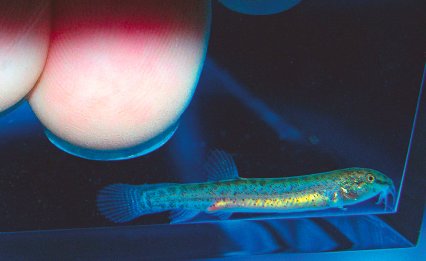
Standard coloration is highly variable. They usually display a yellowy-brown body mottled with dark speckles and with a lighter coloured belly.
A small and often indistinct dark blotch is present on the upper end of the body at the junction with the caudal fin.
A golden variety is also sometimes available in the aquarium trade. These range from an overall yellow to orange or pinkish colour and sometimes sport blotches of dark brown/black pigment. Most are not true albinos, as they have dark eyes, although the occasional one turns up in batches of the golden variety. These variants of the same species mix well in the aquarium.
Feeding weather loaches
Weather loaches will accept many foods, but offer a good variety. Some specimens will even eat small snails, searching them out with their five pairs of sensory barbels. Sinking pellets and frozen foods such as mosquito larvae and Daphnia make good options.
The fish may feed from your hand as this species seems to enjoy human contact. They will often actively seek out the fishkeeper’s hands when he or she is carrying out maintenance.
In their opinion these are worthy of curious investigation!
Tank mates and aquarium decor
Provide your weather loaches with several hiding places in the form of wood, rocks or even ceramic caves and PVC pipes. Although they can be rather active, they tend to rest for the best part of the day and come to life in the evening and during the night.
You can add plants that are tolerant of temperate conditions into the aquarium. But these fish tend to mischievously dig and uproot them. Small rock piles or pieces of bogwood placed around the stems can help prevent this happening.
Good alternatives are species such as Anubias, Java fern and Java moss. These will grow on bogwood and rocks, meaning any digging activities will not uproot them.
They are usually happy to share their tank with most temperate fishes. However, avoid shy species that scare easily. The loach’s sudden, unpredictable, darts around the aquarium may be too much for them. Avoid anything aggressive, and any tiny fish or fry.
Good community fish choices include:
- Lake Tebera rainbowfish (Melanotaenia herbertaxelrodi)
- Variatus platies (Xiphophorus variatus)
- Golden barbs (Puntius semifasciolatus var.)
- Rosy barbs (Pethia conchonius)
- Red phantom tetras (Megalamphodus sweglesi)
- Bloodfin tetras (Aphyocharax anisitsi)
- Many subtropical Danionins.
Weather loaches are even suitable tank mates for many varieties of fancy goldfish.

Harsh aquatic environments
Weather loaches have evolved to live in many ‘temporary’ locations. These include ponds, streams, and man-made rice fields where water often becomes stagnant and therefore low in oxygen. In some areas the water may even dry up.
These loaches have developed ways to cope with such extremes — most noteworthy the ability to breathe air. Their modified intestinal tract can extract oxygen from gulps of air taken from above the water surface. At the same time they expel air from the vent, giving the impression that the fish is experiencing a wind problem.
This means the species can survive harsh aquatic environments. Leave a gap between the surface of your aquarium water and the cover to allow this natural behaviour.
Their ability to produce a layer of mucus to keep themselves moist also comes in useful when out of water. It allows them to survive when a temporary pool dries up, or if they successfully escape from an aquarium.
Why the name?
The common names weather loaches or ‘weather fish’ stems from their apparent sensitivity to changes in barometric pressure. These ‘living barometers’ are supposedly far more active if a storm is approaching.
Many aquarists state that as the pressure decreases the loaches become restless, frantically swimming, and even jumping. This is particularly the case in countries with more volatile weather,
Breeding is a rare success
Reports of captive spawning are few and far between. In the wild they spawn annually after going through extreme seasonal changes.
Aquarium spawnings seem to occur after conditioning mated pairs with live or frozen foods. They then experienced higher than normal temperatures before frequent cooler water changes.
The final trigger seems to be a sudden dramatic increase in flow. They lay large batches of small adhesive eggs near to the outlets of the filters and powerheads.
In store breeding!
I documented a successful chance breeding at a Maidenhead Aquatics store in Lincoln several years ago. Prior to official opening to the public, the systems were already maturing. We started stocking certain hardier species during this time, including a batch of good-sized weather loaches.
Eagle-eyed staff spotted the tiniest movement in the gravel in a sump tank and a thorough search revealed three fry. The babies were just over 2cm (0.8”) long, so presumably just a couple of weeks old.
The adults in the system above had not been in the store that long. A pair must have formed and found the different water, large slightly cooler water changes and more current enough to get in the mood. I took the fry home to nurture over the next months and they took most foods with gusto and rapidly grew.

Mature males (as pictured above left) have a thicker and longer second ray, giving them an almost triangular appearance. In the female (pictured right) the pectoral fins are smaller and rounder and she is often fuller in the belly.
Many loaches are difficult to breed and a lot of spawnings do not have sufficient proof. If you have had any degree of breeding success, please take photographs and as many notes as possible. These will be invaluable to other loach enthusiasts and we would love to hear about your successes.
The impact of careless introductions
Misgurnus anguillicaudatus have been carelessly introduced into waterways of non-native countries, where they have firmly established themselves. Australia is one country reporting adverse ecological impact following such introductions during the 1980s.
Unfortunately, people have released weather loaches in Italy, the Philippines, parts of the USA and Germany.
This species is not a threat to UK water systems because temperatures drop too low during winter. This is why they are still available in our shops.
However, the UK has bans in place for a a similar species, Misgurnus fossilis. They are a threat because they can tolerate the lower temperatures of our waters.
Want more advice on temperate fish?
Register to receive our FREE email newsletter. You will receive fish keeping advice, tips, competitions, latest news and updates, straight to your inbox!