


Rubricatochromis exsul is a stunning cichlid that would rival any ruby with its bold red pigmentation. Gabor outlines his experiences keeping this African cichlid in an aquarium.
Jewel cichlids have been gracing our aquariums for quite some time. They are well-known for their stunning nuptial colours and infamous for their aggressive nature. When I began my hobby there was only a single species of jewel cichlid in circulation – called Hemichromis bimaculatus. In the nearly five decades since then lots of things have changed.
Firstly, many other jewel cichlids began to appear in the aquarium stores. We had to learn new names – like H. lifalili and H. guttatus.
Then, quite recently, a revision of the Hemichromis genus found that the red jewel cichlids are not as closely related to the type species of the genus (H. fasciatus) as it was thought before so a new genus, Rubricatochromis, was created. The name literally means “red coloured cichlid”, perfectly describing the species belonging to this taxon.
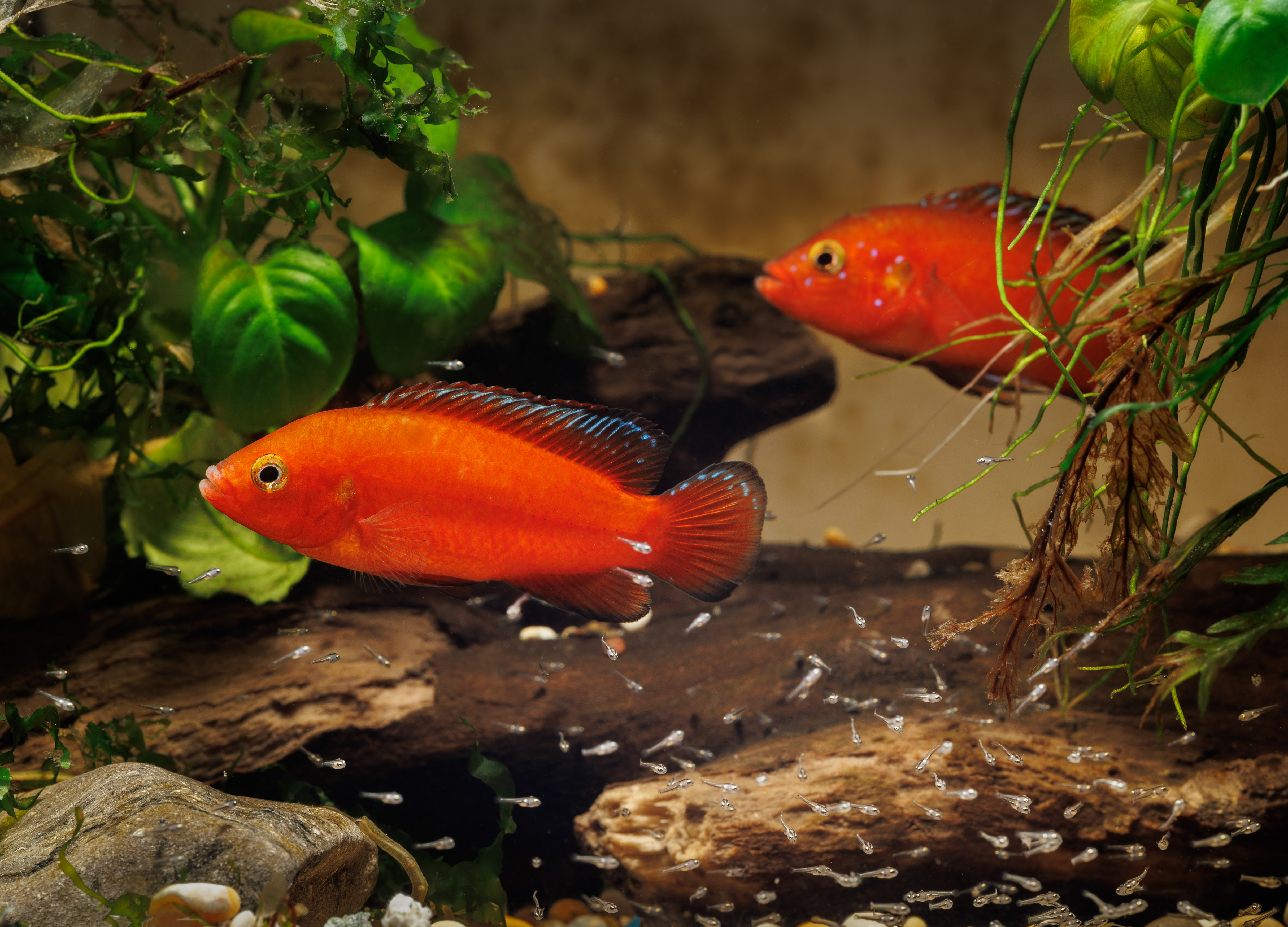
The species of jewel cichlids are quite similar to each other and keenly hybridise in aquaria. Often it is difficult – or even impossible – to identify the actual fish you are looking at. Luckily, the subject of this article – Rubricatochromis exsul – is quite unique in this respect. The Lake Turkana jewel cichlid has an unmistakable look.
Related article: Cichlid communities: when worlds collide.
All photos by Gabor Horvath
Learning about Lake Turkana jewels
At a first glance you would think they are one of the Lake Tanganyikan cichlids. They display an incredibly bright – almost artificial-looking - orange body colour (especially the females). The lack of the dot on their side, which is present on almost every other red jewel cichlid, just emphasises this feeling.
This is what caught my attention when I first saw them in person at my local fish store. I was browsing for new potential projects when I spotted a tank at the other end with dazzling red fish. As the tank was next to the mbuna section my first thought was to give them a miss. I’m not overly keen on rift lake cichlids – especially on unidentifiable – hybrids but my curiosity drew me closer.
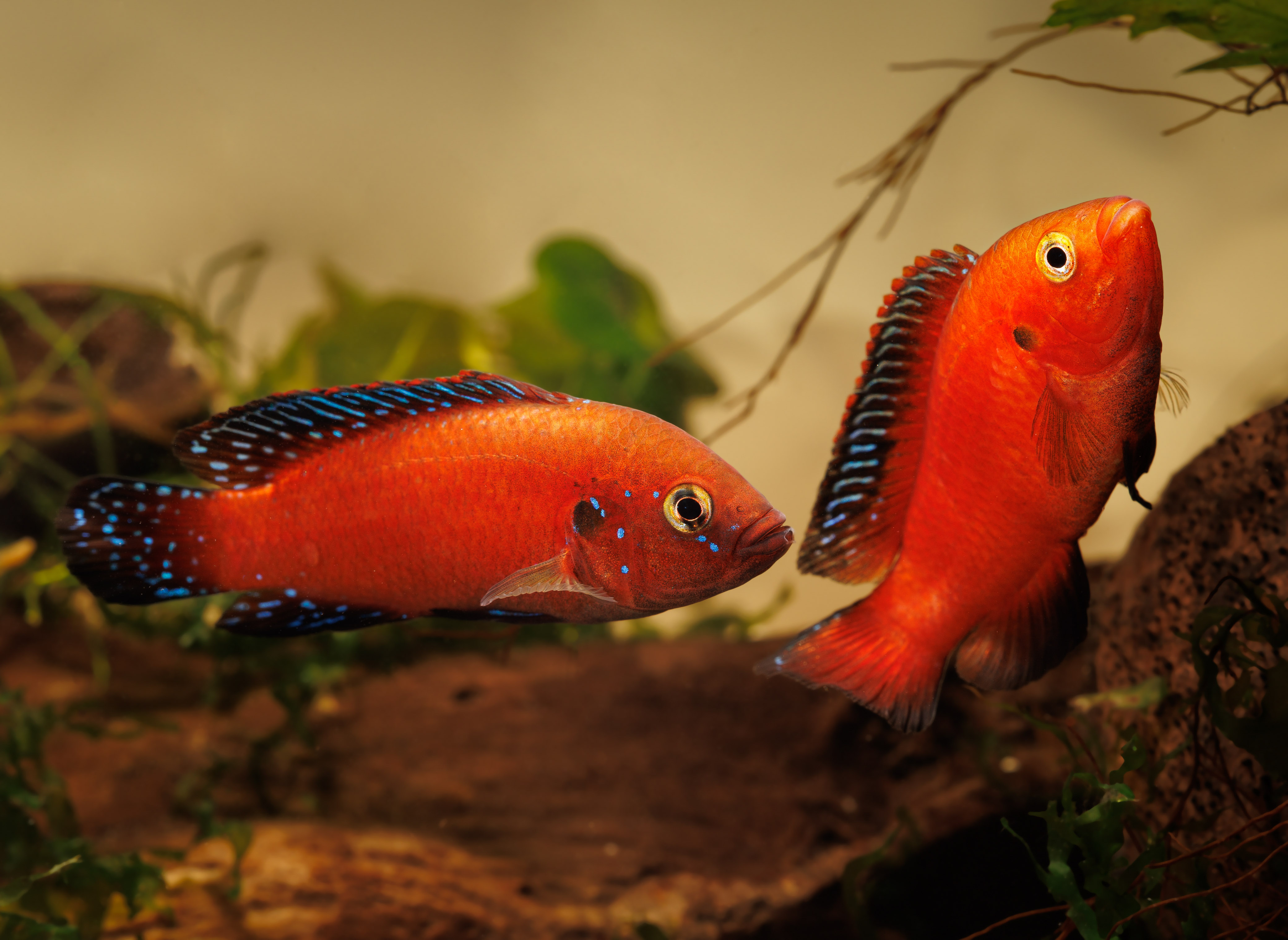
I could clearly see that they were jewel cichlids, but with striking colouration. Labelled as "dwarf jewel cichlid” I checked the scientific name, Rubricatochromis exsul. As I wasn’t familiar with this particular species, I did a quick search to learn more about them.
The search revealed some interesting facts about the Lake Turkana jewel cichlid. As the name suggests they originate from Lake Turkana (formerly Lake Rudolf) in Kenya. At 250km length and 44km width, it is the fourth largest rift lake in Africa and the largest desert lake in the world.
The sediment and the hardscape are volcanic, and rich in alkaline minerals. These minerals slowly dissolve in the slightly acidic water of the springs that feed into the lake. The lake has no drainage, so when the water evaporates it leaves behind an increasingly alkaline environment.
The “usual” water chemistry is pH 9.1-9.4 and 2500ppm salinity. During flooding this drops to a more “user friendly” pH 8.
Life in the aquarium
At home I allocated one of my 90cm (3') aquariums to them and furnished it according to their needs. I used gravel mixed with volcanic rock chippings as substrate. On top of this I placed lava rock and a few pieces of bogwood for decoration.
Knowing their digging habits I didn’t use any rooted plants but I tied a few Anubias to the wood to provide shelter. I threw in a couple of coconut shells as potential spawning sites.
Although Lake Turkana has extremely alkaline and saline water, you don't need to keep them in these conditions. They’re well accustomed to changing water conditions.
My recommendation is to aim for a pH between 7.5 and 8 and moderate to high hardness (GH of 8-25). Temperature wise they do best between 23-28°C (73-86°F) with the top end being suitable for breeding—which settled pairs do a lot.

Turkana jewel cichlid fact file
- Scientific name: Rubricatochromis exsul
- Size: Females to 7.5cm (3”), while males may reach up to 10cm (4”)
- Origin: Native to Lake Turkana in Kenya
- Habitat: Seen living in areas of dark igneous rocks of varying sizes. Aquatic plants are not present in their habitat.
- Tank size: 90x30x30cm (36x12x12”)
- Water requirements: A pH 7.5-9 with moderate to hard water (8-25°H) will work well.
- Temperature: 23-30°C (73-86°F)
- Temperament: One of the less aggressive jewel cichlids although remains highly territorial when spawning. Other robust species that need similar water chemistry can work if the tank is large enough.
- Feeding: An omnivore, captive bred specimens will accept most foods. Provide a quality and varied diet.
- Availability & cost: Uncommon, expect to pay around £40 per pair.
This article is an abbreviated version of an article first published in the April 2025 issue of Practical Fishkeeping. Subscribe now so you don't miss an issue!