


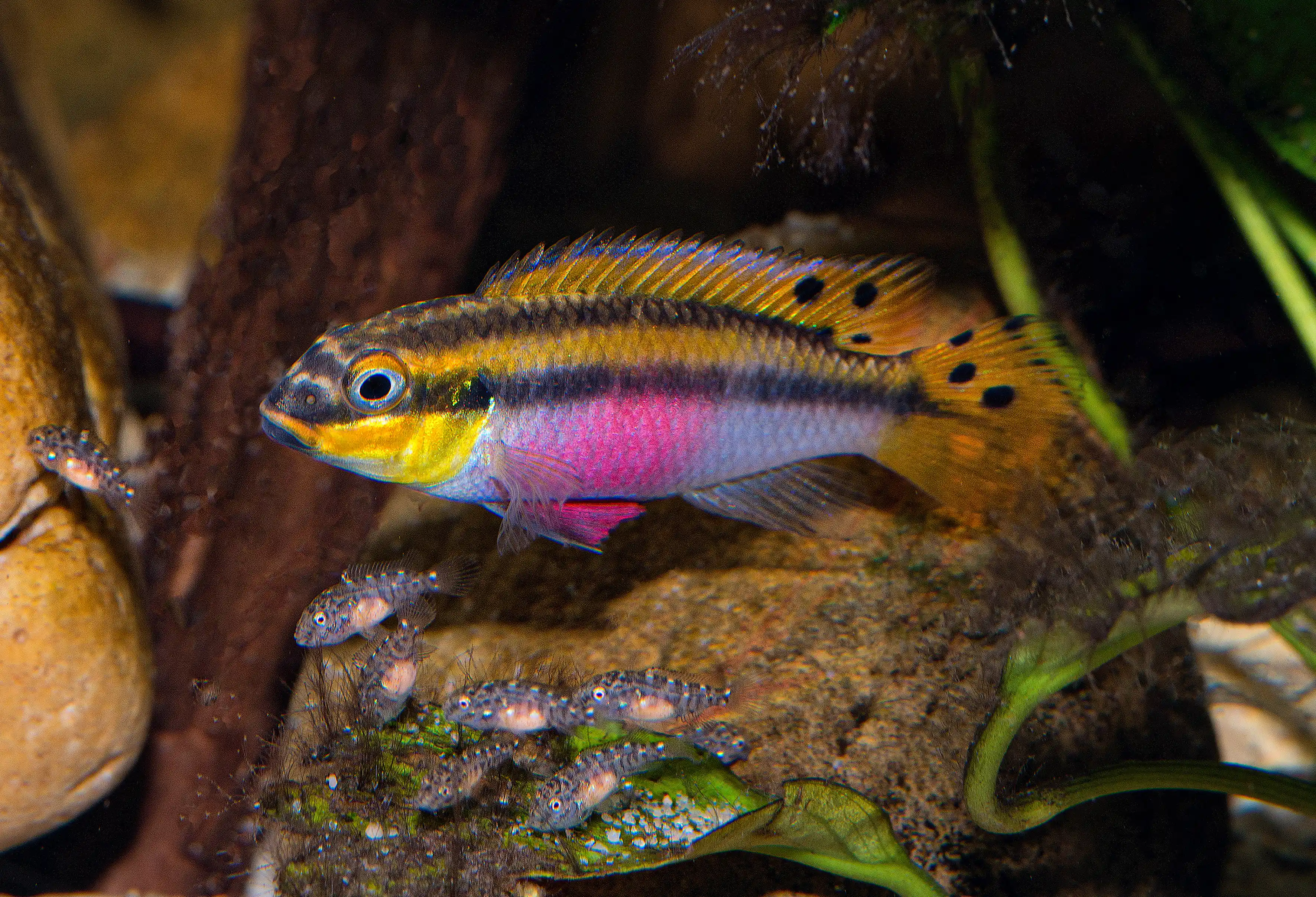
Michel Keijman shows off the various patterns that the true kribs display across their native ranges. He also outlines how to care for this beautiful dwarf cichlid.
The fish we all know and love as the kribensis cichlid is not actually Pelvicachromis kribensis! No, the fish we all instantly think of is actually Pelvicachromis pulcher. Indeed, if you are wanting to research this species, this may not be the article for you. However, we do have an overview of the common krib cichlid available.
The name kribensis stems from a catch all name adopted for P. taeniatus which for some time included P. kribensis. In 2014, Lamboj et al. split them into three distinct species: P. drachenfelsi, P. kribensis, and P. taeniatus.
Identification is challenging thanks to the many geographical variants occurring in P. kribensis found across Cameroon. Let's look at each one before examining their native biotopes and aquarium care requirements.
A huge variety of colourful cichlids
Moliwe - male
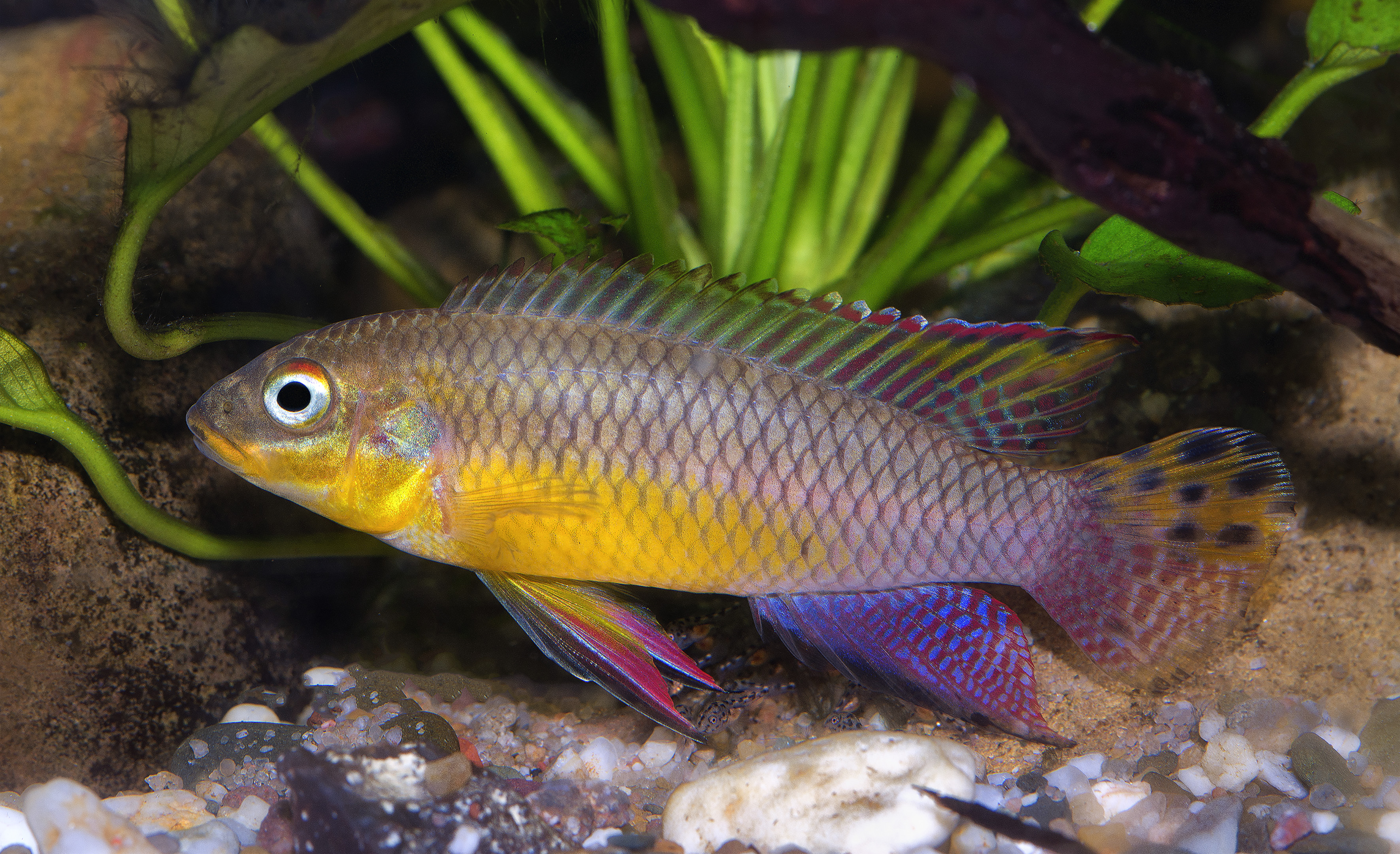
Ndonga - Pair
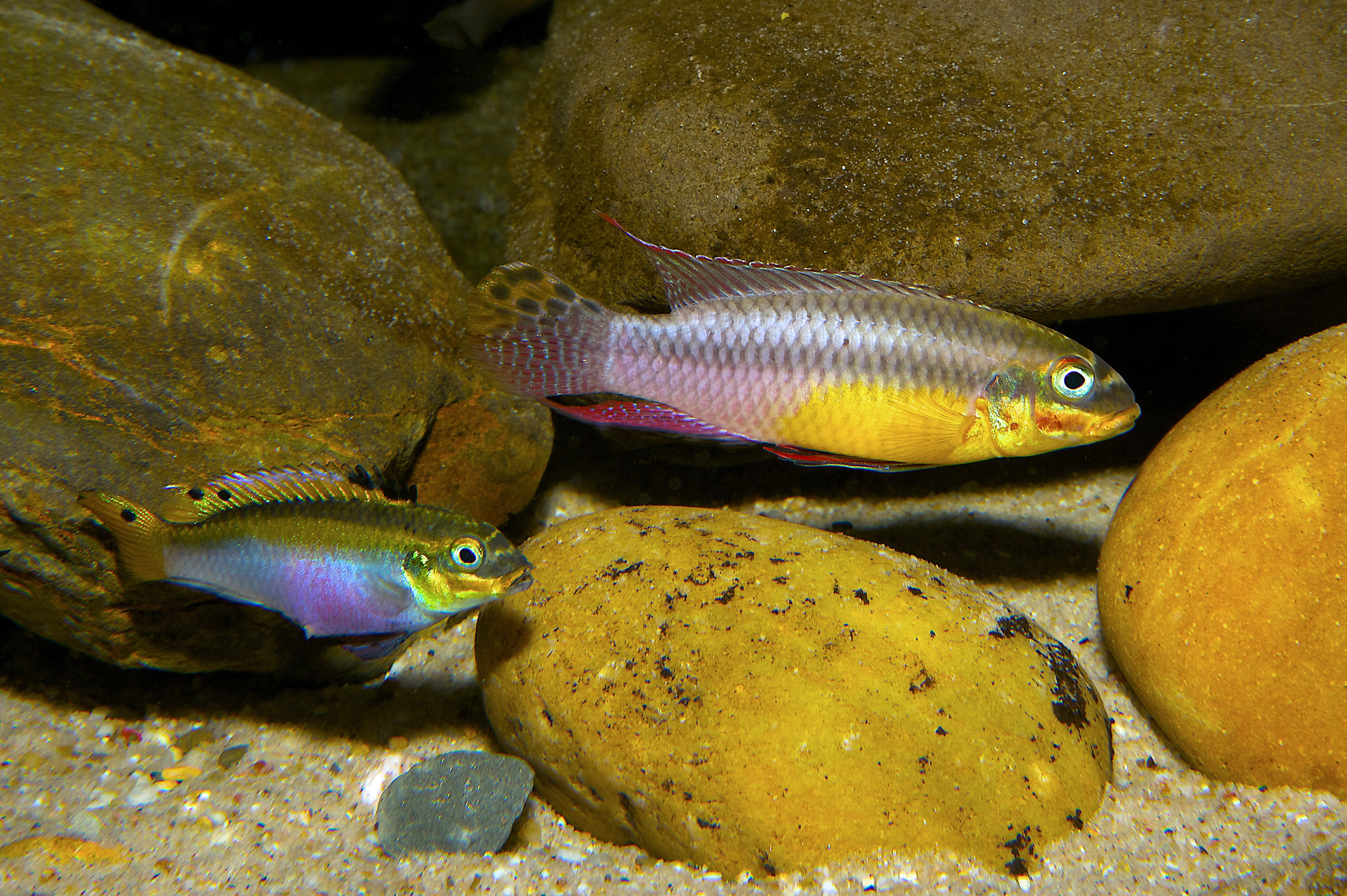
Muyuka - Male
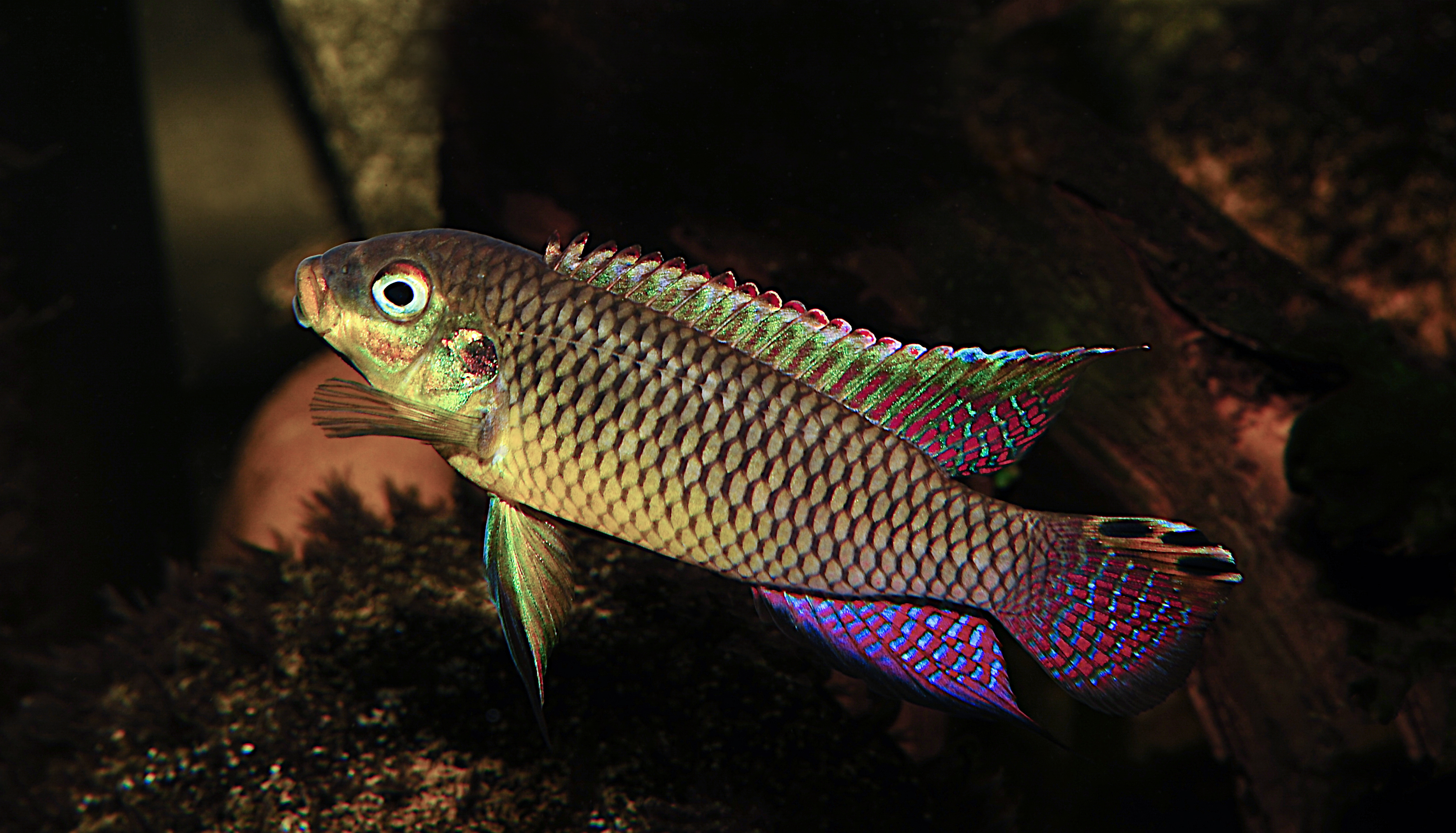
Lokoundjé - Female

Kienké - pair

Lobé - pair

Bandevouri - female

Bidou-Konya - male

Njanje - pair

Dehane - male

Koukoué - pair with fry

Makoure - pair

Habitats and biotopes of kribensis
In general, the habitats of all P. kribensis variants are in flat lowland areas situated near Cameroon’s coastal area. This zone extends approximately 50km (31 miles) inland.
Plenty of shaded areas are present thanks to the dense canopy of trees growing along the banks of these streams and rivulets. These waterways carry purely freshwater, indicating that they (as far as currently known) occur only in freshwater environments.

Tributary to the Lokoundje River
Furthermore, these streams have shallow water levels, ranging from 15 to 50cm (6-20”) in depth. A layer of sediment, frequently topped with a blanket of fallen leaves, covers the substrate. In some biotopes, aquatic plants are also present, including aquarium favourites Anubias, Bolbitis, and Crinum.
Because of the geographical separation of the different P. kribensis populations, water conditions vary between locations. At the time of visiting I recorded the following at each habitat, but these are likely to change throughout the year.
Moliwe River had a temperature of 27.2°C (81°F), a pH of 7.6 and conductivity between 130 and 289μS/cm.
Ndonga River also had a temperature of 28.2°C (81°F), a pH of 6.21 and 25.4μS/cm.
Muyuka River had a temperature of 26.7°C (82.8°F), a pH of 7.16 and 93.5μS/cm.
Nyong River had a temperature of 27.2°C (80.1°F), a pH of 5.29 and 17.7μS/cm.
Lokoundjé River had a temperature of 26.9°C (80.4°F), a pH of 5.37 and 21.4μS/cm.
Kienké River had a temperature of 26.5°C (79.7°F), a pH of 5.21 and 20.1μS/cm.
Lobé River had a temperature of 27°C (80.6°F), a pH of 6.5 and 6μS/cm.
Pelvicachromis kribensis fact file

Male P. kribensis Bandevouri
Scientific name: Pelvicachromis kribensis
Size: up to 9cm (3.5”).
Origin: Native to Cameroon, Africa.
Habitat: Shallow, lowland streams and rivers in areas shaded by the vegetation growing on the banks. The substrate is comprised of sands and find gravel often littered with leaves. Aquatic plants are sometimes present.
Tank size: 60x35x30cm (24x14x12”) for breeding.
Water requirements: Somewhat adaptable, a pH between 5 and 7.5 and a hardness below 12°H will work well.
Temperature: 22-26°C (72-79°F)
Temperament: Can become aggressive when spawning so ensure the tank is large enough for any tank mates to be able to keep away from their chosen spot. Otherwise fairly peaceful and can even be a little shy.
Feeding: Easy to feed accepting most small prepared, frozen and live foods. Include a plant or algae-based option as they do naturally eat some plant matter.
Availability & cost: Uncommon, try specialist shops and clubs can be mislabeled as P. taeniatus due to the somewhat recent revision. Expect to pay around £30 a pair depending on source.
Aquarium set up for kribensis
What could be more rewarding than caring for this small, colourful species in your own home aquarium? To set up a tank in a way that makes this species feel truly at home, there are several important criteria to consider.

Tributary to the Kienké River
I recommend that you use an aquarium with a minimum length of 1m (39”) if you plan to keep other fish with your pair. This will ensure there is enough space for them to retreat to when your P. kribensis breed.
Next, ensure you use an appropriate substrate, ideally a mix of fine sand and gravel. If possible, I recommend opting for dark-coloured sand, as it enhances the stunning colours of the species.
Avoid using overly bright lighting, since this species is only occurs in the more shaded areas. The plants mentioned above that we found in their natural habitat will still do well with lower lighting.
Make sure you add hardscape to the tank in such a way to form caves. The fish will use these as spawning sites. Alternatively, large seed pods, coconut shells and ceramic caves can work well.
All Pelvicachromis are sensitive and prone to bacterial infections when the water quality is not optimal. The required filtration capacity depends on the total volume of water. Aim for around two times the tank volume per hour as a minimum turnover. This species does not require strong water flow.
Additionally, it is both necessary and advisable to carry out partial weekly water changes. Changing one-third of the water per week is sufficient to keep nitrates at the required low levels.

Related article: How to set up an African biotope aquarium.
Are kribensis peaceful community fish?
Although the various variants are relatively small, they can certainly hold their own. Their behaviour towards other fish species is peaceful, even somewhat shy. Only during courtship and brood care do they display more territorial behaviour. They will chase away of other fish, including conspecifics, in short bursts of aggression when protecting their offspring.
While including a single pair in a community tank setting is possible, you do need to choose tank mates with the above in mind. Small tetras from South America and rasboras of Asia often work well, requiring similar water parameters and shaded conditions.
For a more biotope correct community you could include the following: Awaous lateristriga, Bryconalestes longipinnis, Chromaphyosemion spp., Enteromius camptacanthus, E. callipterus, E. jae, Epiplatys fasciolatus “Zenkeri”, Kribia kribensis, Nannaethiops unitaeniatus, Nannocharax intermedius, N. latifasciatus, Neolebias ansorgii, or Procatopus nototaenia.

Jae barb (Enteromius jae) males sparring
Want to read more about this fascinating species, including their diet and reproduction? Get yourself a digital copy of the September 2025 issue of Practical Fishkeeping for the full feature. Alternative, you could get an annual subscription so you never miss an issue!