


Dave Wolfenden investigates how to care for anemones, creatures with a reproductive method that's pure science fiction.
Anemones are among the most fascinating of the ocean’s inhabitants. The beguiling sight of a huge carpet anemone and the clownfish symbionts will fascinate any aquarist.
What's more fascinating is that when their pedal disc becomes lacerated, a shard of body tissue can create a new individual. This is a reproductive strategy which sounds straight out of a John Carpenter film.
Anemones can be among the more challenging of inverts, with many requiring specific conditions in aquaria.
Anemones are cnidarians, a group including corals and jellies. They have radial symmetry and tentacles with batteries of nematocysts (stinging cells) around a central mouth. The creature itself will either anchor to a hard substrate or burrow into sand or mud sediments using its pedal disc.
The anemone’s morphology may vary depending on adapting to habitat, although the fundamental body plan remains constant. Many tropical ones live with zooxanthellae and several species have symbiotic relationships with many animals other than clownfish!

Anemone requirements
Anemones can have demanding parameters and will shrivel and 'sulk' if conditions are not to their liking. They need optimal water quality, along with oxygen levels as near saturation as possible. Effective skimming is therefore highly desirable.
A mature system is preferable, as any spikes of ammonia could be disastrous. Most popular species are hermatypic, housing zooxanthellae as symbiotic algae, so suitably intense, 'reef quality' lighting is necessary.
Adequate water movement is essential to carry oxygen and food to the anemone and rid it of wastes.
They won't appreciate a direct blast from a powerhead, but chaotic water flow patterns are ideal. Also, ensure you install protective screens on the intakes for any pumps and powerheads. This will prevent them from sucking in any roaming anemones.
Caring for anemones in an aquarium
When choosing one it should appear 'inflated' and plump rather than shrivelled and covered in mucus. Examine the pedal disc for signs of trauma – as most physical damage during capture occurs here. If there is evidence of damage, avoid buying this individual. Acclimatisation should be slow, using the ‘drip’ method over a couple of hours as they are sensitive to changes.
Avoid taking an anemone out of the water during this process. Do not introduce any transport water as this is liable to have high levels of ammonia.
Some aquarists strongly deny anemones need any supplementary feeding. However, others maintain that feeding is necessary to promote health and growth.
Many species will do fine without any supplementary feeding if kept with other invertebrates and a few fish. This is because they can sustain themselves on leftovers. Having said that, carpet anemones (Stichodactyla spp.) may benefit from finely-chopped meaty foods twice a week. But be cautious rather than risk pollution through overfeeding.
Many anemones will discharge 'pellets' of partially digested foods. These are a pollution risk so it is best to remove them from your reef tank when noticed.
Anemone reproduction
Separate sexes are encountered in many species and reproduction may be utilised. Male and female gametes are released through the mouth in a co-ordinated manner. The resulting eggs develop into motile planula larvae, which find a suitable substrate to settle on.
They also employ asexual methods. Budding, or the formation of tiny replicates of the parent, occurs in some species. Binary fission, during which the anemone splits in two, happens as well.

Related article: do clownfish (Amphiprion) always live in a pair?
What can I keep with anemones?
Many people add anemones to existing reef aquariums stocked with corals and other sessile invertebrates. This isn’t always successful as they may employ ‘chemical warfare’ against heterospecific cnidarians and conspecifics. They are also carnivorous, so many small fish and mobile inverts are fair game.
Bear in mind too that many fish species will naturally peck at anemone tentacles. Never maintain them alongside butterflyfish, large angels or triggerfish. Careful choice of tank mates is therefore essential and mixing anemone species and conspecifics requires plenty of room.
What species of anemone are in the hobby?

Radianthus crispa, the sebae anemone, reaches 45cm (18”). It has long, thin, stinging tentacles with a pink dot at the centre of each. It attaches to a hard substrate and is reasonably hardy. Many species of clownfish will associate with this Indo-West Pacific anemone.

R. malu, the malu anemone, is an Indo-Pacific species with a relatively long ‘stalk’ buried in the substrate. Highly variable in coloration, this reaches around 20cm (8”).
It symbiotically associates with several species of clownfish.

R. magnifica, the ritteri anemone, is another symbiont and unsuitable for most captive systems. They require several hundred litres as they can reach 1m (3.3’). It attaches to a rocky substrate and is quite mobile.
This demanding Indo-Pacific species, requiries exceptional water quality, brisk water movement and intense lighting.

Condylactis gigantea, the giant Caribbean anemone, grows to 30cm (12”). Naturally, they occur on rocky substrates in shallow water.
Clownfish don’t naturally associate with this anemone, as there are none native to the region. Although some species may form unnatural partnerships in the aquarium. Nevertheless, many species naturally act as symbionts, including Periclemenes shrimps, mithrax crabs, arrow crabs and many others.
This anemone is a relatively demanding of light.
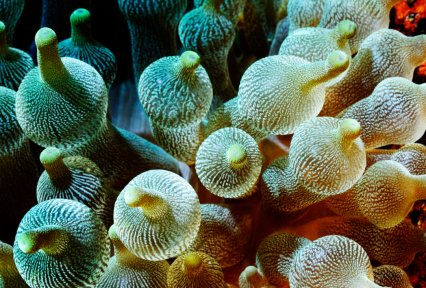
Entacmaea quadricolor, the bubble-tip anemone, from the Indo-Pacific is hardy and relatively inexpensive. They make a great host for many clownfish species, Periclemines shrimps and porcelain crabs of the Neopetrolisthes genus.
The common name comes from the often bulb-tipped tentacles, however, many specimens don’t exhibit this characteristic. This species is available in a variety of colour morphs, with the stunning red perhaps the most desirable.
Bubble-tips will, in optimal conditions, readily undergo binary fission in the aquarium.
This species is fairly undemanding and adapts well to a range of intensities. This is the best option for first-time anemone keepers, growing to 30cm (12”).

Carpet anemones are impressive, with some species growing to more than 1m (3.3’). Their sheer size and aggression mean they aren't suitable for many reef keepers.
Any aquarium environment must meet some exacting needs. Plus, it is equally important that the existing species of your system don't fall prey to this feisty cnidarian.
The giant carpet anemone (Stichodactyla gigantea) needs a minimum of 500 l (110 gal). There needs to be an expansive sand bed at least 10cm (4”) to burrow into as well as some form of hard substrate.
Carpet anemones will consume a wide variety of fish and invertebrates, even clownfish aren't safe. Despite this, they can play host to clownfish and threespot domino damsels (Dascyllus trimaculatus) as well as Periclemenes shrimps.
Careful planning is key here so maintain carpet anemones as part of a dedicated system. Limit invertebrates and fish to a minimum while including 'tried and tested' symbionts.
The following three species are all Indo-Pacific in origin.
S. gigantea grows to 1m (3’3’) and is available in a range of colour morphs. This species requires solid substrate in addition to a sand bed.
Haddon’s anemone (S. haddoni) grows to around two-thirds the size of S. gigantea. They require a relatively deep sand bed. This species is available in a range of colour morphs.
Merten’s anemone (S. mertensii) differs from the previous two in requiring a rocky substrate. Reaching sizes greater than S. gigantea, this species is not well suited to aquariums. When available, specimens carry a hefty price tag but are nevertheless quickly snapped up.
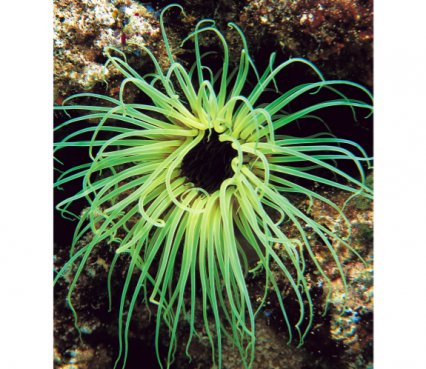
The Cerianthus tube anemones are sometimes available in fish shops. Their name stems from their habit of constructing a tube, courtesy of specialised cells.
These anemones are undemanding of light and actually prefer relatively soft lighting. They require a sandy substrate in which to burrow. But, take care when housing them with small fish species, as even clownfish are potentially prey!
Most common in the trade is the Indo-Pacific C. membranaceus which grows to 20cm (8”). Although some coloured species may be available — usually identified only to genus level.
Bartholomea annulata, the curlycue or corkscrew anemone, grows to 15cm (6”). You can easily identify them from the curly-looking tentacles. Hailing from the tropical West Atlantic, this species is cheap and cheerful. It tolerates lower lighting levels than many anemones and is of the same family as Aiptasia, the rock anemone.
While less problematic, it can be aggressive towards other invertebrates. It lives in association with Alpheus armautus shrimps in the wild.
Subscribe to Practical Fishkeeping magazine, see our latest subscription offer.