


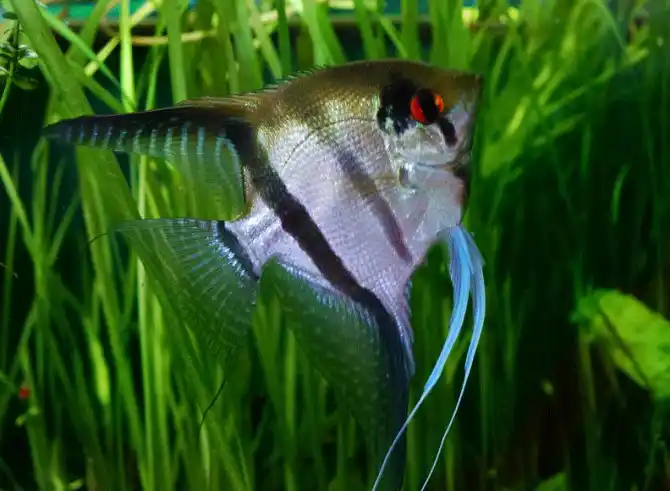
Those beautiful, juvenile angelfish you see in your local fish store will not remain at that small size forever. John Rundle warns of the problems faced by many fishkeepers when these popular tropical fish reach adulthood.
I wish I had a pound for every time I encountered two large angelfish that a despairing customer had returned to a fish store.
Either these fish became too large for a community tank set-up, or they are a breeding pair that are attacking other tank mates.
These are common problems involving what must be one of the most majestic freshwater tropical fish in the hobby. I often hear from readers with angelfish in community aquariums that were hoping to breed them in this scenario. It almost always results in issues of aggression and territorial disputes.
I don’t intend to look at genetics and methods on how to establish pure bred lines — I use the word ‘pure’ with reservation. The likelihood is that the pair in the community tank is a mixed pair. One could be a normal silver and the other pure black, or one gold and the other marbled.
These mixed crossings don’t prevent the production of healthy fish. Normally, any resulting youngsters will be of mixed colours. So here are some solutions to the problems associated with pairs of angels in a community tank.
The angelfish is a member of the cichlid family and the genus Pterophyllum. In this the most popular species is Pterophyllum scalare. The original wild fish displays a silver body and dark, vertical, bands. From these fish selective breeding has produced multiple colour variants.
The other species, such as Pterophyllum altum and Pterophyllum leopoldi, when seen in shops, are usually wild fish. These are often rather expensive compared to P. scalare.
What size aquarium do I need for angelfish?
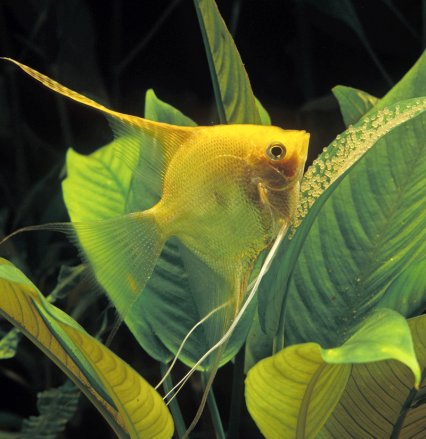
With its large disc-like body and extensive dorsal and anal fins, the angelfish can be more than 15cm (6”) tall. These fish are typically about 5cm (2") when for sale in aquarium stores, but they soon turn into these large, elegant, adults.
A 30cm (12”) deep fish tank quickly becomes cramped for space when these fish begin to grow. For long term housing, aim to keep them in aquariums at least 50cm (20”) tall.
Some time ago my living room tank, measuring 127cm (50”) long, contained just eight adults and a few Corydoras catfish. This was one of the best set-ups I ever created in this tank and I regretted changing it.
The tank had tall plants to the rear, such as sword plants (Echinodorus spp. and Aponogeton bolvinianus) and Java fern (Microsorium pteropus). In front were species of lower growing Cryptocoryne. The angels would love to glide through the tall, background plants into a clear space at the front.
The water temperature was 27ºC (80ºF), and an internal power filter supplied the filtration. I restricted the water flow of the filter, because angels do not like to swim in fast conditions.
This tank size and set-up will help alleviate the problem of having to move the angelfish on later.
Angelfish also prefer water conditions that are slightly acidic, 6.6 to 6.8 pH, and quite soft. Although, the many colour types we see will breed in surprisingly varying conditions. You must avoid water that’s hard and alkaline though.

Feeding angelfish
The parents will benefit from a varied diet. Try a selection of quality dry foods, along with frozen bloodworm, and add a source of live food. I used live whiteworm fed once a week to keep them in the best possible condition.
The fry will take brineshrimp nauplii as a first food and will need it for up to three weeks. After this they will readily accept finely crushed flake foods.
Angelfish breeding in a community tank
When a pair of angelfish spawn in an aquarium also home to tank mates, the problems begin. They include the possibility of the pair attacking the other inmates. Small fish may die because of this aggression. Other tank residents could also eat the eggs; catfish can eat them at night when the angelfish drop their guard.
Even if the parents can protect the eggs, other fish can pick off the tiny free-swimming fry. The parents then get frustrated trying to protect their eggs or fry and may eat them.
In a community aquarium, the fishkeeper has two choices. Which ever you choose, you will require at least one extra tank. If the pair decide to deposit their eggs on something that you can move, then use ‘method one’.
If the pair decide to deposit eggs on an area of the glass or an immovable object, then the keeper should use ‘method two’.
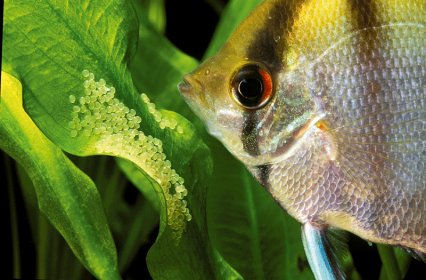
To help the pair decide where to spawn, offer them a choice of portable breeding sites. These can include pieces of slate or flat stone set near vertical. Also offer plastic sword plants that have large leaves, or the leaves of real plants.
Method one
Once angelfish start a breeding cycle they can spawn regularly, creating the time needed to prepare the set-up.
For this method you need to remove the eggs, that are on a portable breeding site, to a separate tank.
The tank, which should be no less than 60x30x30cm (24x12x12”), does not require a substrate. You only need a heater set to 27-28ºC (80-82ºF) and a sponge filter.
You also need a clear glass container large enough to hold the eggs and portable egg site. I use medium-sized sweet jars or small home-made tanks.
Now we’re ready for the angelfish to spawn again!
Once this has happened and spawning is complete, take some tank water and pour it into the jar or small tank. Now carefully take the eggs, attached to the portable breeding site, and place them into the jar which must be under the surface. Try to prevent the eggs leaving the water during this operation.
At this stage some breeders place methylene blue into the container to help prevent egg fungus. I have never found this necessary as if the eggs are fertile they will hatch without problems.
Place the container with eggs into the bare tank set-up — and make sure no tank water enters the container at this stage. Into the container place an open-ended air line that allows water movement to pass over the eggs. You want a gentle flow of air, too fierce it will blow any hatching larvae off the leaf or slate too soon. This movement replaces the parents’ fanning action.
Regularly perform small water changes in the container. If any of the eggs are showing signs of fungus you can carefully remove them.
At the temperature suggested the eggs will hatch within 48 hours. For the next six to seven days they will be a wriggling mass of tiny heads and tails sticking to the leaf or slate. Some will drop off and fall to the bottom, but this will not normally stop their development.
During this time they are feeding off their yolk sac, so no other form of feeding is necessary. On the seventh day they should become free swimming, probably in the middle and upper areas of the container.
Now the moment of truth. Carefully take the container and slowly tilt it to allow all the fry to swim into the larger growing-on tank. Allow them to settle and feed them newly hatched brineshrimp, which they will eat in copious amounts. Broods could be quite large – up to 400 – but this will differ according to the size and age of the parents.

Method two
Angelfish will always tend to be independent and sometimes lay their eggs in places that won’t allow removal. These could be the glass sides of the tank, filter body or even heater/thermostat cable.
If this continually happens in our community tank scenario, use method two.
This bare tank set-up has the same basic heating and filtration units. The one key difference, the addition of a choice of breeding sites for the pair to deposit their eggs. They may still choose to use the sides of the tank, though.
Move the pair of angelfish from the community tank and place them in their new, temporary, home. Don’t use a 30cm (12”) deep tank for this, but one that’s 38cm (15”) deep is ideal.
When the pair spawn for the first time in this set-up try to give them peace and quiet. Avoid sudden movements that will alarm and make them eat their eggs.
Given this type of set-up you may be lucky in that the parents tend the eggs. When the brood is free swimming, they may look after them until large enough to fend for themselves. A pair of angelfish looking after a large brood is one of the hobby’s most stunning sights.
You may have a pair that keeps eating the eggs or fry. If so, then you will need to revert to method one or remove the pair as soon as they lay eggs. You can quickly move them back to their original community tank.
Go for quality
Growing on will depend on how many fish you have tank space to spare. Do not try and raise a large brood of fish in a 30cm (24”) tank.
A few good fish – say 50 – are far better than 200 runts.
Want more information on angelfish?
This is by no means a detailed article. Instead, it is an offering of ideas on how to save some young from that lone pair of angelfish. Hopefully it also makes you aware of problems of buying two fish the size of 50p pieces that soon attain 15cm (6").
For more specific information regarding angelfish email us at [email protected].
Check out John Rundle's article in which he travels over 80 years back in time to look at how early angels fared. Angelfish - how times have changed