


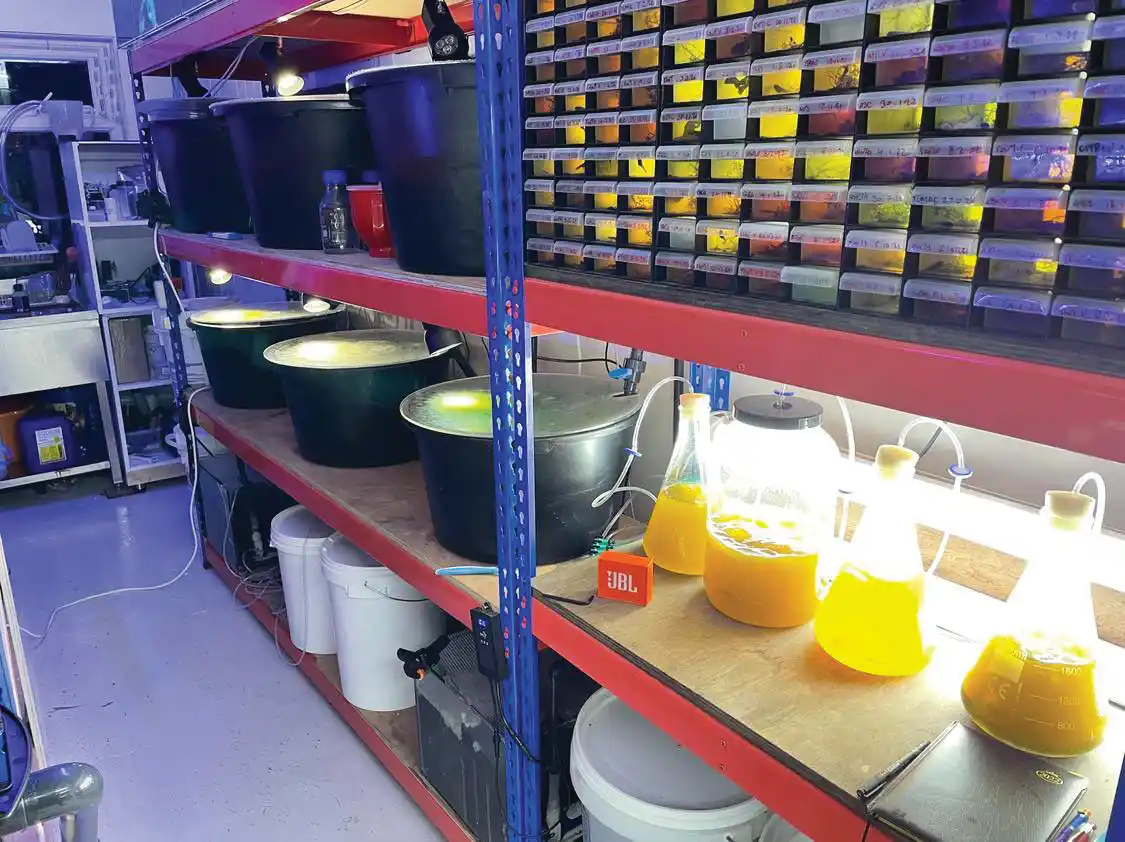
Robin Mannion, managing director of Pholium Mariculture UK, reflects on the basic considerations to take on board if you want to make your breeding hobby into a business.
Breeding behaviour is one of the most fascinating aspects of fishkeeping. Breeding saltwater fish can be incredibly rewarding in this respect and it can even be occasionally lucrative!
However, it is unlikely to become your main source of income. However, with the rising energy costs, setting up a couple of breeding projects can go a long way to offset some costs.
In this article, I outline some topics you must consider when setting up a salt water fish room.
Building your fish room!
The first consideration when planning a fish breeding room is where to locate it. For most this will be an area often neglected by other members of the family, more often than not a garage or a basement.
In the UK, energy is by far the biggest expenditure of fish breeding with heating a major factor. Proper insulation is the best investment for this project and will pay for itself over and over once winter strikes. For me, Kingspan sheeting is the most efficient method to stop your precious heat disappearing.
Kingspan is a little more expensive than other options but one layer of 50mm sheets is adequate. As it is thinner than other insulating materials it gives you more space for marine aquariums.
Once installed you have a choice of materials to finish off the interior. Whatever you choose, make sure it functions well in high humidity and is wipeable. My favourite is white PVC cladding as it is easy to put up and gives a lovely clinical feel to the room. Equally, you can paint typical plaster with a moisture resistant bathroom paint.
Next, we must consider flooring options. Rest assured that even if you are extra careful the floor will get wet. I highly recommend skimming the floor with cement and painting with 2 coats of hard wearing garage paint or even epoxy.
The other option is to turn the entire floor into a drain that you can water change directly onto. The floor drain is definitely the ideal solution but is not always possible.
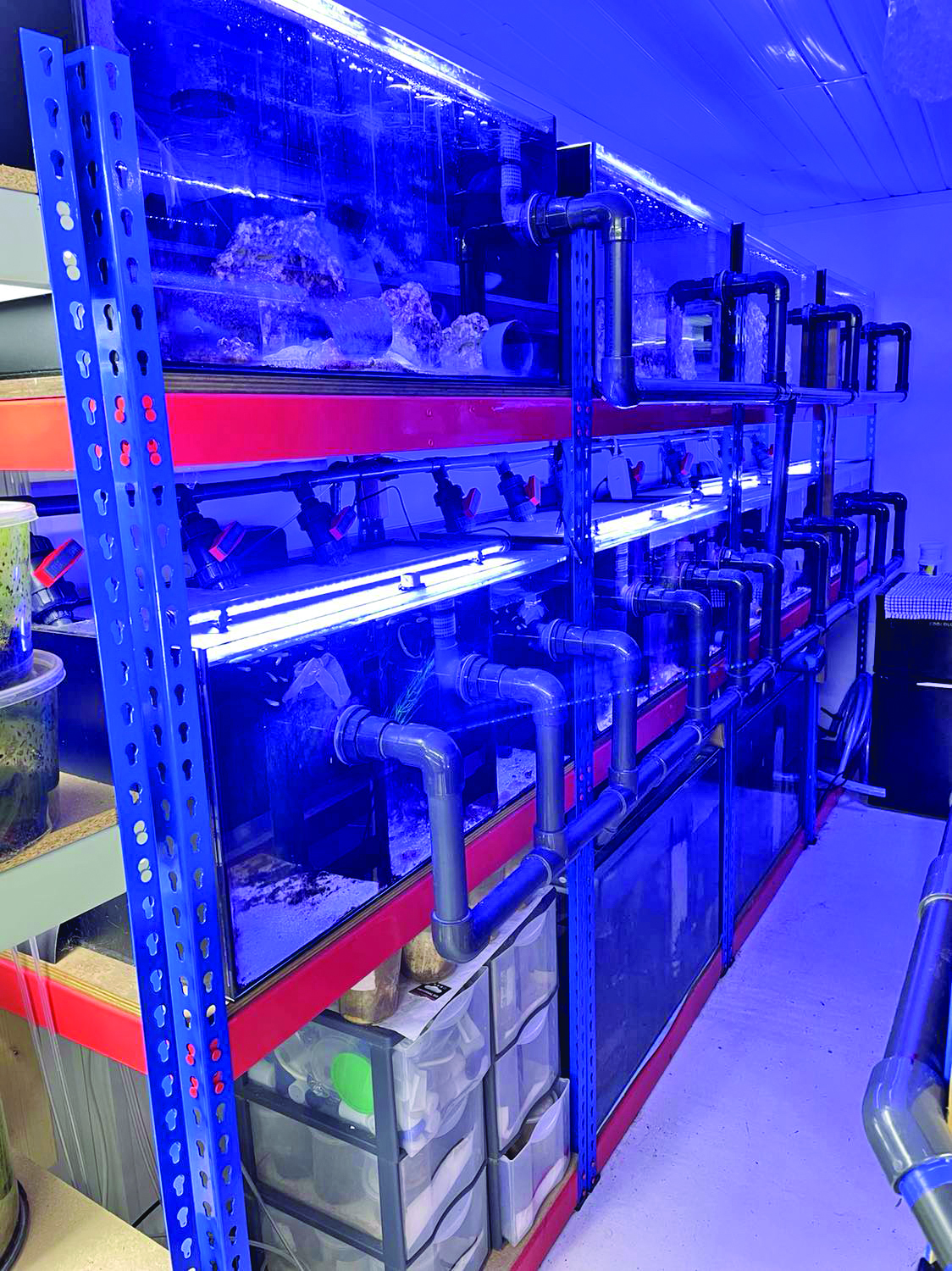
Robin Mannion's fish room
Tanks, tanks, and more tanks!
We all want more saltwater tanks, but it is important to remember that you need to be able to comfortably work in. Draw up a plan and ensure you leave yourself enough space.
The aquariums in a room for ornamental fish culturing can split into 4 groups:
Quarantine tanks: Before anything enters your systems you must put your broodstock through some sort of quarantine. Quarantine can mean different things to different people but I prefer to err on the side of caution these days. Wipeouts are both real and devastating.
Prevention is better than cure. As a minimum you want a few tanks dedicated to observing your new fish for a few weeks. If no signs of disease or parasites are present, then you can cautiously add them to your systems.
I strongly recommend all new species receive two treatments of praziquantel (at 30-day intervals). In addition to this, a month-long copper treatment is advisable. If after a month all fish are feeding well and are visibly clean you are good to go with confidence.
The tanks can be simple with sponge or internal filters, PVC pipes and plastic plants for cover. These tanks do not need lights, keeping the tanks a little darker helps ease the fish into their new homes.
Broodstock tanks: Tailor your stock tanks to the particular species you wish to culture. For example, are they benthic or pelagic spawners?
If breeding the likes of marine angelfish you’ll need a tall enough tank to enable them to perform their mating dance. You will also need to be able to collect the floating eggs. With benthic spawners like clownfish you need to be able to lift the eggs in and out with ease.
Try to link your tanks with a central sump filtration system. This allows you to keep the equipment out of the tanks and enable easy water changing and increases volume.

Clownfish eggs, Photo by Shutterstock
Larval tanks: Growing marine larvae is one of the major challenges of reef fish aquaculture. Firstly, marine larvae are small and there is almost always no parental care after hatching. They aren't that developed and require a tank that simulates the random currents of the open ocean.
Black round tubs with a central airstone are perfect for creating an environment with the correct flow. This keeps the larvae off the walls and suspended in the water column where they spend their days snatching live food.
Linking them to a filtration system will keep down excess nutrients. If that’s not possible you’ll have to rely on frequent, time-consuming water changes.
Lighting is an important factor for rearing marine larvae . Almost all marine larvae are phototaxic, they either move towards or away from light.
You need to provide light and dark areas so the larvae can choose where to be. This is best achieved with dimmable LED spot lights that will naturally produce a light gradient if placed over one side of the tank. Connect these spotlights to a timer to ensure your larvae have a solid routine. In my experience, sixteen hours light and eight hours dark works well as a photoperiod.
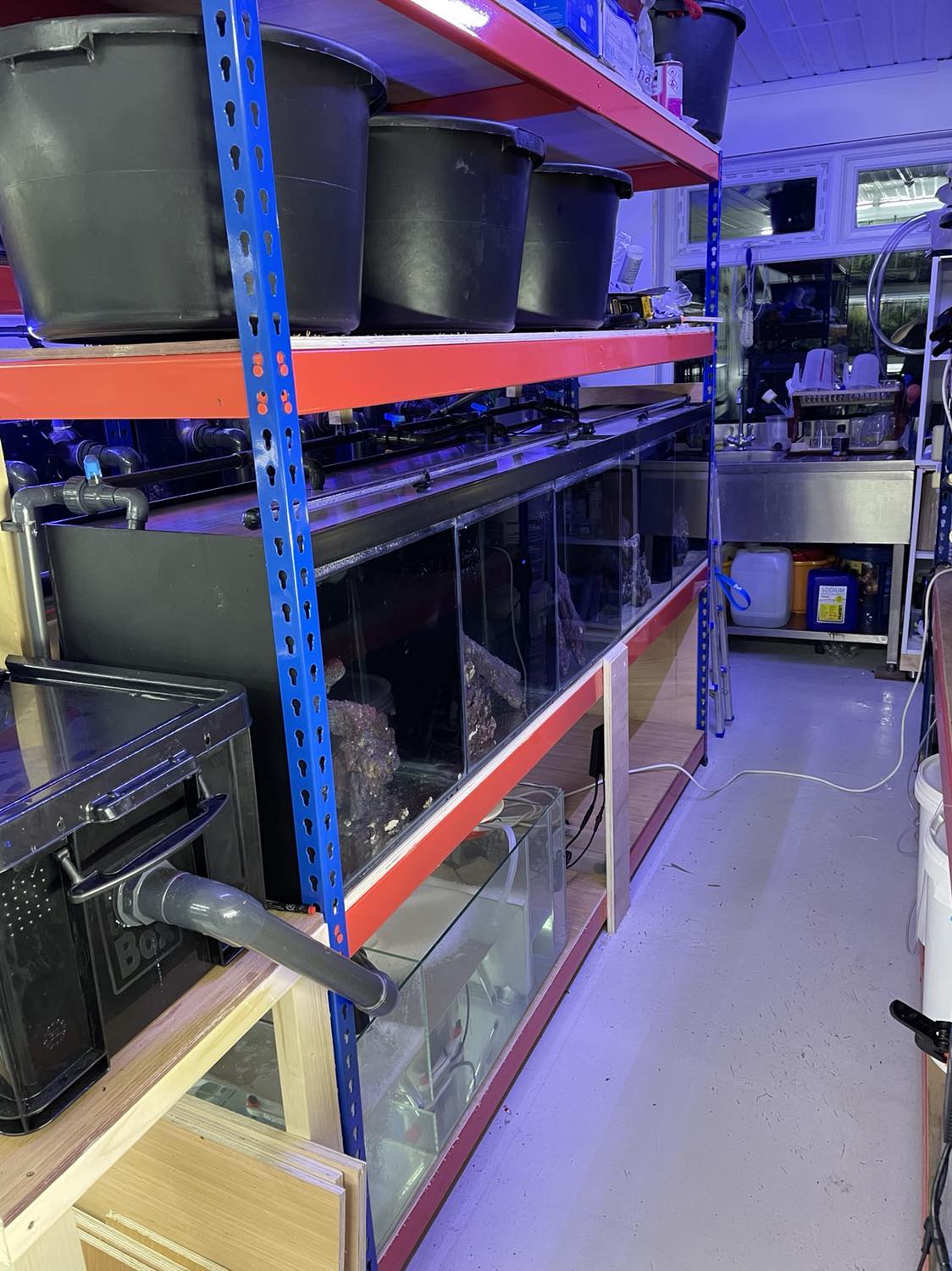
Black tubs are utilised for larvae rearing
Grow out tanks: You’ve spent months nurturing larvae and they have finally reached the point that every marine breeder craves—settlement! This is the point where larval fish change from their pelagic lives to their adult forms.
At this stage the larvae will settle out of the water column and start associating with objects in the tanks. They will also begin to colour up and look more like mini versions of the adults.
The grow out tanks can be fairly sparse of decoration but the important thing here is optimal water quality. Overdo the filtration for these tanks as you will be feeding heavily - four or five times a day. These grow out tanks must be on a separate filter system to your broodstock.
I also include an oversized protein skimmer, a nitrate reactor and an ultraviolet steriliser. If possible, a large chaetomorpha refugium would be perfect to eat up those nitrates and phosphates.
Bagging up your offspring
Something I almost forgot was to have somewhere appropriate to package your offspring. This can be as simple as a waterproof table equipped jugs, bags and elastic bands. If you do not have space, consider a folding table. After all, you will likely not be bagging up offspring all the time.
I use bags with a rounded bottom, however if you only have square bags I recommend that you tape the corners. Many shops use oxygen from a cylinder to inflate their bags for shipping but I’ve never found this to be necessary. Bag the fish singularly and fill them with one third water and two thirds air.
Other considerations when planning a fish room
One essential piece of kit is the humble air pump (or blower, depending on the size of your project). This will power your filters, bubblers, phytoalgae and live food cultures. Consider a decent piston pump, both more durable and expensive than the cheaper diaphragm versions. Place the air pump above the tanks, either in the ceiling or anywhere high-up but accessible.
Fish rooms are not be complete without a stainless sink. Sinks are absolutely essential for all your cleaning needs, including washing out protein skimmer cups. Ensure that the sink you purchase is marine grade stainless 304 or above.
Reverse osmosis units are another must have for the marine hobby. You will need this to replace any evaporation, plus it is the foundations of any saltwater you make.
Go for the biggest unit you can afford with either four or five stages, and a capacity of around 750 litres per day. Larger RO units will last longer between cartridge changes and generally produce water with fewer impurities. If you have a mains pressure of less than 30psi I would consider the addition of a booster pump.
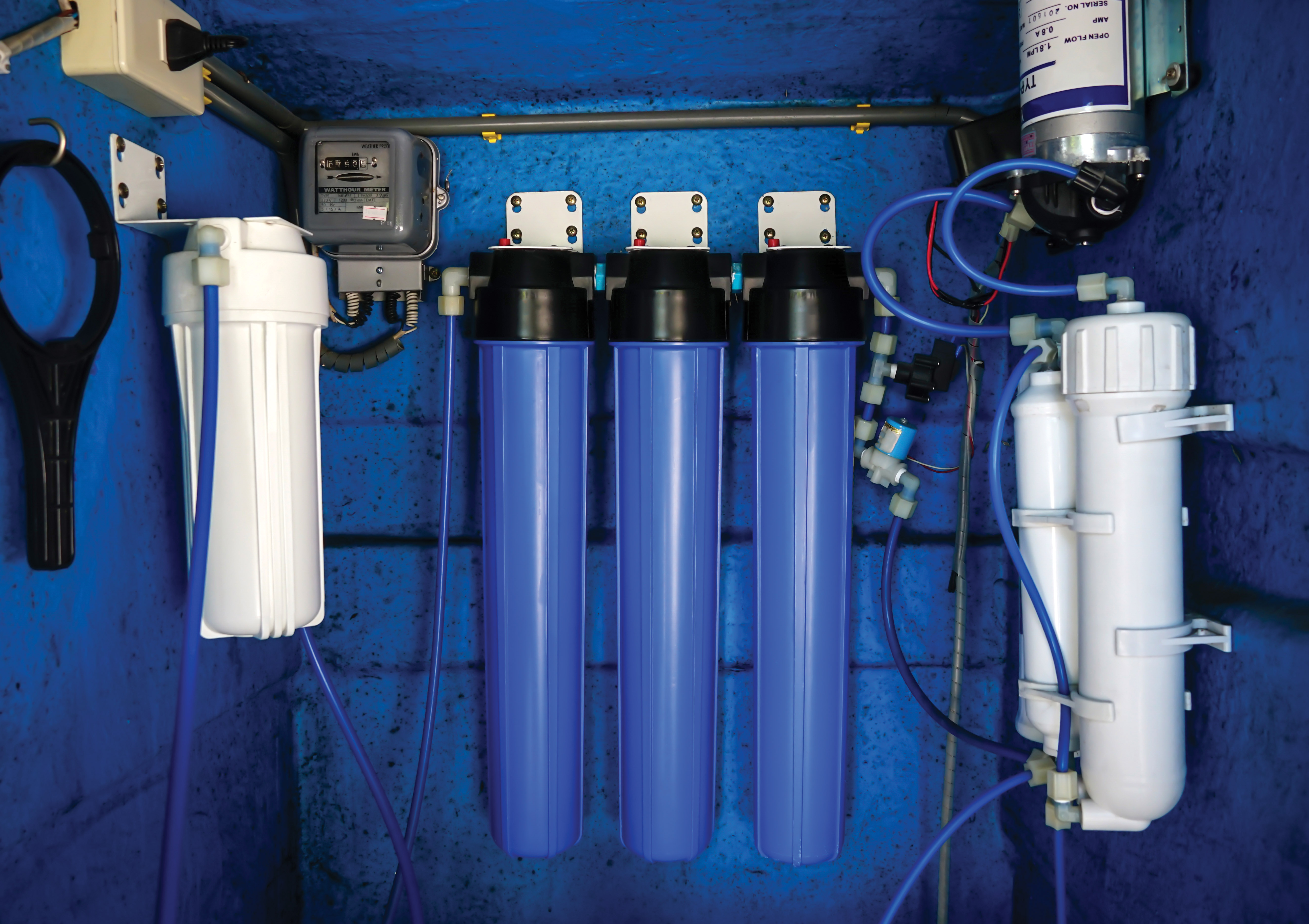
A typical RO unit, Photo by Shutterstock
Paired with the RO filters you will need a salt water mixing barrel. Any food-grade vessel will work as long as it has a lid and is large enough for a water change.
The main reason for most when contemplating such an endeavour is a passion for fishkeeping. That part is essential as, financial concerns aside, you will be spending a lot of time in your self-made fish-cave. Sometimes sacrificing that extra row of tanks and concentrating on fewer species but done to a high standard is the best course of action.
Keep your original goals from when you started in mind as you make each decision. Being a specialist in one particular species or family of fish is often incredibly rewarding.