


Siamese fighting fish remain ever so popular with both new and experienced fishkeepers. Alex investigates what food is best to ensure your fish remains healthy and active.
This article is sponsored by Fluval
The domestic Siamese fighting fish we keep in our nano tanks are incredibly different from their wild relatives. The beautiful long showy fins and intense colours that make them pop in planted tanks would make them vulnerable in the wild. Despite their differences we can still learn a lot about our pets by looking at their wild relatives.
Years of selective breeding has altered their appearance. However, their dietary requirements remain incredibly similar. We can select the best foods for our tropical fish by understanding what they have evolved to eat over thousands of years.
What is the natural diet of wild Betta splendens?
If you were to dive into the rice paddies of Southeast Asia you'll find an abundance of invertebrate lifeforms. These insect larvae and aquatic crustaceans that hide amongst the aquatic plants are the chosen prey of Bettas.
Daphnia, shrimps, midge larvae, and even ants and flies that land on the water's surface are fair game in this natural habitat. As the Betta fish hunts amongst the detritus and plant material, they occasionally consume some of this too.
The general consensus is that fighting fish do not get direct sustenance from the plant matter. This material definitely enters their gut though. Therefore, tiny volumes of plant material in their diet will actually closely resemble natural diets even if not beneficial.

Daphnia are a natural food for wild Betta splendens- Photo by Shutterstock
Prepared foods for Bettas
These are staples in the hobby and are definitely the best food for your Siamese fighting fish. Extensive research on prepared foods like flakes, pellets and granules ensures they provide your fish with everything they need. Whereas, frozen and live foods can be deficient in some nutrients which we will come on to later.
With an abundance of types of prepared foods on the market it can be difficult to know which to purchase for your fish. I always like to look at the ingredients list and match the main ingredients to the natural diet. A fish predator should have a food made up mostly of fish meal, while fish like Bettas require more insect based foods.
One food remains at the top of my shopping list when I need an invertebrate based fish food, Fluval Bug Bites. Containing up to 40% sustainably sourced Black Soldier Fly larvae protein these foods are good for your fish and for the planet.

Feeding Bug Bites Tropical Micro Granules to my plakat Betta in the new Fluval Betta Aquarium
Why choose Bug Bites for your fighting fish?
Being fairly carnivorous, Bettas require high protein diets. Fluval's foods certainly fit the bill with at least 40% protein in both the granules and flake foods designed for tropical fish.
The Bug Bites range also has a good variety of prepared foods that are suitable for Siamese fighting fish. Meaning you can vary your fish's diet ensuring they never become fussy, nor bored of the same food. The foods I would recommend for your Betta fish are below:
Flake foods for Bettas
Bettas will happily feed at the surface of the water, so the Bug Bites Tropical Flakes make a great option. Fluval also produce a Bug Bites Colour Enhancing Flakes. While Bettas don't need much help to be colourful, this food gives them plenty of astaxanthin to promote their natural pigments.
Both of these flake foods work well for smaller fighting fish too. They break up easily and are soft once they hit the water ensuring they can fit the food into their smaller mouths. This means these foods are perfect for feeding bettas that are still juvenile when you buy them.

The Tropical Flake by Fluval is great for fish that like to feed at the surface, including Bettas!
Feeding pellets and granules to Siamese fighting fish
I always like to provide my fish with some variety when feeding them. It means if I cannot buy their usual diet they will be more happy to accept an alternative. The other common offering for aquarium fish is some form of pellet food or granule. Therefore, it makes sense to offer your new Betta one of these alongside the flake food.
The Fluval Bug Bites range also has you covered here, with a variety of granules to pick from. Living in the UK my go to option would be the Bug Bites Tropical Micro Granules measuring between 0.25-1.4 mm. Those of you living stateside will have access to their Betta Micro Granules which has a slightly smaller particle size (maxing out at 1.0mm).
Similar to the flake foods, there are also Bug Bites Colour Enhancing Granules available. These are slightly larger with granules measuring between 1.4-2.0mm and so would only be suitable for the largest of male Bettas. By rubbing the granules between finger and thumb you can reduce their particle size considerably though.
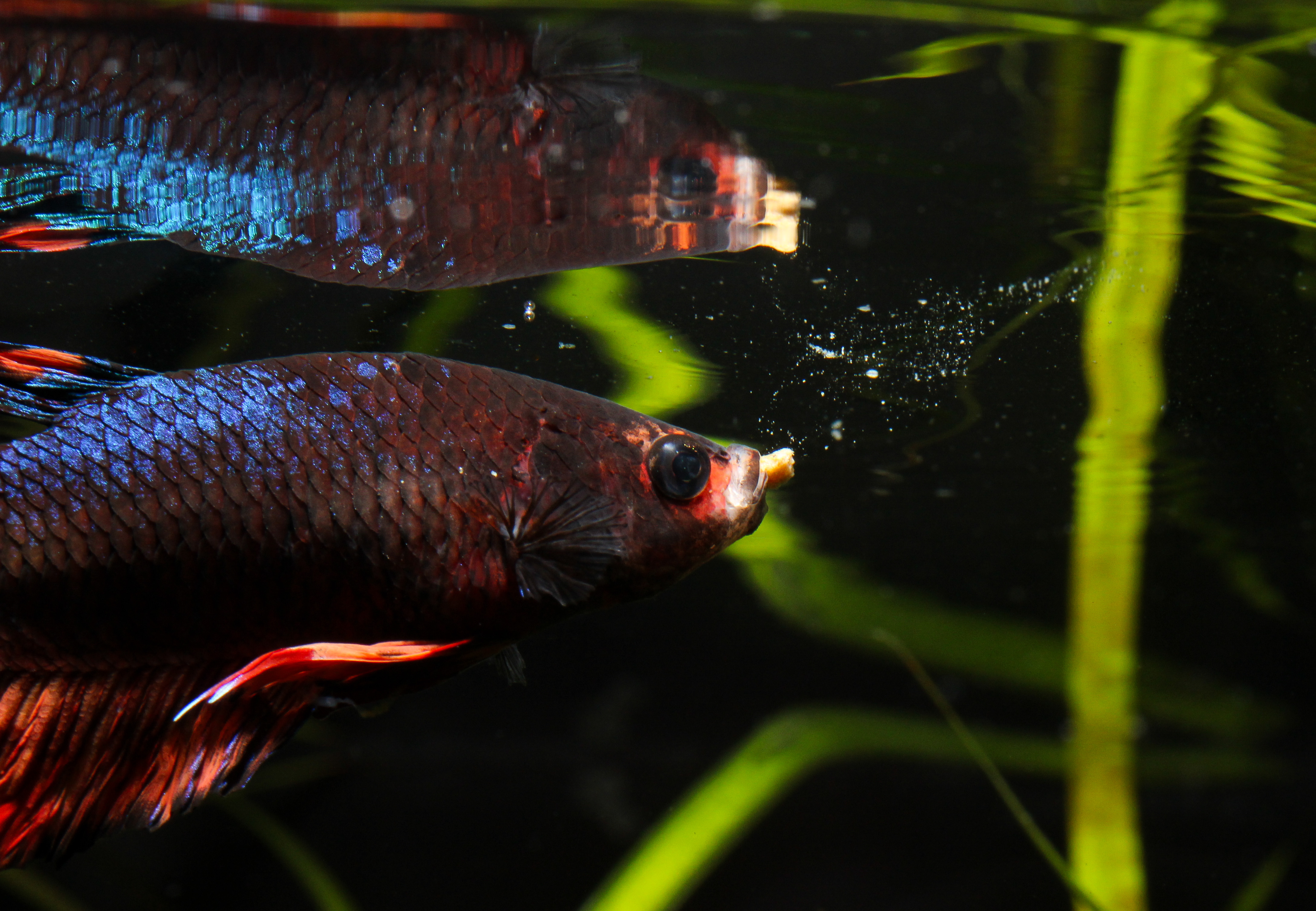
Siamese fighting fish eating a Bug Bites granule
Feeding Bettas live and frozen foods
These foods resemble the natural diets of Siamese fighters even more closely. They are great options and the live foods add a form of enrichment for your fish, allowing it to show natural hunting behaviours.
However, they are unlikely to provide all the nutrients your fish needs on their own. Feeding different species of live and frozen foods can work to ensure your fish gets all it needs, but it can be challenging. Instead, I prefer to offer these alongside a daily staple of Bug Bites for a varied diet.
Bloodworms are available in both live and frozen, but are renowned for having low nutritional value. They make a good treat food, and can help to trigger spawning in some species of tropical fish so they do have their uses. However, a Betta splendens fed solely on bloodworms may not be a very healthy fish.
Daphnia are a brilliant option for Bettas and they are fairly easy to culture at home should you desire. The bonus of live Daphnia over frozen is you can gut load and enrich it to ensure optimal nutrition. Yet, not all fighters take to them, with some swimming through clouds of water fleas without eating one.
Your Betta will gleefully accept many other live and frozen foods but the last one I will highlight here is the humble brine shrimp. People also often call them by the name Artemia, or sometimes even sea monkeys. Whatever name you choose, they remain a staple in the hobby and in aquaculture.
These organisms live in brine lakes, and are actually not a natural food for Bettas. In fact they are not a natural food for any of the aquarium fish we encounter. Instead, their popularity comes from their ease of culturing and ability to gut load them with various supplements.

My Betta is always looking for food but it is important to not give in and overfeed them!
How much and often should I feed my Betta?
In the wild fighting fish will eat small invertebrates throughout the day when the opportunity arises. Consequently it is best to offer your fish small amounts of food multiple times a day.
I recommend providing your fish a couple of Bug Bites granules, or flakes twice a day. Occasionally you can substitute one of these feeds with a small volume of frozen or live foods. Exact volumes will depend on the type of food you choose.
Remember to remove any uneaten food after feeding to ensure the water quality does not decline.
How to build a Betta aquarium
Now you know how to feed your Siamese fighting fish, how about you build it a natural fish tank. You can read all about how I created a natural home for my new fighting fish in a Fluval Betta Premium Aquarium in the June 2025 issue of Practical Fishkeeping, or you can watch the build process below. Perhaps it will inspire you to create a Betta biotope inspired aquarium.