


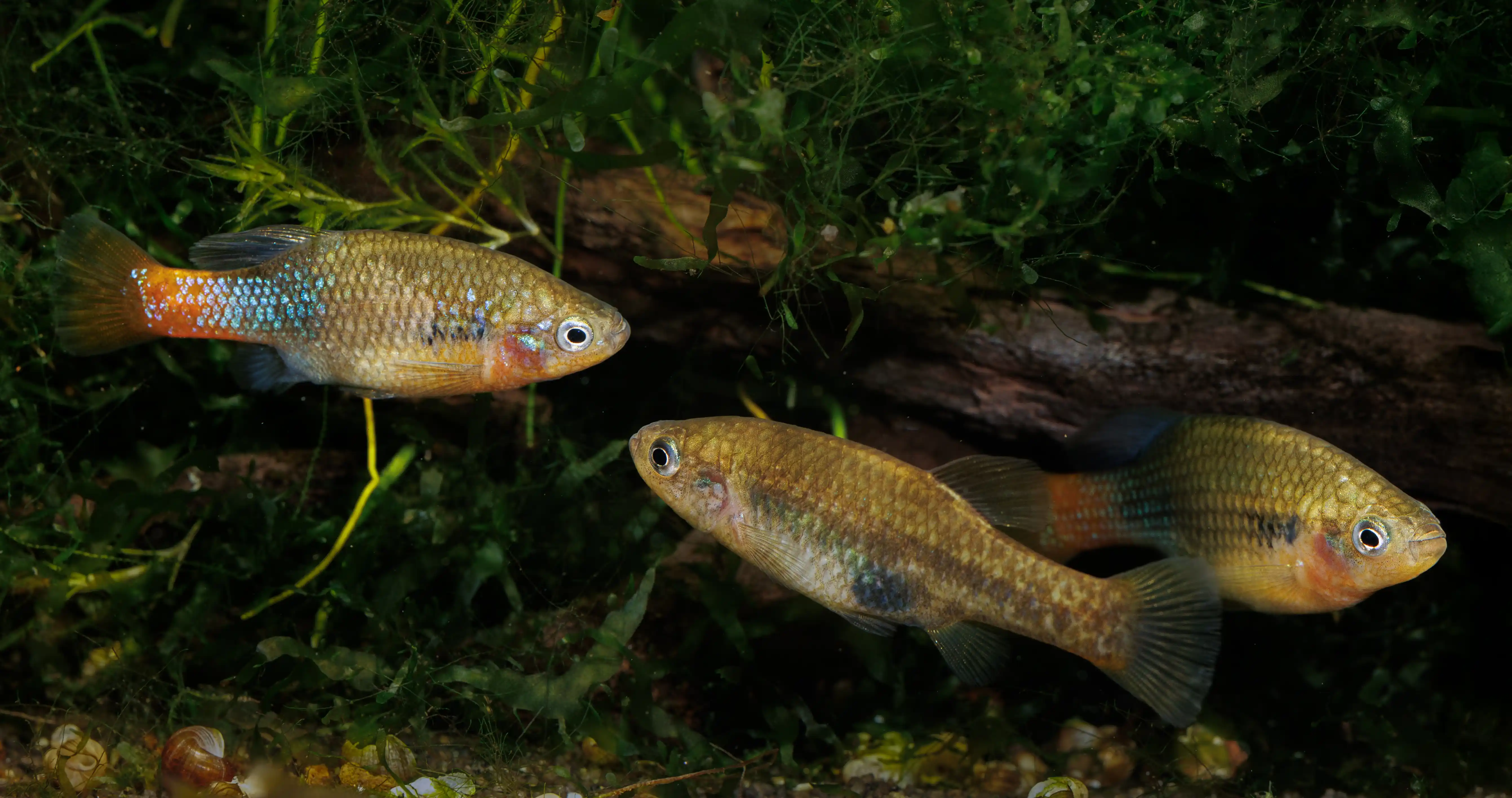
The San Macros redtail splitfin (Xenotoca doadrioi) is a beautiful goodeid that is sadly at risk in the wild. Gabor Horvath outlines his experiences keeping this wonderful livebearer.
Until 2016, the San Marcos redtail splitfin (Xenotoca doadrioi) didn’t even exist as a species. The fish in question did exist before then, but was known only as a local variant of Xenotoca eiseni.
A study by Domínguez-Domínguez et al. in 2016 split this species into three – X. eiseni, X. doadrioi and X. lyonsi – thus creating an “eiseni complex”. If you think, however, that it now completes the taxonomic classification of these redtail splitfins you are wrong.
Although they’re currently Xenotoca, it’s possible that the trio will end up in their own genus. This is because they differ in several characteristics from the type species (Xenotoca variata) of the genus.
Within the eiseni-trio the females look almost identical and – unless you do a ray-count on their fins – are difficult to tell apart. You need to look at the males to be able to identify which redtail splitfin you possess.
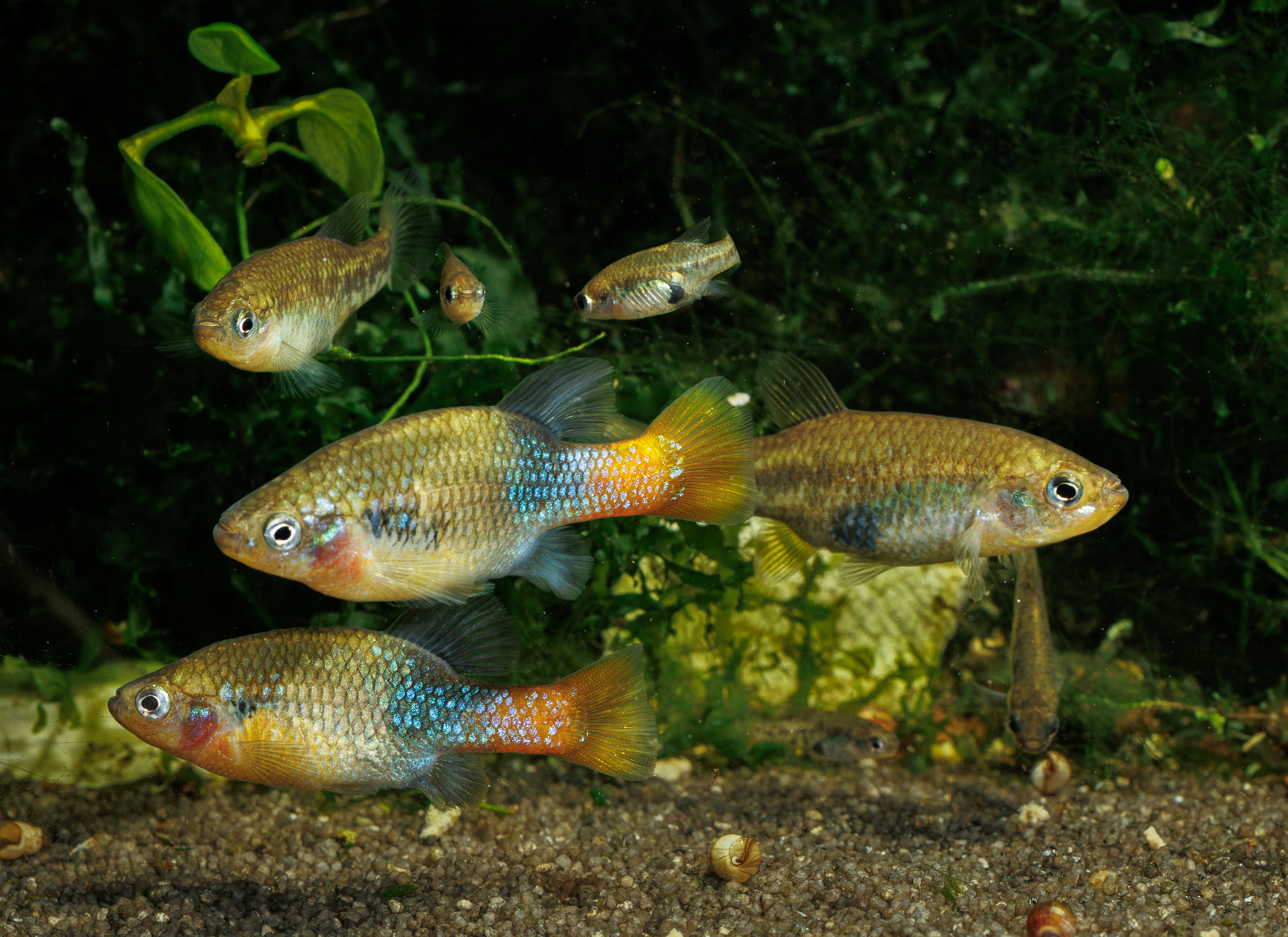
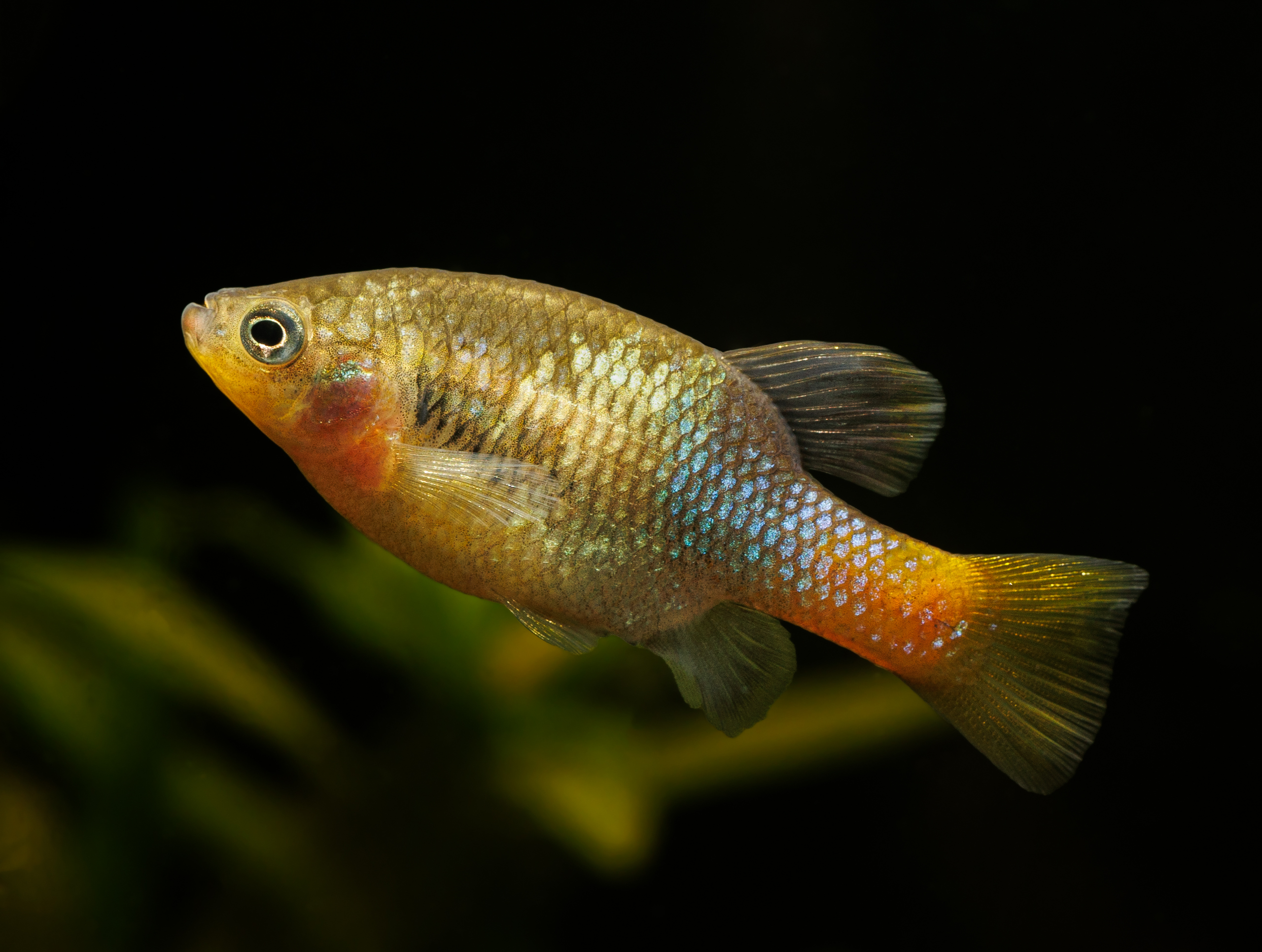
X. doadroi males have a golden-yellow colouration on their chins and bellies, as well as dark black blotches on their sides. They also have a golden “saddle” (looking like a wide golden belt around the “waist”). The other two species display a silvery band instead.
The three species are very close genetically, therefore it’s vital that they are kept separately to avoid cross breeding.
Wild threats to the San Marcos redtail splitfin
These colourful livebearers occur in the waters of the Etzatlan region near San Marcos in Jalisco (Mexico). They occur in many different aquatic habitats including turbid waters over muddy substrates and clear streams with gravel substrates. Aquatic plants do grow in some of their habitats.
The region they live in is at risk though, and suitable habitats are disappearing. The springs and streams that support these splitfins are drying up because of water diversions and groundwater pumping. The remaining populations are also under pressure from invasive species.
More than half of its original habitat have now disappeared. They are currently listed as Critically Endangered, making responsible captive breeding even more important. They make fantastic aquarium inhabitants, but it is worth stopping to think about how we can help wild populations, too.
Maintaining splitfins in aquaria
The San Marcos redtail splitfin isn’t a difficult fish to keep. It doesn’t have special requirements and is rather adaptive in captivity just as it is in nature.
They are not a large fish: even fully grown females remain under 5cm (2"), whilst the males rarely exceed 4cm (1.6"). It makes housing them an easy task as you can accommodate a small group in a relatively small aquarium. A standard 60cm (24") tank will suffice for a group.
The males are mildly territorial and, although not as aggressive as some of the other goodeid species. To avoid over-bullying it’s advisable to break up the line of sight with larger plants, rocks or wood. Any substrate will do but avoid specialist soils that lower the pH, as these splitfins prefer alkaline water.
Regular tap water (ph 7.4-8.2) is perfectly fine for them, as long as it’s not overly hard (GH8-20 is fine). Because my water is way too soft, I have to add extra minerals to increase hardness.
I kept the décor of the tank very simple: a few Anubias plants, two pieces of bogwood, plus a handful of Lomariopsis to provide refuge for any fry. I used my “usual” filtration of a jet-lift powered double sponge filter. Redtail splitfins need clean water. Use good filtration and large weekly water changes to keep them in peak condition.
The adults are easy to feed happily taking whatever you have got to offer. In the wild they are omnivorous opportunistic feeders, consuming everything from algae to worms. Flakes or granules containing vegetable matter and Spirulina should form the main part of their diet.
They gladly devour blanched dandelion or lettuce leaves, too. If you have spare duckweed (Lemna) in your other tanks you can give some to your X. doadrioi as an in-between-meals snack.
What you won’t need (unless the room you keep your tank in is extremely cold) is a heater. Redtail splitfins are perfect candidates for temperate setups, as they thrive at room temperature. In warm tropical tanks – over 26°C – they will struggle, so you may need to cool their water in hot summer days.
On the other hand, keeping them at lower temperatures (but above 15 °C) during the winter stimulates their breeding. They will have a pause for a few months but when the weather warms up you will be rewarded by several strong and healthy fry.

Breeding the San Marcos redtail splitfin
The first step is of course to have both genders. Luckily they are sexually dimorphic so telling mature fish apart is simple.
The females have a typical splitfin look, with irregular brown blotches on the silvery-brown body. Fully matured males are truly stunning fish. They have an orange caudal peduncle, bordered by an iridescent blue band. The remaining part of the body is golden with a few blue sparkling scales and a dark spot behind the head.

The juveniles all have female-like colouration. Only after reaching roughly 2cm (0.8") will the males begin to colour up. If the fish you are looking to buy are smaller than this, buy a larger group to ensure a mix of both genders.
Goodeids have quite a long gestation period and X. doadrioi isn’t an exception. It takes around 60 days for the embryos to fully develop and hatch.
After birth they’re relatively weak and – being poor swimmers – tend to rest on the leaves for a while. This is when they are most at risk and the adults sometimes predate on newborns. After a couple of hours, the fry become free swimming and they are usually left alone afterwards.

San Marcos redtail splitfins Factfile
Scientific name: Xenotoca doadrioi
Size: Females can reach up to 5cm (2") with males staying smaller.
Origin: Found only in the Mexican state of Jalisco in the tributaries and surrounding water bodies of the Ameca River.
Habitat: Adaptable, has been found in turbid water above muddy substrates devoid of aquatic plants and clear water habitats with gravel substrates and plants like Cyperus sp. and water hyacinth.
Tank size: 60x30x30cm (24x12x12”) is the minimum for a small group.
Water requirements: pH of 6.5-8.2, 10-20°H
Temperature: 15-25°C (59-77°F).
Temperament: Males are somewhat territorial although this species tends to be less aggressive than other goodeids. Due to being Critically Endangered it is not advised to keep this fish in community aquariums. Instead, efforts should be made to breed them in captivity.
Feeding: Naturally omnivorous and will eat anything offered. Ensure some greenery is provided as this features heavily in the diets of wild specimens, with vegetable and spirulina based dry foods being a good staple.
Availability & cost: Uncommon in stores likely to be upwards of £8 per fish. Livebearer auctions and hobbyist breeders will probably be your best bet to source this fish.