


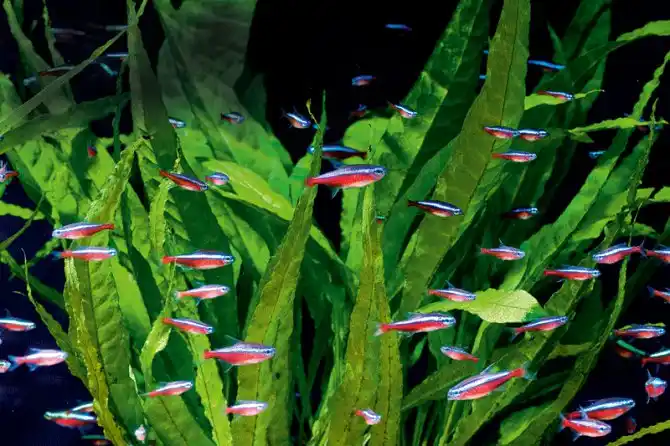
The cardinal tetra is one of the world's most popular aquarium fish species. We remind you exactly why!
What are Cardinal tetras and where do they come from?
This tiny characin comes from the soft, acidic waters of Brazil, South America. They reach just a couple of centimetres in length. As a gregarious species, it appreciates being in a large group and makes for a stunning aquarium showpiece.
They come from the middle to upper Rio Negro basin and the Orinoco basin.

Cardinals in the Rio Negro. Photo by Gabor Horvath
What sort of habitats are cardinal tetras found in?
Cardinals occur in flooded forest areas. Particularly, small, shallow creeks which lie alongside larger rivers and tributaries. Like other fishes, cardinals enter when the rivers swell to feed, breed and take refuge within.
When the rivers initially flood the tetras move upstream and laterally into the forest. They return as waters recede in the dry season.
The waters in which they live therefore vary according to time of year. At the peak of the dry season they could be swimming in just a couple of inches of water in a rapidly disappearing creek.
In the Rio Negro, they occur in igarapés. These are full of fallen botanicals, tinted waters and overhanging plants. The water is acidic and has almost no carbonate hardness (KH).
In the Orinoco, they typically live in morichals. These have clearer water, sandy substrates and dense patches of live plants. The pH levels here, while still acidic, are not as extreme as those found in the Rio Negro.
Related article: How to set up an amazon biotope- with play sand for Paracheirodon axelrodi
What do cardinals feed on in the wild?
According to Instituto Nacional de Pesquisas da Amazonia, the natural diet consists of very small crustaceans, mesofauna, eggs, algae, detritus, and some other types of prey.
Most small crustaceans eaten are cladocera (small, spherical moinids, daphnids, and macrothricids), as well as some copepods (benthonic Harpacticidae). They also consume Rotifera and Thecamoebae as part of their natural diet.
The types of algae they take include unicellular diatoms (Navicularia and Pinnularia) and some green algae (Chlamydomonas, Conjugatophyta and Volvocaceae). They sometimes feed on dead fish, eating the detritus of their muscular, proteinaceous and membraneous tissues.
Paracheirodon axelrodi may also eat ants, fly larvae or pupae, mites, newly-hatched shrimp, fungus, fruit, and fish larvae. They feed constantly throughout the day, so multiple small feeding in captivity is the best way to go.
Cardinal tetras are easy to feed in an aquarium. They readily take flake foods, granules and small pellets, plus many live and frozen foods. These include bloodworm, brine shrimp, black mosquito larvae, cyclops and Daphnia.

A photo of live daphnia by Shutterstock.
Carinal tetra or neon tetra?
Three species belong to the genus Paracheirodon:
- Cardinal tetra (P. axelrodi) from the Rio Negro from Brazil to Colombia
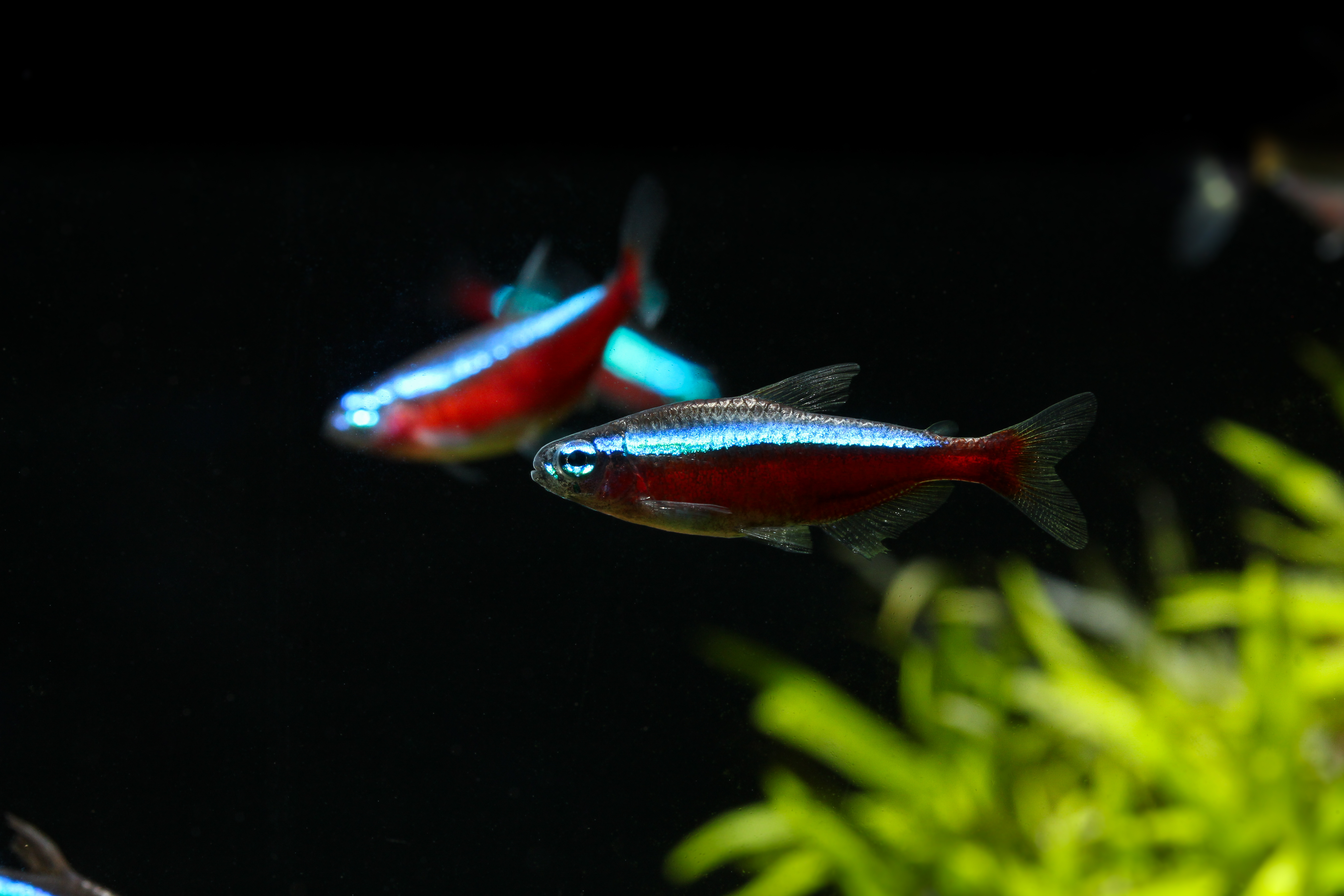
- Neon tetra (P. innesi) from the western Amazon in Peru and the far west of Brazil’s Amazonas state (Photo by Shutterstock)

- Green neon tetra (P. simulans) are also from the Rio Negro in Brazil.
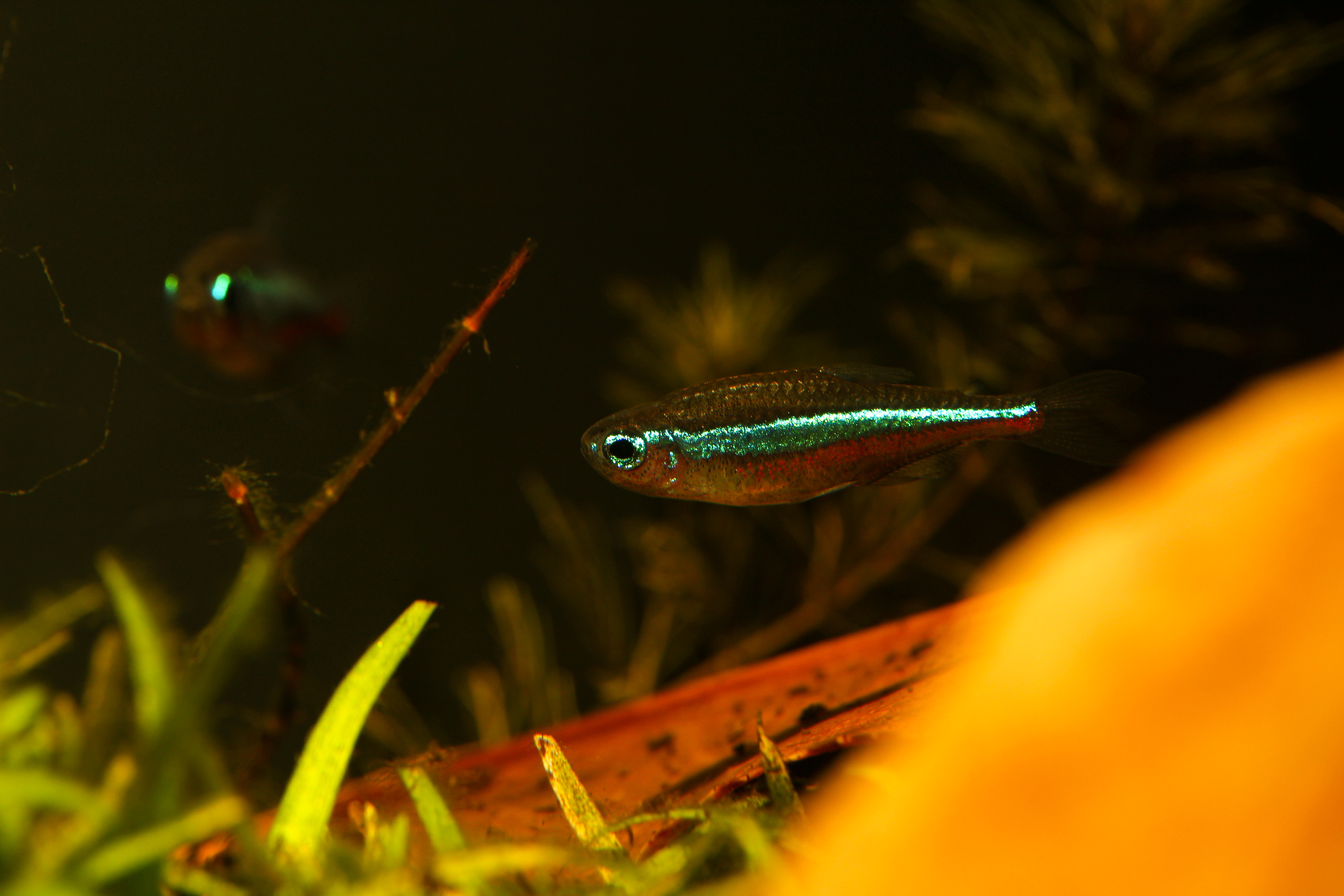
Cardinal tetras are the largest and most colourful of the three. They display more red colouration on the flanks with it extending the length of the body. The blue stripe tends to be broader as well.
The care requirements of all three are similar, preferring soft, acidic water. Green neon tetras, being the smallest, are suitable for tanks measuring 45cm (18") long. The other two species do best in tanks that are no smaller than 60cm (24").
Both cardinals and green neons do well in warmer waters with temperatures reaching 30°C (86°F). Neon tetras require cooler water, we recommend a maximum of 25°C (77°F).
Related article: How to set up a neon tetra biotope
What other species do they live alongside?
When PFK visited the Rio Negro, hockey stick pencilfish (Nannostomus eques) and black winged hatchetfish (Carnegiella marthae) were abundant.
Heiko Bleher listed rummynose tetra, Otocinclus, other pencilfish and hatchetfish, various corydoras, Rineloricaria, Ancistrus and Peckoltia brevis as other suitable biotope occupants.
Plenty of other options are available to choose from as well. Pick the river system you wish to replicate in your cardinal tetra biotope and research it for more inspiration!
Are the cardinal tetras in the UK wild-caught or captive-bred?
Most on sale here are captive-bred, but wild-caught fish are also available. The cardinal tetra is Brazil’s most economically important ornamental fish species. Humans export millions each year from the Rio Negro area.
In the wild cardinals are almost annual fish, with vast numbers dying naturally. Therefore, capturing them before they naturally die does not impact the population year on year.
Scientists have researched the Barcelos region for a long time. They have helped create a sustainable fishery for cardinal tetras. Project Piaba continues to conserve the natural habitat.
How long do cardinal tetras live?
In the wild, the life span of cardinal tetras (Paracheirodon axelrodi) is around a year. During the dry season the shallow pools and creeks dry up stranding billions of tetras. Predators easily pick off the small fishes and any that escape predation die when the pool dries completely. In captivity they’ll live for up to five years if conditions are right.
Why are Paracheirodon so colourful?
The cardinal has bright metallic stripes that you might think would make it rather obvious to predators. However, research has shown the opposite is true.
Although they look bright in colourless clear water, their stripes appear darker when viewed through dark tannin-stained water in the wild. Their metallic stripes reflect light at a specific angle. When near the surface this reflects a bright mirror image onto the underside of the water surface. This provides a false target for predators while the fish remains less conspicuous.
Are there any different colour forms?
There appear to be two different morphs, one from the Rio Negro and one from the Rio Orinoco. Characiform experts Dr Stanley Weitzman and Dr William Fink studied them closely. They found they differed little in morphology, fin ray or scale counts, but did have slightly different markings.
The variety from the Orinoco in Colombia has a shorter blue stripe which does not reach the adipose fin. Meanwhile, the Rio Negro form has a longer blue stripe that does.
Also, there is a morph with a golden stripe and one with a silver stripe. Breeders in the Czech Republic have also fixed a golden form.
Do they suffer from any ailments and diseases in the aquarium?
In well-kept aquariums cardinals are hardy, easy to keep and generally not disease prone. However, newly-imported fish are susceptible to neon tetra disease caused by a tiny parasite called Pleistophora hyphessobryconis.
This can be difficult to eradicate and it’s important to ensure fish are free of it before buying. Beware of fish that are less active and have pale patches on their bodies.
Are cardinal tetras a good community fish?
Cardinals are ideal inhabitant for a community aquarium and do not bother other species of fish. However, they are quite small so ensure any other fish kept with them are not going to try and eat them. Angelfish, in particular, can often predate on cardinals, so be careful if mixing.
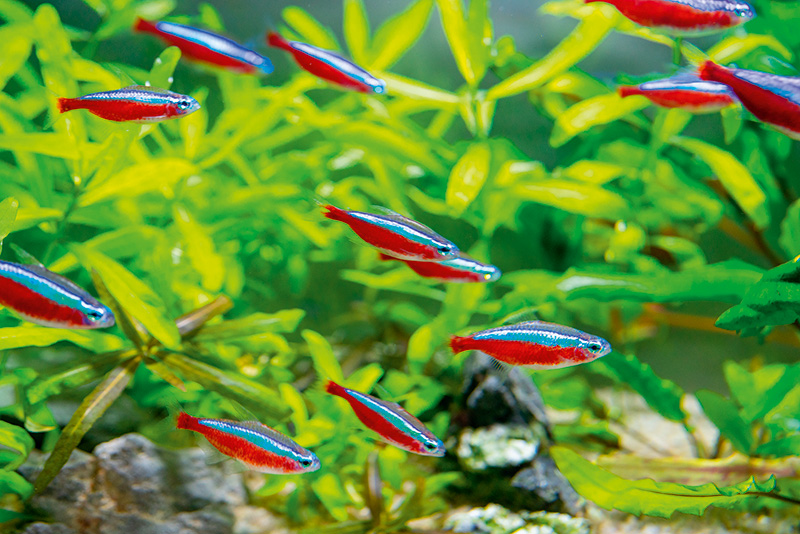
Shoal of cardinal tetras (photo by Shutterstock).
Related article: 12 great community tank tetras
How would I set up the perfect biotope?
The authentic Rio Negro habitat of the cardinal should be blackwater. A temperature range of 25-28°C (77-82°F) with incredibly low pH and zero hardness. Leaf litter and tree branches can help to acidify the water as long as the KH is low to begin with. Few plants grow here because of the acidic water, low light levels and the lack of nutrients.
The substrate should be a blend of crushed leaves, twigs, sands, silts and soils. But, a simple soft pale sand with botanicals scattered across the top will work well too.
Achieve blackwater by using soft water, like RO or rainwater. Using botanical laden tea bags, oak leaves or blackwater extract can then reduce the pH more easily.
Are cardinals tetras difficult to breed?
In the wild they spawn in the rainy season when the habitat becomes much larger. More food becomes available and these small fish can disperse throughout the flooded forest.
The eggs are light sensitive, so there is no need for aquarium lighting. Mating takes place at twilight. Once laid the eggs sink will sink, woollen spawning mops are a good spawning medium.
To breed cardinals successfully, the pH should be between 5.5 and 6. The temperature should be at 24°C (75°F) and lighting should be dim.
You must remove the parents after spawning. Eggs hatch within 24-30 hours and fry are independent within three to four days of hatching. At this point begin to offer some regular feeds of liquid fry food, infusoria, or rotifers.
Larger fry will thrive on small amounts of food processed hard-boiled egg yolk. Powdered eggs are also suitable, as are powdered fry foods.
Males and females reach sexual maturity at some nine months.
Related article: How to breed neon tetras