


With the spooky season just around the corner, we thought it was time to highlight some of our favourite Halloween themed aquarium inhabitants - fish or otherwise...
Whilst we prepare for ghosts and ghouls to walk the earth this October 31st, there we plenty of underwater creatures that evoke the spirit of the season. From eerie aquatic behaviours, creepy crustaceans and phantom fish, Alex Bell takes a look at some fishy favourites which perfectly capture the essence of Halloween.
Words by Alex Bell
I have attempted to not be biased based on a love of small blackwater species, so instead, I have thought back to my time in retail and some of the species that would often catch my eye- even if I would not personally keep all of them.
1. Halloween Hermit Crab

Credit: Shutterstock
Although fish tanks are often designed to house our finned friends, there are some long-legged creepy crawlies that dwell in the lower reaches of our aquariums. One of which cannot be missed off of a Halloween list given the common name- it is of course the Halloween hermit crab! A monster in size compared to the blue or red-legged, or rock hermits that are common to see, I remember being shocked when I unpacked a marine delivery and saw a bright orange striped leg sticking out of a rather large shell. This was my first introduction to this species and certainly not one I will forget.
An affinity for hair algae and cyanobacteria (not an algae) means this species can often be sold as a member of the clean-up crew in a reef tank, however, its large size means they can often become troublesome, knocking off frags, annoying corals by standing on them and stealing their food. Oh, and they do have a reputation for trying to eat, and sometimes successfully so, their slower moving tank mates. So, although not the best addition to a reef aquarium, their novel pattern and larger size could make this an interesting addition to a carefully planned salty aquarium.
Fact File
Halloween hermit crab
Scientific name: Ciliopagurus strigatus
Size: up to 5cm (2”)
Origin: Indo-Pacific
Habitat: Generally found in shallow reefs and the intertidal zone down to a maximum depth 20 metres (65 feet).
Tank size: 90x40x40cm (36x15x15”)
Water requirements: Typical reef aquarium parameters will be suitable, although slightly more tolerant to a range of conditions: specific gravity: 1.020-1.025 (28-35ppt), pH: 8.1-8.4
Temperature: 22-28°c (72-82°f)
Temperament: Can be aggressive towards their own kind as they defend resources and squabble over the best shells, hermit crabs have been known to attack snails for their shells as well so best to avoid homing them together. As with many opportunistic feeders, Halloween hermit crabs will consume live prey if they are given the chance, or are hungry enough, so supplement their diet to reduce the chances of other aquarium inhabitants from becoming dinner. Reef with caution, although unlikely to consume sessile invertebrates they will happily annoy corals by walking over them and stealing their food. Their size means they can also be prone to knocking frags off of their perches.
Feeding: Omnivorous, consuming algae and meaty foods. In a low stocked aquarium they will likely consume left over mysis, brine or prepared foods given to the other inhabitants. Should the natural algae in the aquarium be depleted be sure to give them supplementary greenery.
Availability & cost: Size dependent, expect to pay upwards of £5 each.
2. Purple Vampire Crab

Credit: Shutterstock
Sticking with the crustaceans, although this is one with slightly less salt in the water, we have the brilliantly named vampire crab. I was close to including the similarly named vampire pleco, but upon reviewing an upcoming article on the genus Geosesarma by Gabor for the December 2024 issue of the magazine, I couldn’t not include them.
I have often enjoyed the array of colourful crustaceans coming out of Indonesia. Having kept both Caridina dennelri and caerulea (which are both species of Sulawesi shrimp), I previously spent a lot of time looking at other invertebrates from the region- including rabbit snails and this interesting group of crabs. Despite researching them, I never managed to keep any of the vampire crab species, but upon reading the soon to be published article I immediately looked around my house to see if I could squeeze in a small paludarium. Given their tiny size, I feel like many of us could find an excuse to pop a small tank in the corner somewhere. With colours to suit anyone’s tastes- including one that is orange and purple in colour (a perfect combination for Halloween)- I am sure you will soon fall in love with these almost spidery looking creatures. I won’t go into any more detail personally, as you are all better off hearing about how to keep them from someone who has actually done it before so if this interests you, I highly recommend Gabor Horvath’s article which will be released soon!
Fact File
Purple vampire crab
Scientific name: Geosesarma dennerle
Size: up to 5cm (2”)
Origin: Indonesia, specifically the island of Java.
Habitat: Typically found on terrestrial land but near to small creeks in areas with abundant vegetation and hiding places in the form of rocks and fallen wood and leaves. Occasionally, they can be observed in burrows that they dig themselves. Juveniles typically spend their time closer to the water.
Tank size: Minimum footprint for a trio is 30x30cm (12x12”).
Water requirements: Generally undemanding in terms of water chemistry, avoid acidic conditions.
Temperature: 20°C to 28°C.
Temperament: Males can be aggressive so larger tanks needed to house multiple males. Best kept as a single species.
Feeding: Omnivorous, best to offer a variety of foods including fresh vegetables, prepared crab foods and an occasional meaty treat.
Availability & cost: Generally available but rarely stocked in shops so may require a special order. Expect to pay around £8 depending on species rarity.
3. Black Phantom Tetra

Credit: Shutterstock
For my third choice, I am venturing back to my comfort zone. A relatively small tetra, hiding in the tinted waters of South America. It is not the most colourful of the characins commonly available and I kept this fish within the first couple years of my fish keeping journey, so clearly my love of the more subtle fishes started quite early on. I would bet that many of you have already guessed which species this is, and that many of you have kept it at some point in your hobby journey, just like I did. The black phantom tetra.
There are a few things that make this fish stand out for me, firstly, the dark black elongated dorsal fins of the mature males make a rather impressive display, almost like the fish is flinging around a long, dark cape… perhaps they are perpetually in fancy dress? The females may not have this draping fin, but they have their own, slightly more subtle, defining feature which is still perfectly Halloween themed. Their anal, pectoral and adipose fins have a beautiful pumpkin orange hue (in varying intensity) which add a slight pop of colour as it contrasts with the dark black caudal and dorsal fins.
Yes, it is predominantly a colourless fish, being mostly shades of grey and black, but the occasional flash of orange and the almost metallic blue flash that surround the dark black blotch flanks adds just enough intrigue to keep everyone enthused by this fish. This species has recently been renamed, so you may see it listed as both Megalamphodus megalopterus (which is currently the correct name) and Hyphessobrycon megalopterus; both names refer to the same species, so don’t worry if you get them confused. I am sure we all will use the wrong name from time to time while we learn them.
Fact File
Black phantom tetra
Scientific name: Megalamphodus megalopterus
Size: up to 4cm (1.5”)
Origin: Native to Brazil and Bolivia, found in a number of river systems including: the upper sections of the Madeira and Paraguay, and the Guaporé river.
Habitat: Often found slow moving tributaries, ponds, small lakes and areas of still water created by flooding during the wet season. The fish forms aggregations around structures in the water which can be submerged wood or aquatic vegetation. Some plant genera sometimes found in the area include: Ludwigia, Eleocharis, Echinodorus and Helanthium
Tank size: Minimum 60x30x30cm (24x12x12”)
Water requirements: Captive bred specimens are typically quite adaptable, but ideally should be maintained in acidic conditions (<7pH), especially if breeding is your aim. The water should have soft to medium hardness, although being fairly adaptable in captivity, chasing specific numbers is ill-advised as stability is more critical.
Temperature: 20°C to 28°C (68-82°f)
Temperament: Peaceful and an ideal candidate for a softwater community aquarium. The males and females are sexual dimorphic with the males possessing elongated fins, whereas the females have some orange colouration to the lower fins (pelvic and anal) which can create a lovely display when maintained in larger groups (>8 individuals).
Feeding: Omnivorous in nature, opportunistic feeding on small invertebrates, crustacea, filamentous algae and other terrestrial based foods that may fall into the water. The condition of these fish in aquaria is optimised when provided with a varied diet including the addition of live or frozen insect larvae, daphnia brine shrimp and other similar offerings alongside the standard prepared flakes and pellets.
Availability & cost: Commonly encountered in stores, prices from £3.
4. Black Ghost Knifefish
Credit: Shutterstock
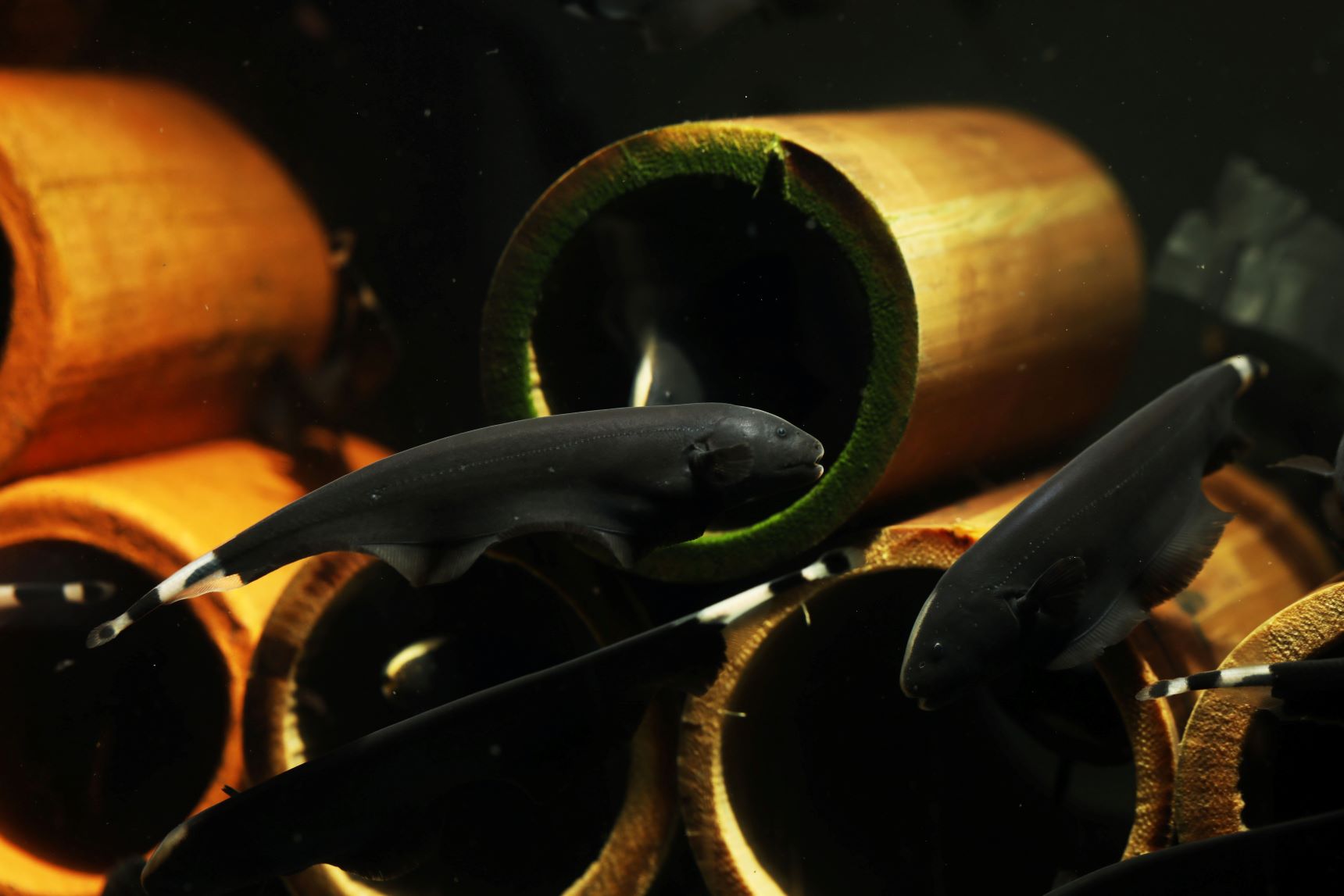
Next up is another fish from South America, and it has the perfect Halloween back story which I will explain in a moment. Unfortunately, I don’t think I will ever have a tank large enough to keep one, although, I know a few people do so it still qualifies as an aquarium inhabitant. For me, I will stick to a smaller relative that currently dwells in my fish room, rarely seen by anyone. This is because all of the Gymnotiformes are generally nocturnal. I am of course talking about the knifefish, which qualifies as a spooky named fish on its own, but the one that makes the list is the black ghost knifefish for obvious reasons!
This fish grows to 50cm, so like I said earlier requires an unattainable sized aquaria for many of us, so for that reason I will focus on their importance to the locals of their native lands rather than their husbandry requirements and biology. If you’d like to know more about knifefish in general, similar to the vampire crabs earlier, there will be a feature all about them in the upcoming magazine (December 2024).
These ‘ghosts’ drift through the waters without much effort, almost like how ghosts drift through the walls without any apparent method of propulsion. Their bodies are mostly black in appearance, with a small area of white at the posterior end of the body, meaning they can lurk in the shadows going unnoticed by humans in boats or on the banks surrounding the stream, only to be seen by the glow of the moonlight. The people that share the waterways with these mysterious fish believe that the ghosts of their loved ones that have recently departed take up residence in these fish meaning they are very protective of the species and that any exports for the trade need to be done in a sensitive way.
Fact File
Black ghost knifefish
Scientific name: Apteronotus albifrons
Size: up to 50cm (20”)
Origin: South American, found across Brazil, Ecuador, Guyana, and Peru in the Amazon and Paraguay river systems.
Habitat: Lives in flowing creeks and streams with a sandy substrate littered in leaf litter and dead wood. The water is typically stained with tannins.
Tank size: 180x70x60cm (6x3x3’) minimum
Water requirements: Soft and acidic water is ideal, 6-7 pH, 0-5dkH
Temperature: 23-28°c (74-82°f)
Temperament: Although large in size, this is not typically a fish predator as such, any tank mates that are large enough to not be consumed should be fine. Avoid overly boisterous fish as the knifefish’s skin is sensitive and can be easily damaged.
Feeding: Generally, an insectivore, offer the usual frozen foods. Captive individuals do sometimes take to prepared pellets so offer these alongside and larger specimens will enjoy smaller earthworms as an occasional treat.
Availability & cost: £10 or more for small individuals, large fish usually seen for sale due to being rehomed and price can vary.
We are back to the salty side of the hobby for my final choice. As we all know, all the ghosts, ghouls and monsters come out at night, and in my experience, Halloween only gets interesting when the clock strikes 12. For this reason, and their once again almost jet black appearance, the midnight angelfish (Centropyge nox) gets the nod for the final place. I have never kept a marine aquarium large enough to house one of the dwarf angelfish, although I have always admired them. A few that always caught my eye when scrolling through import lists were the classic flame angel (Centropyge loricula)- they’re popular for a reason and always sold well, the multicolour angelfish (Centropyge multicolor)- because they were too expensive for me to justify ordering and finally the midnight angelfish (C. nox) because they were always overlooked. People often want reef aquariums because of the vast array of colours available in both the fishes and corals they can stock it with. The species with predominantly black colouration often sit in shop tanks for longer than they should. This often means that the workers in said shop build up an attachment for these fish, they develop a bit of a personality and sometimes even get a name.
This species brings those memories back to me; it also combines my love of the more unusual blackwater (less colourful) fish and my historic interest in the marine environment. It has been a long time since I have maintained a reef aquarium, and when I do keep one again, I will definitely have a more subtly coloured fish hiding in there, and it will no doubt become my favourite.
5. Midnight Angelfish

Credit: Water Colours Aquarium
Fact File
Midnight angelfish
Scientific name: Centropyge nox
Size: up to 10cm (4”)
Origin: Quite wide spread in the Western Pacific
Habitat: Associated with reef habitats in coral-rich areas of the outer slopes. They can be found in lagoons and passages but more typically where dense rock and coral growth is available to provide cover.
Tank size: Minimum 90x40x40cm (36x15x15”)
Water requirements: Typical reef aquarium parameters will be suitable, although slightly more tolerant to a range of conditions: specific gravity: 1.020-1.025 (28-35ppt), pH: 8.1-8.4
Temperature: 22°C to 28°C (72-82°f)
Temperament: Can be maintained in a carefully designed reef aquarium as there are reports of these fish enjoying a coral snack. It is worth trialling your individual with small frags of coral and design the reef around species it does not consume. Avoid housing with lots of other algae grazers as they will compete for their natural food. It is generally best to keep just one Centropyge spp. (or their close relatives) per tank.
Feeding: Reported to feed predominantly on algae, so a mature aquarium with natural algae is preferred. Although, they will usually take to prepared foods, of which those with some marine algae and spirulina in the recipe should be chosen which can supplement their diet. They will enjoy some of the frozen diets like mysis and brine shrimp and other small invertebrate foods and this ensure a varied diet for both the angelfish and other occupants of the aquarium.
Availability & cost: Routinely imported, but not a common sight in stores. Expect to pay around £50