


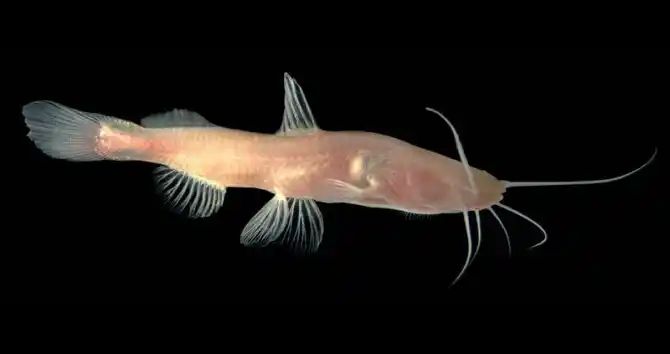
A blind cave catfish that has remained unnamed since its discovery more than 17 years ago has finally been given the name Rhamdiopsis krugi by Flávio Bockmann and Ricardo Castro in the most recent issue of the journal Neotropical Ichthyology.
Because of numerous published studies, we know quite a bit about the biology of Rhamdiopsis krugi, from the caves of Chapada Diamantina in northeastern Brazil, but it has remained unnamed because of the uncertainties surrounding its phylogenetic affinities.
This species is solitary, as with many cave catfishes from Brazil. It shows a marked preference for rocky substrate, and exhibits little tendency to hide (unlike most catfishes).
Like many cave fishes, it displays no reaction to light and does not seem to even fear physical disturbances in the water. Instead, the fish increase sits exploratory behaviour when disturbed. Also, like many cave fishes, R. krugi exhibits no circadian rhythm (day/night cycles) in its activity.
Studies have also shown that the new catfish is strictly carnivorous, preying on invertebrates found near or on the bat guano in the bottom of the cave pools it inhabits. The species breeds at the end of the rainy season in March.
The detailed study by Bockmann and Castro reveals that it is a member of the heptapterid genus Rhamdiopsis distinguished from all other members of the family (including its congeners, R. microcephala and R. moreirai) by the absence of eyes and body pigmentation, presence of a widely exposed pseudotympanum, unusual attributes of the skeletal system, upper and lower caudal-fin lobes typically with six branched fin rays each, 38–39 vertebrae, 14–17 anal-fin rays, and a very short lateral line.
This species is named after Luiz Krug, a professional tourist guide based in the city of Lençóis, in the Chapada Diamantina area, who called the authors’ attention to the existence of the new catfish and helped to collect its type series, and for his efforts dedicated to its conservation.
Because R. krugi possesses so many unique morphological characters, many of which are related to adaptations for subterranean living, it is difficult to assess its phylogenetic relationships based on morphological characters alone. The authors were unable to establish the affinities of R. krugi with its congeners because they share ambiguous derived characters.
For more information, see the paper: Bockmann, FA and RMC Castro (2010) The blind catfish from the caves of Chapada Diamantina, Bahia, Brazil (Siluriformes: Heptapteridae): description, anatomy, phylogenetic relationships, natural history, and biogeography. Neotropical Ichthyology 8, pp. 673–706.