


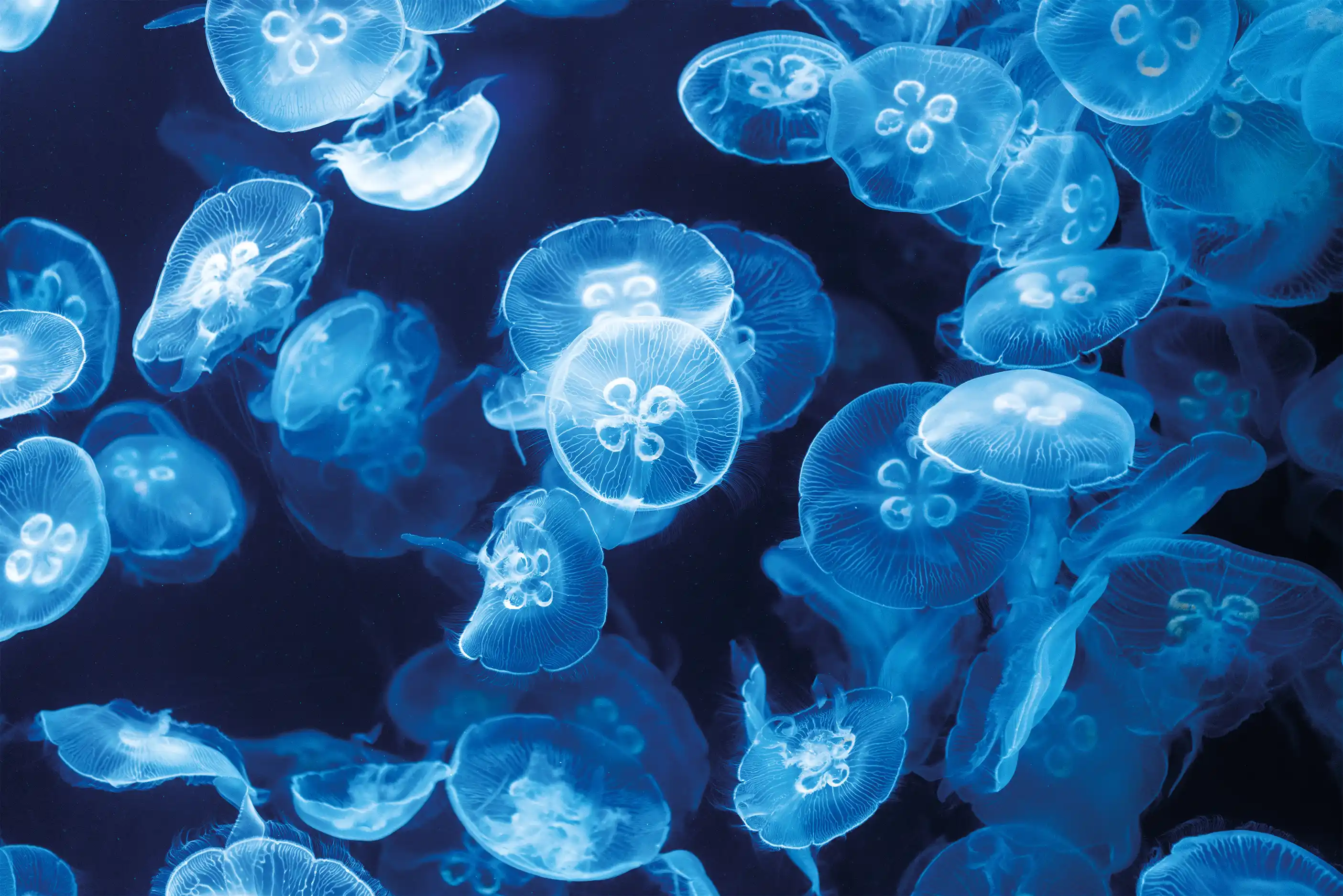
They may be 95% water, but jellyfish are 100% awesome. Chris Sergeant investigates their history, biology and aquarium care.
Jellyfish are a fascinating bunch of marine organisms. With soft fossil records dating back 500 million years, they are one of the oldest groups of animals on Earth. Yet they don’t appear to possess any of the basics required for natural survival.
Being invertebrates, they lack an internal, bony skeletal system. They have even elected to forgo any form of solid, exterior body protection as well. Plus, jellyfish seem to have no discernible eyes, and a closer look reveals an absence of blood, brain, heart and lungs too.
While the focus tends to be on what they don’t have – after all, jellyfish are 95% water – it’s easy to overlook how successful they have been. Not only do they pre-date dinosaurs, but they were also in our oceans long before the existence of trees, and even fungi too. Five mass extinction events have come and gone and countless other creatures perished. But, the humble jellyfish simply bobbed along the side-lines, an unaffected spectator in constantly evolving world.

Mauve stinger (Pelagia noctiluca) - Photo by Shutterstock
What are jellyfish?
Along with corals and anemones, jellyfish belong to the phylum Cnidaria. Jellyfish are split into four classes: Cubozoa, Hydrozoa, Scyphozoa and Staurozoa. They have representatives across a huge array of habitats, from freshwater lakes down to the bone-crushing ocean depths.
The key to their success has been to keep things simple. They display radial symmetry and there are three distinct layers to jellyfish anatomy.
The outer layer, or epidermis is primarily responsible for protecting its insides. The epidermis also plays an important role in facilitating gas exchange. In the event of an injury, epithelial cells migrate to the damaged area and regenerate the tissue to heal the wound.
Beneath that is the mesoglea, which accounts for the majority of the animal, providing structural support to the jellyfish. This layer acts as a hydrostatic skeleton, enabling them to move.
Finally, you have the gastrodermis, here enzymes secreted by the gastrodermal gland cells break down food items. This allows the phagocytic cells to absorb the nutrients from their digested meal. The gastrovascular cavity then transports this around the body.

Spotted jellyfish (Phyllorhiza punctata) are often available via TMC - Photo by Tropical Marine Centre
Jellyfish typically adhere to a general body shape. Sporting a curved, bell-shaped body, they possess an array of stinging tentacles hanging down from the underside. If you were to flip them over, you would find their mouth and four, thickened oral arms.
Jellyfish are, generally, passive carnivores. They predate on other living organisms, but usually only consume items that drift by rather than actively hunting prey. Box jellies from the class Cubozoa are the exceptions, as they actively hunt their prey.
Jellyfish have nematocysts, stinging cells, which fire into the skin of prey items that touch their tentacles. They release a paralysing venom subduing their prey allowing them to slowly move the item to their mouth. These cells are why it is best to avoid touching jellyfish, as they will happily sting humans even if they cannot eat us.
Can I keep jellyfish aquariums at home?
Up until recently, the best way to encounter jellyfish was with a visit to the beach. You can often spot a few different species stranded at the high tide line. Equally, you can take a trip to your local public aquarium. They often have large circular displays of moon jellyfish (Aurelia aurita) which fascinate onlookers.
Previously only expert aquarists and public aquariums were successful at keeping jellies in captivity. Their specific requirements mean they are unsuitable for standard home aquariums. However, jellyfish are not particularly hard to keep if you have the right aquarium. They require a set up called a Kreisel.
Kreisel comes from the German word for ‘spinning top’, and references the tanks circular shape. This shape, along with a gentle, laminar flow, ensures the jellyfish comfortably remain in suspension.
Previous kreisel iterations were costly meaning keeping a jellyfish tank at home was unrealistic. That was until Tropical Marine Centre (TMC) launched the TMC Kreisel aquariums in 2023. At under £170 for the larger TMC Kreisel 15, maintaining jellies at home has never been so affordable.

TMC's Kreisel 10 is just £159.98. You can order direct from TMC and pick it up at your favourite local store via the Support Your LFS campagin.
The built in filtration system of the TMC Kreisel is tucked behind an overflow screen with very small openings. The return flow produces a gentle, bubble-free gyre keeping your pets in suspension like they require.
The beauty of these TMC tanks is their efficiency and cost-effective nature. With a 2w pump and 4-6w colour-changing integrated LED lighting, the tank barely makes a dent in your energy bills. They recommend keeping the moon jellyfish, which live in temperate waters, so you don't need a heater either.
Caring for jellyfish in an aquarium
With the TMC Kreisel in hand, caring for jellies is fairly straight forward. First you need to cycle the aquarium's hidden filter before you add the jellyfish. This means that it can deal with any waste they produce ensuring water quality remains optimal.

Feeding is fairly simple as well. Jellyfish will eagerly accept live or frozen meaty foods, including brine shrimp, copepods or Mysis. More bespoke diets are also available, tailored for jellies, like the Tropic Marin Jellyfish Food.
Broadcast feeding, adding the food in larger amounts across the surface of the tank, is best for the jellies. However, it creates more waste from left over food, especially when not using live foods, meaning more water changes. Target feeding with a pipette can work to reduce this but not all jellyfish feed as well with this method.
Monitor the water and keep the parameters within the safe limits for your species (see below). Ammonia and Nitrite levels should be all but zero. Keep nitrate below 10ppm and phosphate below 2ppm limit algae growth and ensure your jellies remain healthy.
What jellyfish species can I keep?
TMC recommend the aforementioned moon jelly as the best beginner option. For this species, aim for a salinity between 25 and 30 ppt, pH 7.9-8.4 and a temperature of 18-25°C (64-77°F).
The spotted jellyfish (Phyllorhiza punctata) are another possible species. They are a tropical jelly requiring temperatures of 23-28°C (73-82°F) and salinity of 31-35ppt.
TMC also recommend the cannonball jellyfish (Stomolophus meleagris) for their Kreisels. Aim to keep their water between 20-26°C (68-79°F) and 25-30ppt for success with his species.
Note that all species are relatively short-lived, with a year being the aim.
Cool Jellyfish facts
- The bell of the jellyfish is packed with fluid, circular muscles. When they wish to move, they contract them, squirting water in the opposite direction.
- Cubozoan box jellyfish can move at speeds of up to 4-knots. The rim of their bell folds inwards to form a shelf, known as a velarium, helping create a far more powerful jet of water when the bell pulses.
- Jellyfish don't have a brain, instead they have a network of nerves called a nerve net. They use this to detected localised environmental changes.
- The purple circles you can see in the bell of moon jellyfish are actually their reproductive organs!
- Leatherback sea turtles feed primarily on jellyfish, as do the giant sunfish.
- The Portuguese man-o-war is actually a siphonophore, not a jellyfish. Despite this, they still have a potent sting so be sure to avoid them when swimming
![Portuguese man-o-war aren't true jellyfish]()

Portuguese man-o-war - Photo by Shutterstock