


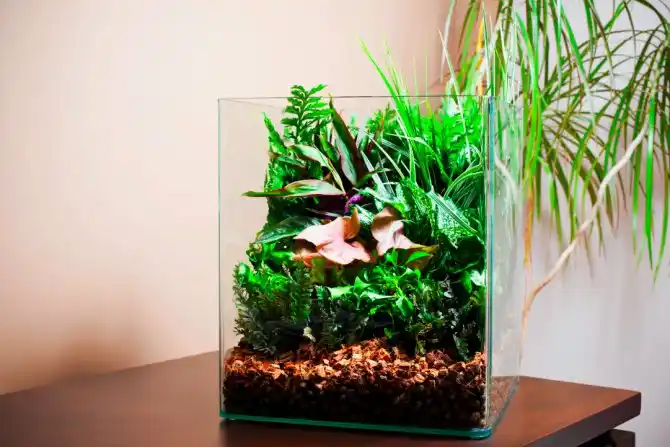
Many new hobbyists have problems keeping plants in their tanks because they've been sold non-aquatic ones. Jeremy Gay explains more.
I could travel the length and breadth of the country visiting aquatic shops and I would see non-aquatic plants sold for aquariums. One look into the standard, tiered plant cascade and I'd spot plants that should actually be in a pot or on a windowsill.
Thankfully, this seems to be improving as planted tanks have become far more popular. This means everyone is more familiar with plant names and less likely to pick a terrestrial species.
Newcomers to the hobby might not be aware though, and may still get plagued by melting terrestrial plants. So, it is still worth reminding everyone of the common green leaves that don't adapt to life underwater.
Related article: Five great houseplants to grow above your aquarium.
Who’s to blame for non-aquatic plants?
The sources of aquatic plants are mainly greenhouse enterprises on mainland Europe, or outdoor plant farms in the Far East. Such places produce many varieties of aquatic plants — as well as many non-aquatic ones.
The usual procedure for most stores was simply to order, say, 250 assorted bunches. Within this mix will usually be non-aquatic species. However, these will not last long underwater. They drown, then disintegrate and could degrade water quality.
They are, however, available in a stunning variety of leaf forms, colours and textures. This means that, given the choice, the uninformed aquarist will actually choose non-aquatics over true aquatics. This is because they look more exotic and more colourful.
So where does the blame lie? Plant nurseries may have a legitimate business growing house plants for garden centres. Although, if they have we could do with them telling the wholesalers and retailers which are good underwater and which are not.
That’s the first problem. The second is that some retailers were either ignorant of plant names and varieties and cannot tell the difference. Or worse, they are blatantly aware of what they are selling and just take the money. Nurseries, of course, could be doing the same.
Either way, an aquatic shop which stocks and then sells non-aquatic plants probably isn’t the best place to buy plants. If they are prone to the odd lie in the chase for a quick buck, what else aren’t they telling you?

…but most aquatic plants are grown out of the water!
Here lies another twist. Many common aquatic plants grow above the water in the greenhouses, and in wild habitats. This includes Amazon swords (Echinodorus spp.), Crypts (Cryptocoryne spp.), Java ferns (Microsorum spp.) and Anubias.
In fact, all the stem, moss and carpeting plants are too. The only ones that aren’t are true floating plants like water lettuce and true aquatics like Vallisneria. So most of our "aquatic" plants only spend some time underwater in the wild, as in the rainy season. For most of the year they just grow on the water’s edge, either with their roots in water or moist soil.
These plants mostly grow and flower during the dry season. Here, they have abundant light and CO2 from the atmosphere. Nurseries use this to grow their aquatic plants out of the water as they will grow more quickly. They won’t pick up algae or aquatic snails either — and are much easier to propagate that way.
Nurseries will grow plants without any soil, instead just having their roots in water, known as hydroponics. This way only fertilisers need adding to the water and the plant has everything it needs.
This then translates to the difference between success and failure when you put plants in your aquarium. To keep them happy and growing underwater you must also provide them with enough light, CO2 and fertilisers. Get this wrong and species like Glossostigma will last just a short a time underwater, as will the true house plant species mentioned earlier.

How do you identify house plants over aquatic plants? The giveaway is to avoid anything with a variegated leaf, like green and white (as pictured above) or red and green. Next feel them or pick them up. A house plant will stand up in the pot unassisted, but most aquatics will droop when out of water.
The leaves on a non-aquatic plant will feel shiny or waxy. The leaves themselves may come to a sharp point, as these are actually drip tips for channeling away rainwater! If it looks and feels wrong, it probably is.
Related article: 5 easy and beautiful stem plants for your aquascape
Better education
So, all in all, we need better education into what will grow underwater and what won’t. Part of PFK’s job is to inform the consumer about what to buy and what not to buy. So, we bought a load of the most commonly stocked non-aquatics and photographed them.
Hopefully, you will be able to use the below guide so you can avoid them. It certainly seems to have worked so far as we see far less of these plants in shops now.

Should just anyone sell non-aquatic varieties?
This is the interesting bit and potentially when the stocking and selling of non-aquatics may come full circle. For as well as aquariums, there are also growing pet/plant/other aquatic sectors where these plants come into their own.
Do a quick search of the terms paludarium, terrarium, vivarium and even riparium, and you'll discover a new world. A world that caters for life both above and below the water line.
Paludariums, from the word meaning marsh, typically contain one third to one half of water volume and air above. This means you can then have terrestrial (dry land) areas above the water line. Here, you can stock the flora and fauna that like to inhabit these conditions, as in the picture above.
Many non-aquatics featured here would be perfect planted in soil or coconut fibre. They could either be completely above the water or with their roots in the water below to obtain a constant supply of moisture.
Indeed, the paludarium can offer a whole host of opportunities for fishkeepers. If the set up is large enough, you can keep fish in the bottom with plants, amphibians and even reptiles in the space above.
If you're setting up an Amazon-themed aquarium what would be more natural than a living canopy growing above. Plus, by putting their roots in the water, all those house plants will help to purify the water. As they grow they will use up the nitrate and phosphates as fertiliser.
Moree and more glass terrariums are available these days. You can have not only the rainforest stream biotope but the rainforest biotope above it.
So, thanks to the growth of paludariums and terrariums, a switched-on retailer may be knowingly selling house plants. However, they will be open about doing so as they know their customers have these sorts of set ups.
If checking online, good sellers will label their goods as "terrarium plants" so that everyone is clear when they make a purchase.
Related article: Why are my plants turning black?
21 house plants to watch out for

Dracaena deremensis

Hemigraphis repanda

Cordyline 'Red edge special'

Hemigraphis colorata

Dracaena deramensis var.

Dracaena godseffiana

Cordyline sp 'Red Edge'

Acorus gramineus var. variegatus

Ophiopogon jubaran

Chlorophytum bichetti

Dracaena sanderiana

Syngonium podophyllum

Ophiopogon japonica

Cordyline sp 'Compacta'

Spathiphyllum wallisii

Acorus gramineus var. Ogon

Syngonium podophyllum 'Red Knight'

Trichomanes javanicum

Selaginella wildenowii

Cordyline sp

Acorus gramineus var. pusillus