


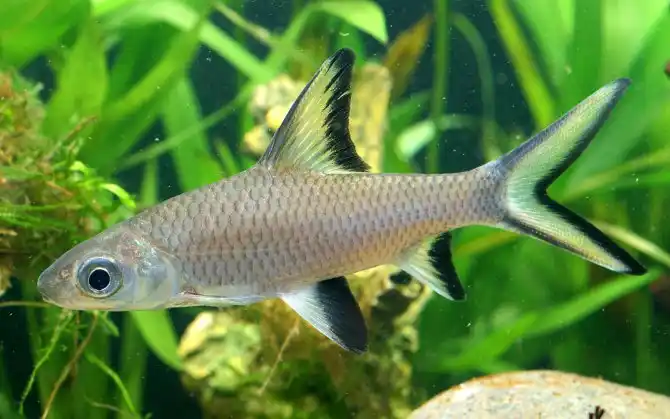
New fishkeepers are inevitably drawn to freshwater sharks. Jeremy Gay looks at what's regularly available and advises on which are suitable for home aquaria.
Freshwater "sharks" are popular tropical fish stocked the length and breadth of the country. They are in no way related to true sharks. Instead, they just bear a resemblance to them with those similar elongate bodies and quite rigid angular fins. However, new tank owners love them and as a result they often end up in community aquariums.
With the exception of two catfish, the sharks all belong to the group Cypriniformes and family Cyprinidae. This group includes common freshwater fish like barbs, rasboras, loaches and even goldfish.
Roughly speaking, there are two main types of freshwater shark: territorial bottom dwelling and midwater shoaling. Knowing which one you have or intend to have is important, as mistakes will mean fights. Check out their characteristics below…

Territorial sharks
These include the most well-known red-tailed black shark, the rainbow or ruby shark, the black shark from Asia. Plus, the less commonly seen African sharks like the harlequin.
These sharks graze in the wild and must protect a patch of river so that algae can grow for them to eat. Hence their reputation for being aggressive fish. If similar fish come along, their food source may be in danger. So, they chase away their own ilk and any other fish they perceive to be a competitive grazer.
See the potential problem here? In the aquarium our fish don’t usually want their food. However, the shark doesn’t know that. In their desperate desire to ensure they have a patch of the aquarium just for themselves, they will constantly chase their tank mates.
The other fish cannot avoid the shark's territory, further frustrating the shark and causing particularly aggressive behaviour. This is not fault of the shark or unwitting trespasser. They just aren't good community fish.
However, we can help by not stocking sharks in tanks that are too small. We’re talking 120cm (48") fish tanks minimum for red-tailed black and ruby sharks.
We should also avoid stocking them alongside other grazers, or other similarly patterned or shaped species.
Popular territorial sharks and their requirements:

Name: Red-tailed black shark
Scientific name: Epalzeorhynchos bicolor.
Origin: Thailand, although they are Critically Endangered in the wild.
Size: 15cm (6").
Tank size: 120cm (48") minimum (keep singularly).
Water parameters: Temperature 24-28°C (75-82°F), pH 6-8.
Notes: A truly stunning fish with jet back body and crimson tail fin. Mature sharks may also develop a white tip to the dorsal and a green metallic sheen. Albino forms of these sharks are also available.
Price: £4 upwards, depending on size.
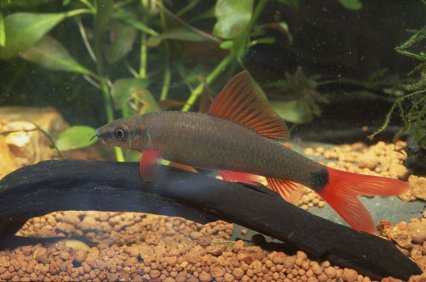
Name: Ruby shark, rainbow shark
Scientific name: Epalzeorhynchos frenatum
Origin: Thailand
Size: 15cm (6")
Tank size: 120cm (48") minimum for one
Water parameters: Temperature 24-27°C (75-81°F), pH 6-8
Notes: Ruby sharks are almost as popular as RTBS and look similar. The difference is all the fins being red and the body grey rather than black. They get more intense colours as they mature and under ideal conditions.
Price: £4 upwards, depending on size.

Name: Black shark
Scientific name: Labeo chrysophekadion
Origin: Thailand
Size: Up to 90cm (35") and 7kg (15lb) in weight.
Tank size: At least 360cm (12').
Water parameters: Temperature 24-27°C (75-81°F), pH 6.5-7.5.
Notes: This species grows deceptively massive, though, despite this, they are regularly on sale as juveniles. Incredibly territorial, these fish have the size to match.
Price: £10, upwards

Name: Harlequin shark
Scientific name: Labeo cyclorhynchus
Origin: Democratic Republic of the Congo (DRC) and Gabon, Africa.
Size: 15cm (6")
Tank size: 120cm (48") minimum.
Water parameters: Temperature 22-27°C (72-81°F), pH 6-7.5.
Notes: Harlequin sharks look more Garra-like than the Asian sharks and have interesting markings. Imported via specialist wholesalers, they represent something different for the oddball or West African biotope tank. Like the Asian fish, they become more territorial and less tolerant of each other as they grow.
Price: Around £25.
Shoaling sharks
The most popular representative of this group by far is the silver shark, also known as the bala shark. Such shoaling species need five or more shoal mates, with open water for exercise and no aggressive tank mates. Keeping them with the territorial sharks is often an ill-fated combination.
The silver shark exceeds 30cm (12"), so will need an aquarium of 180cm (71"). Multiply this by five other 30cm (12") tank mates and you have a housing problem…
Unlike the bullish, territorial sharks, the shoaling species are right at the other end of the scale of aggression. They are far more shy and skittish. A sudden fright and these will dart across the tank with a flick of the tail, careering into the glass and risking injury. They are also prone to jumping out of open-topped tanks.
With the size and bulk of the silver shark comes the odd accident too. When they reach 15cm (6") plus they may predate on smaller fish.
The Apollo shark is even more likely to eat other species of fish, so only keep them with fish larger than 8cm (3").
Popular shoaling sharks include:

Name: Silver shark
Scientific name: Balantiocheilos melanopterus
Origin: Malaysia, Sumatra and Borneo.
Size: 35cm (14")
Tank size: 180cm (72") minimum.
Water parameters: Temperature 22-28°C (72-82°F), pH 6-8.
Notes: A popular fish, but rarely sold for suitably large tanks. They look great in a group in a furnished tank, without aggressive tank mates. Fish in good condition develop more intense coloration in the fins. Females are larger and deeper bodied.
Price: From £5 for young specimens.

Name: Apollo shark
Scientific name: Luciosoma spilopleura
Origin: Borneo
Size: 25cm (10")
Tank size: 180cm (72")
Water parameters: Temperature 24-28°C (75-82°F), pH 6-7.5.
Notes: This is a fast, streamlined surface swimmer from clear forest streams and rivers. A beautiful fish, it needs a long tank with water flow to exercise properly and no aggressive tank mates. Make sure the tank has a tight lid to prevent jumping.
Price: Around £15, depending on size.

Name: Rosyline shark, Red line torpedo barb or Denison's barb.
Scientific name: Dawkinsia denisonii
Origin: India
Size: 15cm (6")
Tank size: 120cm (48" minimum)
Water parameters: Temperature 15-25°C (59-77°F), pH 6.5-7.5.
Notes: Not even a freshwater shark, this fish is a barb proper. However, they are occasionally for sale under the name 'rosyline shark'. Needs well oxygenated, well filtered water and the company of its own kind. Hugely popular, but deserving of space and experienced owners.
Price: £7.50 upwards, depending on size.

Name: Cigar shark (photo above by Heiko Bleher)
Scientific name: Leptobarbus rubripinna
Origin: Thailand, Laos, Cambodia and Vietnam.
Size: Grows to 1m (39"), though usually around 60cm (24”) in captivity.
Tank size: 360cm (12') minimum, although probably not suitable for any home aquarium.
Water parameters: Temperature 23-26°C (73-79°F), pH 6-8.
Notes: These fish grow far too large for aquaria, though, sadly, are still available. Adults are hard to rehome and are a problem for public aquaria. Avoid.
Price: £7.50 upwards
Shark catfish
The shark catfish perhaps looks most like the true marine sharks and backs it up with silver coloration. Large, and ranging from pretty unsuitable to ludicrously unsuitable, shark catfish are popular with unwitting, unaware or uncaring fishkeepers.
This fish does go out to sea, being a brackish and estuary roamer. Replicate this by keeping them in brackish conditions. The main problem, however, is that these cats reach over 30cm (12") in length. Even an 245cm (8') aquarium wouldn’t cut it long term for a group.
The iridescent shark is also a huge problem. Because of its vague shark shape it’s a popular aquarium fish. It tops 90cm (35") in the wild.
This is a huge, active fish with migratory instincts, predatory tendencies and needs the company of conspecifics. So, if you don’t own a converted swimming pool, forget owning a shark catfish. Even juveniles aren't suitable aquarium residents, as they frequently crash into the glass.
Pangasianodon represent one of the biggest problems in tropical fishkeeping. They don't belong in the aquarium hobby.

Name: Shark catfish
Scientific name: Ariopsis seemanni
Origin: Northern South America
Size: 35cm (14")
Tank size: 240cm (96") minimum.
Water parameters: Temperature 22-26°C (72-79°F), pH 7.5-8.5.
Notes: This needs a brackish biotope tank, company of its own kind and lots of room. You are best to avoid purchasing this species.
Price: £7.50 upwards

Name: Iridescent shark
Scientific name: Pangasianodon hypophthalmus
Origin: Mekong river, South-East Asia
Size: 130cm (52")
Tank size: Unsuitable for home aquaria
Water parameters: Temperature 22-26°C (72-79°F), pH 6.5-7.5.
Notes: If there was ever a case of a fish being unsuitable for aquaria this is it. Pelagic, migratory, these fish need miles of water. See my introduction for more details. Avoid — and spread the word!
Price: £5 upwards

Can I breed freshwater sharks?
Breeding any fish in captivity is technically possible. Although, to date, no one breeds any freshwater sharks naturally in captivity. Instead, commercial farms breed these sharks using hormones.
What stops them breeding in captivity? The fact that the species hate each other is a significant factor. You would need a huge area for males and females to carve out territory and tolerate each other.
Maturity of fish may also be a factor, as there aren’t many mature adults in aquaria.
It may also be that our tanks just don't have the right environmental triggers. We’re pretty sure that someone has bred these fish somewhere, but it was probably by accident.
Want more freshwater shark advice?
Sign up to our FREE newsletter for further advice, useful tips, competitions and latest news straight to your inbox! Sign up here